Tag: PEO

Recruitment Agencies in China: How Companies Find the Right Talent Faster

Recruitment Agencies in China: How Companies Find the Right Talent Faster

1. Introduction

Finding the right person for the right role is one of the most consequential decisions a company makes, and one of the most time-consuming. The average time-to-hire for a mid-level professional role exceeds six weeks. In competitive talent markets like China, where demand for skilled professionals outpaces supply in many sectors, that timeline can stretch significantly longer.

Recruitment agencies exist to solve this problem. By leveraging specialized talent networks, industry expertise, and dedicated search capacity, they compress the time between identifying a need and making a hire, while improving the quality of candidates who reach the interview stage. In this guide, VVR International explains how recruitment agencies work, what they cost, the different types available, and how to choose the right partner for hiring in China and across ASEAN. We also address where recruitment agencies fit alongside other hiring solutions, like in-house HR and Employer of Record (EOR) services.

2. What Is a Recruitment Agency?

A recruitment agency is a company that connects employers with qualified candidates, managing the sourcing, screening, and shortlisting process on the employer’s behalf. The agency’s role is to deliver a curated shortlist of candidates who meet the client’s requirements, saving internal teams from the time-intensive work of sourcing and initial screening.

It is worth distinguishing between two common terms that are sometimes used interchangeably:

  • Recruitment agency (employer-facing): Hired by companies to find candidates. The employer pays the fee. The agency’s client is the hiring company.
  • Job agency or job placement company (candidate-facing): Works directly with job seekers to help them find positions. Sometimes called “companies that find jobs for you.” In practice, many agencies operate on both sides of the market, but the fee structure and primary accountability differ.

For B2B hiring purposes, where companies are looking to build teams in new markets, the relevant model is the employer – facing recruitment agency. To sum up, a recruitment agency helps companies find, screen, and shortlist qualified candidates faster. For businesses hiring in China, the right agency can improve candidate quality, reduce time-to-hire, and strengthen market access.

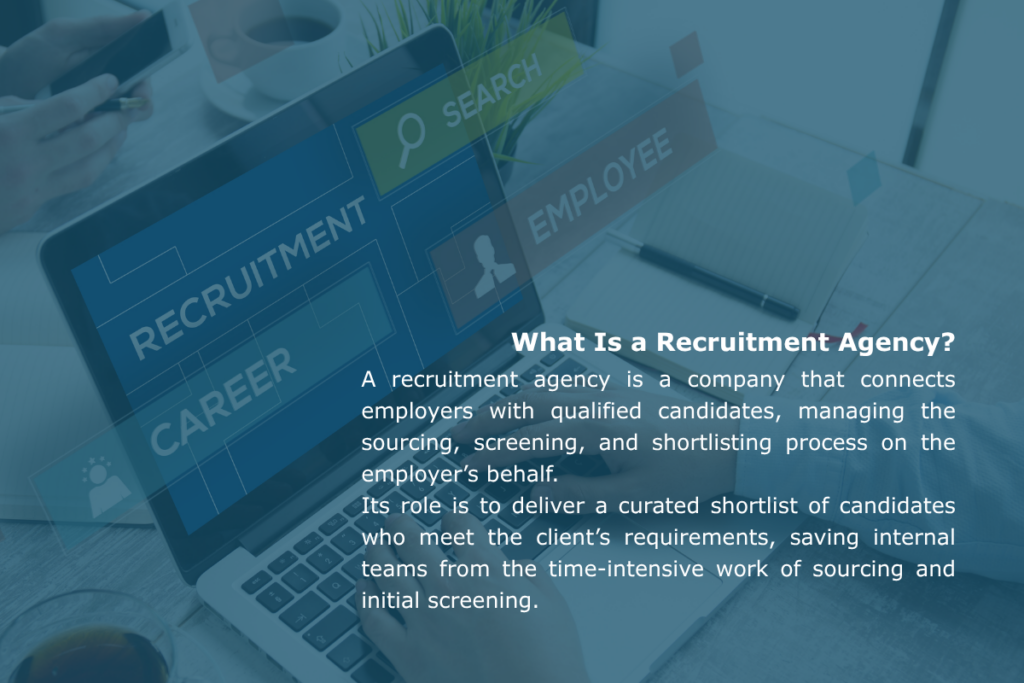
Laptop screen with recruitment search interface explaining what a recruitment agency is and how it helps employers hire qualified candidates.

A recruitment agency helps employers source, screen, and shortlist qualified candidates faster and more efficiently.

3. Types of Recruitment Agencies

Not all recruitment agencies operate in the same way. The right model depends on the seniority of the role, the urgency of the hire, and the market where you need talent. In practice, the terms recruitment agency and staffing agency are often used interchangeably, but their service models can differ depending on the role type and contract structure.

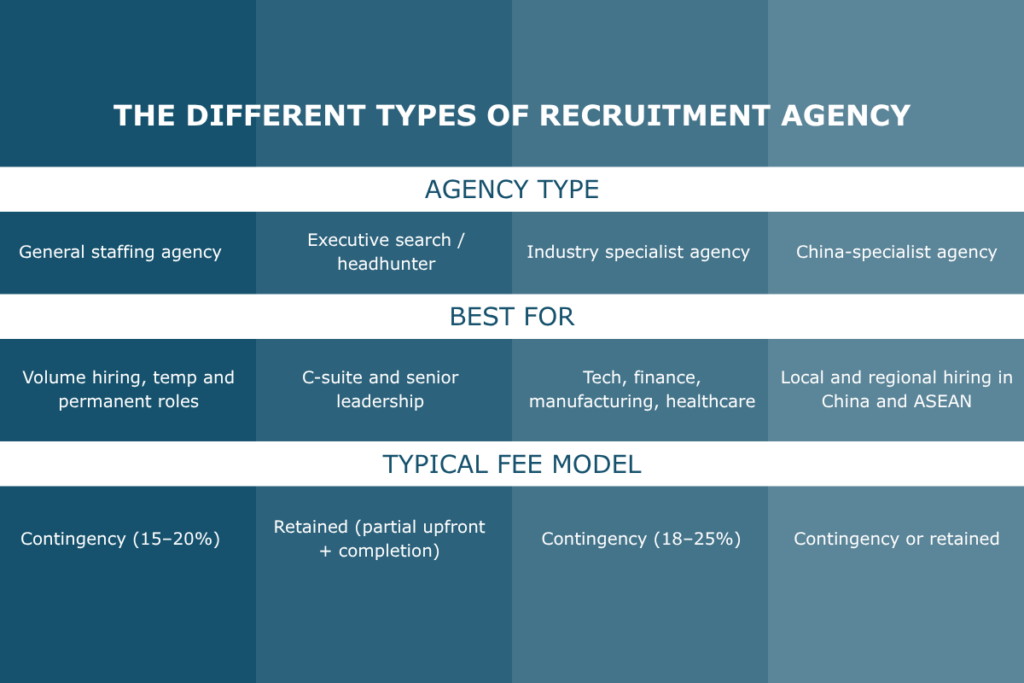
Agency Type Best For Typical Fee Model
General staffing agency Volume hiring, temp, and permanent roles Contingency (15–20%)
Executive search/headhunter C-suite and senior leadership Retained (partial upfront + completion)
Industry specialist agency Tech, finance, manufacturing, healthcare Contingency (18–25%)
China-specialist agency Local and regional hiring in China and ASEAN Contingency or retained


General staffing agencies

General staffing agencies handle a broad range of roles across multiple industries. They typically maintain large candidate databases and excel at volume hiring for permanent, contract, or temporary positions. For companies with straightforward hiring needs, administrative, operational, or entry-level professional roles, a general staffing agency offers fast turnaround at competitive fees. In China, many established general staffing agencies can support hiring across multiple cities, which is valuable for companies building distributed teams.

Executive search firms (headhunters)

By contrast, executive search firms—commonly called headhunters—specialize in senior and C-suite roles. They conduct proactive, confidential searches targeting passive candidates who are not actively job-seeking. The retained model means the client pays a portion of the fee upfront, regardless of outcome, which reflects the time-intensive nature of senior search. For leadership hiring in China, where the talent pool for bilingual, internationally experienced executives is limited, headhunters with established local networks deliver significantly higher-quality shortlists than generalist approaches.

Industry-specialist agencies

Industry-specialist agencies focus on specific verticals: technology, finance, life sciences, manufacturing, or logistics. Their value lies in pre-existing candidate relationships within a specific field, a deeper understanding of role requirements, and the ability to evaluate technical qualifications that generalists may lack. For companies hiring in sectors like semiconductor manufacturing, fintech, or pharmaceutical R&D—all significant in China—a specialist agency consistently outperforms generalists on candidate quality and speed.

China-specialist recruitment agencies

China presents unique recruitment challenges: a vast talent market with significant regional variation, language and cultural nuances that affect candidate assessment, and a competitive landscape where strong candidates receive multiple offers simultaneously. Agencies that operate specifically in China and ASEAN bring local market intelligence, Mandarin-language assessment capability, and relationships with passive candidates that international generalist agencies cannot replicate. For companies entering China for the first time, a China-specialist agency significantly reduces the risk of a bad hire, particularly for roles where cultural fit and local market knowledge are critical.

Comparison chart of recruitment agency types including general staffing agency, executive search firm, industry specialist agency, and China-specialist agency.

Different recruitment agency models serve different hiring needs, from volume staffing to executive search and China-focused recruitment.

4. How Do Recruitment Agencies Work?

Before engaging an agency, companies should understand how the recruitment process works in practice and where an agency adds the most value.

The standard recruitment process

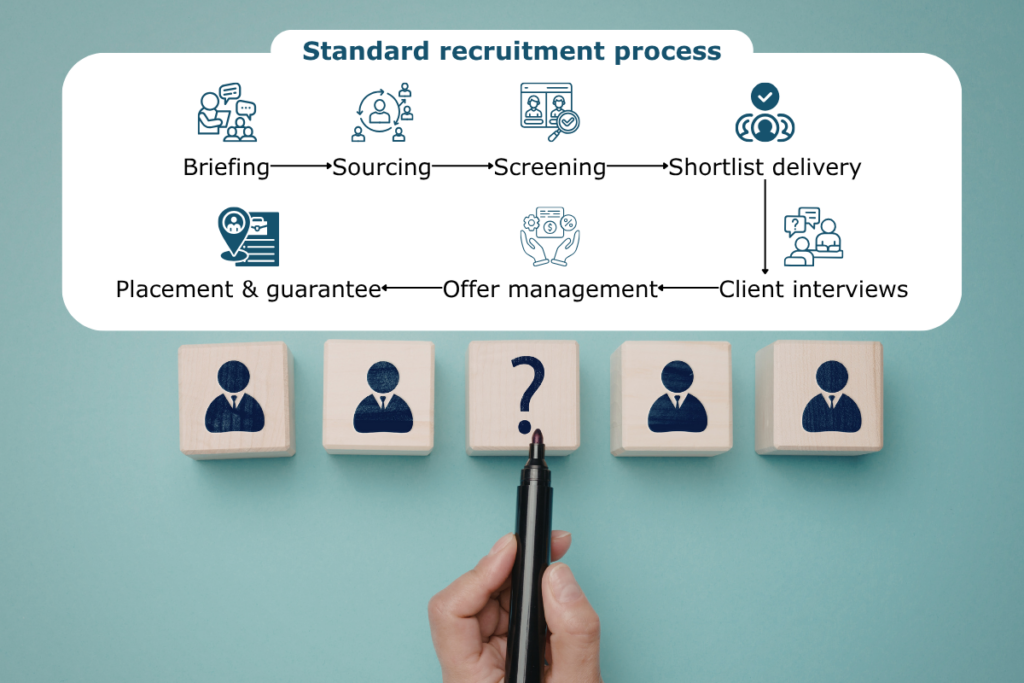
Although each firm has its own methodology, most recruitment agencies follow a similar process from briefing to placement.

  • Briefing: The agency meets with the hiring manager to understand the role, team context, required qualifications, and culture fit criteria. The quality of this briefing directly determines the quality of candidates delivered.
  • Sourcing: The agency searches its database, professional networks (local platforms like Liepin and Boss Zhipin in China), and passive candidate relationships to build a longlist.
  • Screening: Candidates are interviewed by the agency to assess qualifications, communication skills, salary expectations, and availability. Only candidates who meet the brief proceed.
  • Shortlist delivery: Typically, 3 to 6 qualified candidates are presented to the client with profiles and the agency’s assessment notes.
  • Client interviews: The hiring company conducts interviews and selects the preferred candidate.
  • Offer management: Experienced agencies play an active role in offer negotiation, managing candidate expectations on salary and notice periods to minimize drop-out risk.
  • Placement and guarantee: Once placed, most agencies offer a replacement guarantee period (typically 3 months) if the hire does not work out.
Standard recruitment process showing briefing, sourcing, screening, shortlist delivery, client interviews, offer management, and placement guarantee.

A structured recruitment process helps companies move faster from hiring need to successful placement while improving candidate quality.

Contingency vs. retained search

The two dominant fee models reflect very different levels of commitment and search approach:

  • Contingency search: The agency is only paid if a candidate they present is successfully hired. Multiple agencies may work the same role simultaneously. This model works well for roles with reasonable candidate availability.
  • Retained search: The client pays a portion of the fee upfront (typically one-third), a second installment at shortlist delivery, and the remainder on placement. The agency commits exclusively to the search. Used for senior roles, confidential searches, or markets where sourcing requires significant time investment—like executive hiring in China.

5. How Much Do Recruitment Agencies Charge?

Recruitment agency fees are typically calculated as a percentage of the placed candidate’s first-year salary. This is the most important number for companies to understand when budgeting for external hiring.

  • General staffing agencies: 15 to 20 percent of first-year salary for permanent placement
  • Industry-specialist agencies: 18 to 25 percent, reflecting the higher effort involved in sourcing qualified candidates in competitive fields
  • Executive search firms: 25 to 35 percent, often on a retained basis with partial upfront payment
  • China-specialist agencies: Variable, depending on role level, market conditions, and the required level of candidate access. In China, access to qualified candidates is highly relationship-driven, especially for specialized, senior, or industry-specific roles.

To put this in perspective: for a China-based senior manager earning RMB 600,000 per year (approximately $84,000), a 20 percent contingency fee amounts to approximately $16,800. For a C-suite hire, the fee can exceed $50,000. When evaluating agency fees, companies should compare them against the fully loaded cost of in-house recruitment: job board advertising, HR team time, interview time from senior leaders, and the cost of a vacancy remaining open for additional weeks. In most cases, a well-performing agency delivers a positive return.

6. Recruitment Agencies vs. In-House Hiring vs. EOR

In practice, these are not competing alternatives—they serve different functions in the talent acquisition and employment lifecycle. Understanding how they complement each other helps companies build more effective hiring strategies.

Factor Recruitment Agency In-House HR EOR
Primary function Find and deliver candidates Full HR lifecycle Legal employment & compliance
Speed to shortlist 2–4 weeks 4–8 weeks N/A (not a sourcing function)
Cost model 15–25% of first-year salary Fixed HR overhead $400–$800/month per employee
Handles compliance No Partial (entity required) Yes — fully
China market expertise Depends on agency specialization Only if team has local knowledge Yes (with local EOR)
Best for Sourcing hard-to-find talent Large HR teams, mature markets Compliant employment without an entity


The practical implication for companies expanding into China: a recruitment agency finds the right candidate; an EOR employs them compliantly. These two services are natural partners. Many companies entering China need both candidate sourcing and compliant employment support. VVR International provides both services in-house, combining recruitment expertise with direct EOR solutions to help clients identify, screen, hire, and employ candidates compliantly, especially when they do not yet have a local entity.


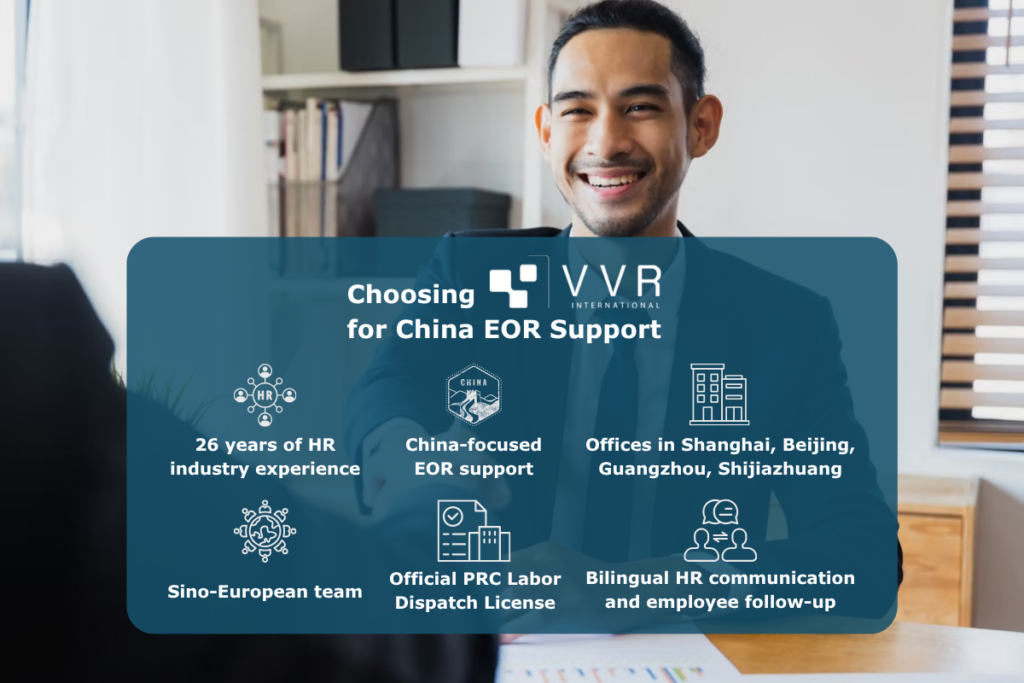
Why Companies Should Choose VVR International

  • 26 years of HR experience
  • Strong Sino-European team
  • Official PRC Labor Dispatch License
  • 5-star client service
  • Offices in Shanghai, Beijing, Guangzhou, and Shijiazhuang


7. How to Choose the Right Recruitment Agency

Not all recruitment agencies deliver equal results, and the stakes are high – a bad hire in China can take significant time and cost to resolve, particularly when termination procedures and severance obligations are involved. The following criteria separate high-performing agency partners from the rest.

  • Market and industry specialization

An agency that specializes in your industry and your target market will consistently outperform a generalist on candidate quality and speed. For China hiring, prioritize agencies with in-country teams, Mandarin-language assessment capability, and documented experience placing candidates in your sector. Ask specifically: how many placements have you made in this role type, in this city, in the past 12 months?

  • Candidate database and network quality

The best recruitment agencies do not simply post job listings and wait—they proactively source passive candidates through established professional relationships. Ask about the agency’s methodology for finding candidates who are not actively job-seeking. In China’s competitive talent market, the most qualified candidates are rarely the ones submitting applications.

  • Track record and client references

Request client references from companies with similar hiring needs: same industry, comparable role levels, same target cities in China. Ask reference clients specifically about the quality of the shortlist, the agency’s responsiveness when challenges arose, and whether the candidates placed are still in role.

  • Fee structure and replacement guarantee

Understand exactly what is included in the fee and what the replacement guarantee covers. A 3-month replacement guarantee is standard; some agencies offer longer periods for senior roles. Clarify whether the guarantee is a refund or a free replacement search—and under what circumstances it applies.

  • Cultural and communication fit

Working with a recruitment agency is an ongoing relationship, not a one-time transaction. The agency needs to understand your company culture deeply enough to assess cultural fit on your behalf. If the agency’s communication style, responsiveness, and cultural fluency do not align with your standards during the briefing process, that misalignment will be amplified when they are representing your brand to candidates.

8. Conclusion

Recruitment agencies compress the time and effort required to find qualified talent—and in complex markets like China, where language barriers, talent competition, and regional market knowledge create genuine sourcing challenges, the right agency partner delivers measurable competitive advantage.

The most effective international hiring strategies combine specialist sourcing with compliant employment infrastructure: a recruitment agency to identify and deliver the right candidates, and an EOR to handle the legal and compliance dimensions of employment. Together, they allow companies to move quickly and compliantly, without the overhead of building full in-house capability from day one.

With 26 years of project management experience in China, VVR International has developed a strong cross-industry talent network across sectors such as distribution, pharmaceuticals, railway, chemicals, food and beverage, and cosmetics. This allows our team to access a broad pool of qualified candidates, while our in-house experts conduct deep interviews to assess technical fit, market experience, and cultural alignment.

VVR International combines recruitment expertise with direct EOR services across China. Whether you need help finding the right candidate, employing them compliantly, or both, fill in the contact form, and our team will outline the right approach for your hiring goals.

Share your project with us via contact@vvrinternational.com.

CONTACT US

FAQs

  • How do I find a recruitment agency for hiring in China?

Look for agencies with in-country teams in China, Mandarin-language assessment capability, and documented experience in your specific industry. Generic international staffing agencies rarely deliver the same results as specialists with established local networks in Chinese talent markets.

  • Do recruitment agencies charge job seekers?

Reputable employer-facing recruitment agencies do not charge candidates. Their fee is paid by the hiring company. Be cautious of any agency that requests payment from job seekers—this is not standard practice in professional recruitment.

  • What is the difference between a recruitment agency and a staffing agency?

The terms are often used interchangeably, but there is a distinction: staffing agencies typically focus on temporary and contract placements, often for operational or administrative roles. Recruitment agencies more commonly handle permanent professional placements. Many firms offer both services.

  • Are recruitment agencies worth it for hiring in China?

Yes, particularly for professional and senior roles. The Chinese talent market is highly competitive, and strong candidates receive multiple offers. Agencies with established local networks can access passive candidates and move faster than in-house teams. In many cases, the fee can be justified quickly through reduced vacancy time and stronger hire quality, especially for hard-to-fill roles.

  • Can I use a recruitment agency and an EOR together?

Yes, and this is the most effective model for companies entering China without a local entity. The recruitment agency sources and shortlists candidates; the EOR employs them compliantly. This combination gives you specialist sourcing plus full legal employment coverage, without requiring a registered WFOE.

Related Posts

Read More
Can You Hire Employees Without Local Entity? A Complete Guide for Global Hiring

Can You Hire Employees Without a Local Entity? Global Hiring Guide (2026)

Can i hire employees without a local entity, global hiring guide in 2026

1. Introduction

You have named the right market and found the right candidate. Now comes the question that stops many global expansion plans in their tracks: “Do you need to set up a legal entity before you can hire employees in China?” A short answer is no. You can hire employees without setting up a local entity, and for most companies, testing a new market or building a lean international team, it is also the smarter path.

Solutions like Employer of Record (EOR), Professional Employer Organizations (PEO), and carefully structured contractor arrangements allow companies to hire compliantly in markets like China without the time and capital burden of entity incorporation. In this guide, we at VVR International break down every legal option available. Then it compares the true costs and explains what companies need to know specifically when hiring in China.

2. Key Takeaways

  • Companies can legally hire employees in China without establishing a local entity by using an EOR/PEO structure, which significantly reduces setup time, cost, and operational complexity.
  • In China, EOR/PEO is generally the safest and most compliant hiring model for foreign companies because Chinese labor law imposes strict obligations around contracts, social insurance, payroll, and employee protections.
  • Many international companies now use a phased market-entry approach: they first validate the market through EOR/PEO, then establish a local entity only after commercial traction and operational scale are proven.

3. Do You Need a Local Entity to Hire Globally?

Before choosing a hiring structure, it is important to understand what a local entity enables and when it is truly necessary. A local entity is a legally registered business structure in a foreign country, such as a Wholly Foreign-Owned Enterprise (WFOE) or Joint Venture (JV) in China. It gives a company the legal standing to sign contracts, issue invoices, and directly employ staff under local law. 

Setting up a local entity in China typically takes 6 to 12 months and costs between $15,000 and $50,000 in legal, accounting, and registration fees, before you have hired a single person. Ongoing compliance adds further operational overhead: annual audits, tax filings, registered capital requirements, and dedicated local management. So, do you need one? The answer is not necessarily. Here are the determining factors that you need to know: 

  • Headcount and timeline: Hiring 1–5 people quickly? An entity is overkill. Planning for 20+ over 3 years? An entity may eventually make sense. 
  • Revenue generation: If your China operation will sign contracts and generate local revenue, a WFOE is typically required. 
  • IP and control sensitivity: Companies with highly proprietary products may prefer the direct control that an entity provides. 
  • Market commitment: Testing a new market before committing? Starting without an entity reduces your exit cost significantly. 

For most companies in the early-to-mid stages of international expansion, our answer is to start without an entity and build the infrastructure once the market justifies it. 

4. Two Legal Ways to Hire Employees Without a Local Entity in China

Companies that want to hire quickly without incorporation usually rely on two practical legal routes. Each comes with different levels of control, cost, and compliance risk.

4.1. Employer of Record (EOR) /Professional Employer Organization (PEO)

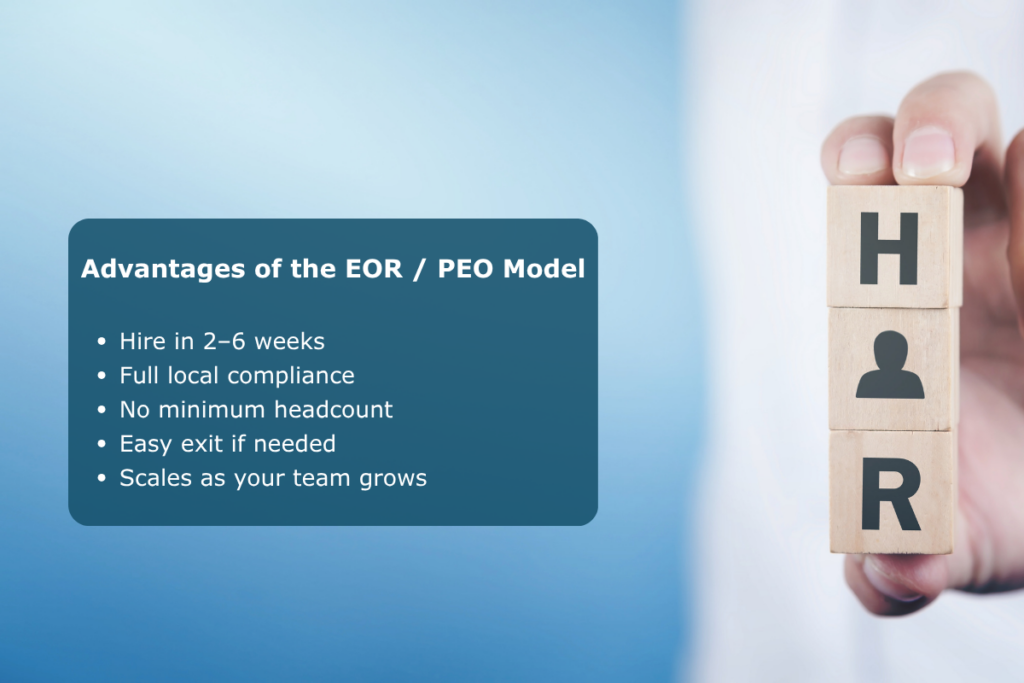
For most international hiring plans, this is the safest and fastest solution. An EOR or PEO is a third-party company that becomes the legal employer of your staff on paper. It handles payroll, tax withholding, social insurance contributions, and labor contract compliance while you retain operational control over day-to-day work.

This is the most widely used and legally robust solution for hiring without a local entity. In China specifically, where labor law is stringent and non-compliance carries significant penalties, an EOR/PEO drops the risk of misclassification or administrative violations. The EOR/PEO model brings some advantages: 

  • Hire in 2 to 6 weeks instead of waiting months for entity approval;
  • Full compliance with local labor law, social insurance, and tax obligations;
  • No minimum headcount – suitable for hiring even a single employee;
  • Straightforward offboarding if the market does not perform as expected;
  • Scales seamlessly as your team grows.

VVR International provides direct EOR/PEO services across China, acting as the legal employer while your team works under your direction. In case you already have a registered entity in China but want to outsource the operational burden of employment administration, an EOR/PEO is still a strong choice.

EOR and PEO solutions help companies hire internationally faster, stay compliant, and scale teams without setting up a local entity.

Both EOR and PEO solutions help companies hire internationally faster, stay compliant, and scale teams without setting up a local entity.

4.2. Independent Contractors

Engaging independent contractors is the fastest and lowest-cost way to access talent abroad, but it carries significant legal risk, particularly in China. Chinese labor law distinguishes sharply between employees and contractors. If a contractor works exclusively for your company, follows your schedule, and uses your equipment. In that case, Chinese authorities may reclassify them as full-time employees. The consequences include back payment of social insurance contributions, tax penalties, and potential fines. 

However, contractors are appropriate for genuinely project-based, time-limited engagements with professionals who serve multiple clients. They are not a compliant substitute for full-time employment in China.

5. How Much Does It Cost to Hire an Employee Without a Local Entity in China?

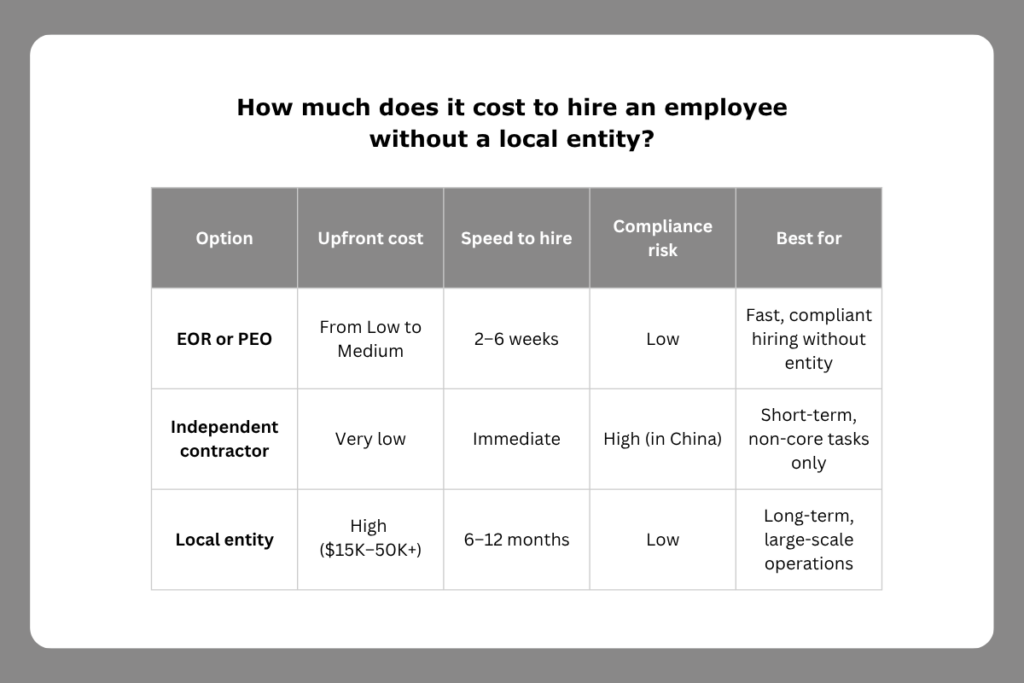
Cost is often the deciding factor. However, the cheapest option on paper is not always the lowest risk option in practice. Below is a practical breakdown to answer the question “How much does it cost to hire an employee without a local entity?”: 

Option 

Upfront Cost  Speed to Hire  Compliance Risk 

Best For 

EOR/PEO 

From Low to Medium 

2–6 weeks  Low  Fast, compliant hiring without an entity 

Contractor 

Very low 

Immediate 

High (in China) 

Short-term, non-core tasks only 

Local entity  High ($15K–50K+)  6–12 months  Low 

Long-term, large-scale operations 

Beyond the table, consider the hidden costs of entity setup: registered capital requirements (often RMB 100,000–500,000 in China), ongoing annual audit fees, dedicated local accounting and legal retainers, and the management time diverted to compliance rather than growth. In practice, for most companies with fewer than 15 employees in a new market, EOR fees are substantially cheaper than maintaining a local entity.

Comparing EOR, contractor, and local entity models helps companies choose the most cost-effective path for international hiring.

Comparing EOR, contractor, and local entity models helps companies choose the most cost-effective path for international hiring.

6. Hiring Employees in China Without a Local Entity: What You Need to Know

While China offers a major commercial opportunity, it also has one of the most structured labor compliance systems in Asia. Indeed, China presents a unique combination of opportunity and regulatory complexity. It is the world’s largest manufacturing base, a growing consumer market, and an increasingly important source of technical talent, but its labor law framework leaves little room for shortcuts. 

Several features of Chinese employment law are especially important for foreign companies hiring without an entity: 

  • Mandatory written labor contracts: Required within one month of employment commencement. Failure to provide a written contract within that window triggers automatic double-salary liability. 
  • Social insurance and housing fund: Employers must contribute to five mandatory social insurance streams (pension, medical, unemployment, work injury, maternity) plus a housing provident fund. Rates vary by city but typically add 30–40% to base salary costs. 
  • Probation period limits: Capped by law based on contract duration—maximum 6 months for contracts of 3 years or more. 
  • Termination protections: Chinese labor law provides strong employee protections. Termination without cause requires severance based on years of service. Unlawful termination can trigger double severance of liability. 
  • Stricter contractor environment: Unlike some markets, China does not have a well-established compliant contractor framework for core employment roles. Thus, the EOR is the appropriate structure. 

For foreign nationals being hired into China roles, additional work permit requirements apply, including the tiered work permit system (Categories A, B, and C) introduced in 2017. Additionally, processing typically takes 4 to 8 weeks and requires documentation, including degree certificates, work history, and background checks. 

7. When Should You Set Up a Local Entity Instead?

For a long-term plan, EOR/PEO is not the right answer forever. As your China operations mature, the calculus shifts. You need to consider moving to a local entity when: 

  • Headcount reaches 10–15 employees, depending on salary levels and market: At this scale, entity costs often become competitive with monthly EOR fees. 
  • Revenue generation is the goal: If your team signs contracts, issues invoices, or collects payments locally, a WFOE or equivalent structure is typically required. 
  • IP protection is a priority: Holding patents, trademarks, or proprietary technology through a local entity provides stronger legal protection. 
  • Long-term strategic commitment: If China is central to your 5-year plan, the investment in a proper legal structure pays off over time. 

As a result, many companies use EOR/PEO as a bridge. They enter the market quickly through EOR/PEO, validate the business case, and establish a local entity once operations reach the scale that justifies it. Consequently, this sequenced approach reduces risk and preserves capital during the critical early phase. 

8. Conclusion

To sum up, you do not need a local entity to hire compliantly in China. An EOR/PEO gives you speed, compliance, and flexibility to build international teams without the capital commitment and operational complexity of entity incorporation, and without putting your company at legal risk.

Therefore, for founders and HR leaders navigating global expansion, the question is not whether EOR/PEO works. It is whether you have the right partner – one with genuine local expertise, in-country teams, and a track record of navigating complex labor environments like China. 

VVR International provides direct EOR/PEO services across China.


Why should you choose VVR International? 

With 26 years of experience in the HR industry, VVR International supports companies hiring and expanding across China through a strong Sino-European team that understands both local execution and international business standards. 

We are proudly one of the very few non-Chinese firms holding an official Labor Dispatch License issued by the PRC government. This license authorizes us to act as the legal employer for dispatched staff across China, providing a compliant and secure route for hiring local or expatriate employees. Clients also benefit from our 5-star customer service and on-the-ground support through offices in Shanghai, Beijing, Guangzhou, and Shijiazhuang. 


If you are ready to hire internationally without setting up a local entity, fill in the contact form below. Then, our team will outline the fastest, most compliant path forward for your specific market and role. 

Share your project with us via contact@vvrinternational.com.

CONTACT US

FAQ

  • Can I hire a full-time employee in China without registering a company? 

Yes. Through an Employer of Record (EOR) like VVR International, you can hire full-time employees in China without setting up a local entity. The EOR becomes the legal employer and handles all payroll, tax, and social insurance obligations on your behalf. 

  • How long does it take to hire through an EOR/PEO in China? 

Most EOR onboarding processes in China take between 2 and 4 weeks from signed agreements to the employee’s first day. This compares 6 to 12 months for entity setup. 

  • Is it legal to use contractors in China instead of employees? 

It is legal, but high-risk for ongoing, full-time roles. Chinese authorities can reclassify contractors as employees if the working relationship resembles standard employment, triggering back-payment of social insurance and tax penalties. For core team members, EOR employment is the compliant solution. 

Related Posts

Read More
Hiring International Employees in China: How to Build Global Teams Without Borders

Hiring International Employees in China: How to Build Global Teams Without Borders

Hiring International Employees in China: How to Build Global Teams Without Borders

1. Introduction

China remains one of the most strategically important markets for companies building global teams. It is home to the world’s largest manufacturing base, a rapidly growing technology talent pool, and a consumer market that demands local presence to serve effectively. Yet for HR leaders and founders approaching China for the first time, the employment landscape can feel genuinely complex. 

Hiring international employees in China involves navigating layers of regulation that have no equivalent in Western markets: a national labor law framework that strongly favors employees, city-specific social insurance contribution rates, a tiered work permit system for foreign nationals, and strict data privacy obligations that affect how you manage employee information. 

In this guide, our VVR experts explain the legal options available, walk through the step-by-step process of hiring in China, cover work permit and visa requirements for foreign employees, and highlight the compliance considerations that catch international companies off guard. 

2. Understanding the Landscape: Two Types of International Hiring in China

When companies talk about hiring international employees in China, they are typically referring to one of two distinct situations, and the requirements for each are very different. 

  • Hiring Chinese nationals as part of an international team: A foreign company brings Chinese employees onto its global workforce, employing them locally under Chinese law. This is the most common scenario for companies expanding into China. 
  • Relocating foreign nationals to work in China: A company transfers an employee from another country, or hires a foreign candidate directly, to work on the ground in China. This triggers work permits and visa requirements. 

Both scenarios require a compliant employment structure in China. The key question is always the same: who is the legal employer? Foreign companies generally need a compliant employment structure, such as a local entity or licensed EOR arrangement, to hire staff in China. 

3. Legal Options for Hiring International Employees in China

Before making an offer, companies need to choose the right employment structure. This decision affects speed, cost, control, and long-term compliance. 

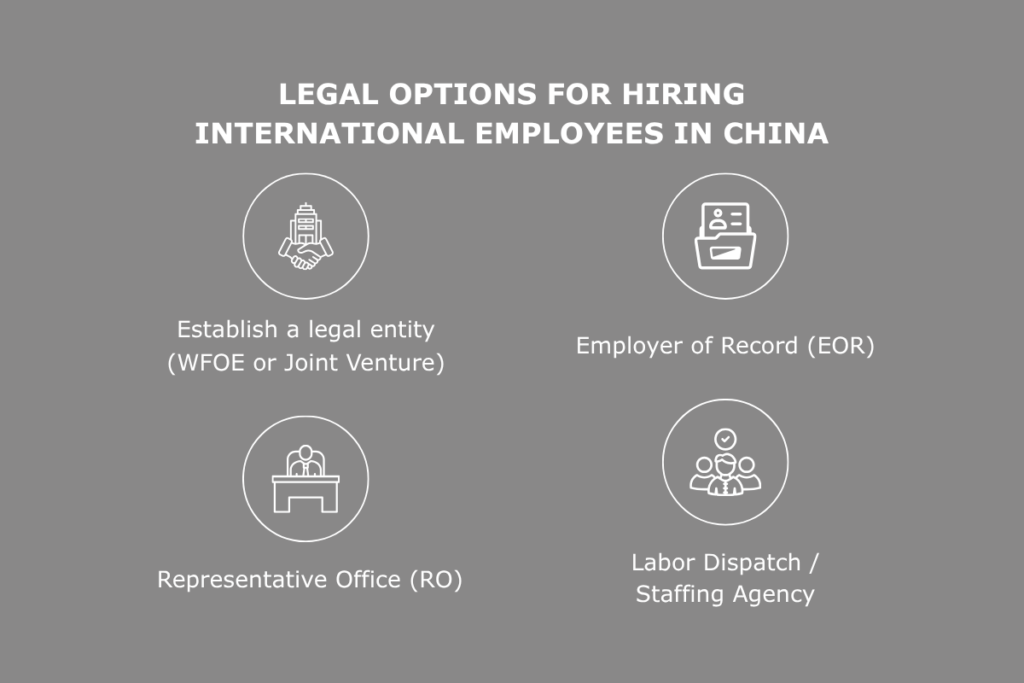
Companies can hire in China through several legal structures, including a WFOE, Employer of Record, Representative Office, or staffing agency.

Companies can hire in China through several legal structures, including a WFOE, Employer of Record, Representative Office, or staffing agency.

Option 1: Set up a legal entity (WFOE or Joint Venture) 

A Wholly Foreign-Owned Enterprise (WFOE) is the most common structure for foreign companies that want direct operational control in China. It allows the company to sign contracts, generate local revenue, and directly employ staff under Chinese labor law. 

The limitations are well-known: setup takes 6 to 12 months, costs between $15,000 and $50,000 in professional fees, and requires ongoing compliance investment in auditing, tax filing, and registered capital management. For companies at the early stages of China entry, this commitment is often premature. 

Option 2: Employer of Record (EOR) 

An Employer of Record is the fastest and most compliant route for hiring international employees in China without establishing a local entity. The EOR becomes the legal employer of record, handling payroll, social insurance contributions, labor contract execution, and tax withholding — while the client company keeps full operational direction of the employee’s work. 

For companies hiring overseas employees in China for the first time, or testing the market before committing to a WFOE, EOR is the standard professional approach. Onboarding typically takes 2 to 6 weeks. 

Learn more about how EOR simplifies recruitment in China now! 

Option 3: Representative Office (RO) 

A Representative Office allows a foreign company to prove a limited presence in China without full incorporation. However, ROs face significant restrictions: they cannot sign commercial contracts, generate revenue, or directly employ more than a small number of staff (typically managed through a licensed dispatch agency). 

ROs are proper for market research, liaison activities, and supporting a physical presence, not for building a functional operating team. 

Option 4: Labor Dispatch / Staffing Agency 

Labor dispatch is a historically common model in China where a staffing agency acts as the formal employer while the worker runs at a client company. Following 2013 labor reforms, its use has been restricted, such as: dispatched workers can only be placed in temporary, auxiliary, or substitute roles, and cannot exceed 10 percent of a company’s total workforce. 

For international companies hiring core team members, labor dispatch is restricted for core long-term workforce planning and should be assessed carefully under current regulations. Thus, the EOR still remains in the appropriate structure. 


Why Companies Choose VVR International for Hiring in China 

With 26 years of HR industry experience, VVR International helps international companies hire and scale teams in China through a strong Sino-European team that understands both local execution and international business expectations. 

We are one of the few non-Chinese firms holding an official PRC Labor Dispatch License, allowing us to legally employ local and expatriate staff across China through a secure and compliant structure. 

Clients also receive help from 5-star customer service and direct operational support through our offices in Shanghai, Beijing, Guangzhou, and Shijiazhuang. 


4. How to Hire International Employees in China: Step-by-Step 

Once the hiring model is clear, the next priority is execution. A structured onboarding process helps companies avoid delays and early compliance mistakes. 

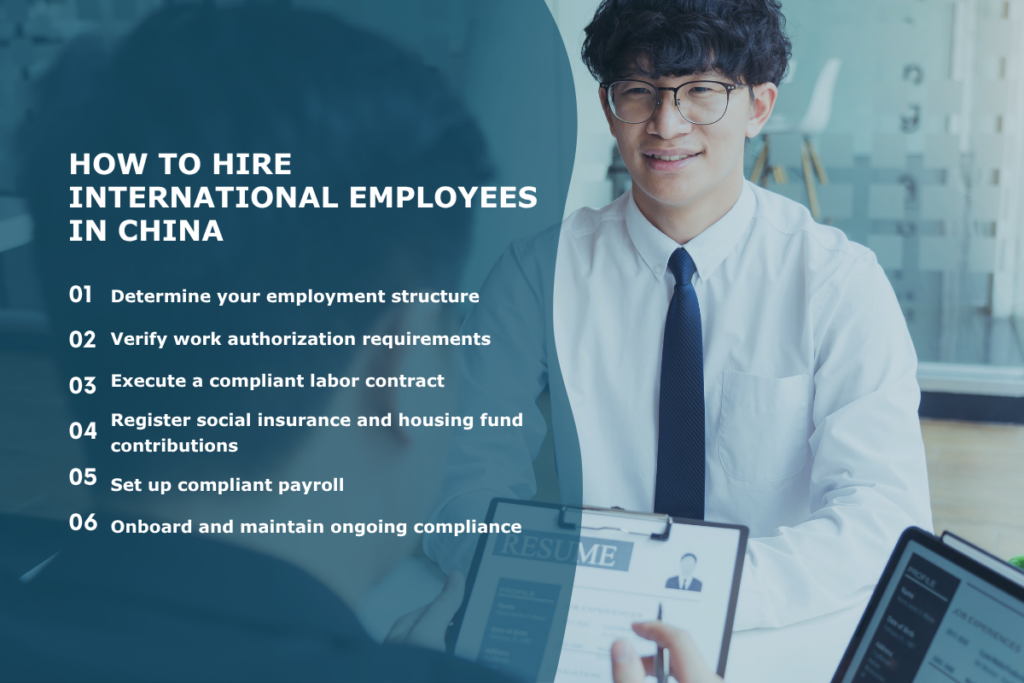
A successful hiring process in China starts with the right employment structure, legal contracts, payroll setup, and ongoing compliance management.

A successful hiring process in China starts with the right employment structure, legal contracts, payroll setup, and ongoing compliance management.

  • Step 1: Determine your employment structure 

Before anything else, decide whether you will hire through a WFOE, EOR, or another structure. For most companies in the early stages of China expansion, EOR is the fastest compliant path. If you already have a WFOE, you can employ it directly. 

  • Step 2: Verify work authorization requirements 

For Chinese nationals, no work authorization is needed. For foreign nationals, decide which work permit category applies (see the Work Permit section below) and begin documentation collection early—the process takes a minimum of 4 to 6 weeks. 

  • Step 3: Execute a compliant labor contract 

Chinese law requires a written labor contract within one month of employment commencement. The contract must follow the Labor Contract Law and should be bilingual (Chinese and English) if the employee is a foreign national. The Chinese version governs in all legal disputes. 

Key terms to specify, including job title and duties, work location, compensation, probation period (if applicable), working hours arrangement, and confidentiality obligations. 

  • Step 4: Register social insurance and housing fund contributions 

Employers must register new employees with local social insurance and housing provident fund authorities. Contributions begin from the first month of employment. Rates vary by city, see the contribution table in the Compliance section below. 

  • Step 5: Set up compliant payroll 

Salaries in China must be paid in RMB. Employers must withhold an Individual Income Tax (IIT) at the source. For foreign employees, the tax treatment depends on their residency status and any applicable double-taxation treaties between China and their home country. 

  • Step 6: Onboard and maintain ongoing compliance 

Ongoing obligations include monthly payroll and tax filings, annual IIT reconciliation, social insurance payment records, and adherence to labor law requirements around working hours, leave entitlements, and termination procedures. 

5. Work Permit and Visa Requirements for Foreign Employees in China

China introduced a points-based work permit system in 2017, replacing the earlier two-tier system with a three-category framework. Foreign nationals require a work permit to be legally employed in China. 

Category 

Profile 

Typical Process Time 

Category A  High-end talents: Nobel laureates, globally recognized experts, senior executives of MNCs  Expedited; often 15 working days 
Category B  Professionals meeting point-based criteria: education, salary threshold, age, work experience  15–20 working days 
Category C  Non-skilled or service roles; subject to quotas and stricter review  20–30 working days 


Most professional hires for international companies fall into Category B. Key requirements for Category B work permits include: 

  • Bachelor’s degree or above (Master’s or higher preferred and awarded added points) 
  • At least two years of relevant professional work experience 
  • Salary meeting or exceeding the local minimum threshold (typically set by each city) 
  • Criminal background check from home country (apostilled and translated) 
  • Medical examination certificate from a designated Chinese medical facility 
  • No criminal record in China 

Processing typically takes 15 to 20 working days once a complete documentation package is submitted. The work permit must be obtained before the employee’s work visa (Z-visa) is issued, and both must be secured before the employee begins working in China. 

6. Key Compliance Considerations When Hiring in China

China hiring compliance goes far beyond payroll. Employers need to manage tax, insurance, contracts, and employee data correctly from day one. 

Social insurance and housing fund contributions 

All employees in China, including foreign nationals in most cities, must be enrolled in the mandatory social insurance system and housing provident fund. Contribution rates vary by city and are adjusted periodically. The table below reflects approximate rates based on common major cities; always verify current local rates before budgeting. 

Insurance Type  Employer Contribution (approx.)  Employee Contribution (approx.) 
Pension  16%  8% 
Medical insurance  8–10%  2% 
Unemployment insurance  0.5–1%  0.5% 
Work injury insurance  0.2–1.9%  0% 
Maternity insurance  0.5–1%  0% 
Housing provident fund  5–12%  5–12% 


For employers budgeting labor costs in China, add approximately 35 to 45 percent on top of gross salary to account for total employer-side contributions. This varies by city and salary level. 

Individual Income Tax (IIT) 

China uses a progressive IIT system with rates from 3 to 45 percent. Employers must withhold IIT monthly and remit it to the tax authority. For foreign employees, tax residency rules figure out the scope of taxable income: employees living in China for more than 183 days in a calendar year are taxed on worldwide income. 

The country has signed double-taxation treaties with many countries. Foreign employees may be eligible for treaty benefits that reduce their China tax burden, but this requires proper documentation and filing. 

Labor contract law protections 

China’s Labor Contract Law provides strong employee protections that international companies must understand before hiring. The most important rules include the following:

  • Written contract deadline: A written contract must be in place within one month of employment. Failure triggers automatic double-salary liability. 
  • Probation period caps: For contracts of 1 to 3 years, maximum probation is 2 months. For contracts of 3+ years, maximum is 6 months. Probation cannot be extended. 
  • Termination with cause: Allowed for specific reasons defined in law (serious misconduct, inability to perform duties after training, etc.). Documentation is critical. 
  • Termination without cause: Requires 30 days’ written notice or one month’s pay in lieu. Severance is payable at one month’s salary per year of service. 
  • Unlawful termination: Triggers double severance liability. Chinese labor arbitration can be employee-protective in practice, making documentation and compliant procedures especially important. 

Personal Information Protection Law (PIPL) 

China’s PIPL, effective November 2021, regulates how companies collect, process, store, and transfer personal data – including employee data. International companies hiring in China must ensure their HR systems and data transfer practices follow PIPL, particularly if employee data is processed outside China. 

Common Mistakes When Hiring International Employees in China 

Based on common patterns across international market entries, these are the mistakes that create the most significant compliance and financial exposure: 

  • Misclassifying employees as contractors. Using contractor agreements for effectively full-time employment relationships exposes companies to backdate social insurance liability and penalties. Chinese authorities look at the substance of the working relationship, not just the contract label. 
  • Ignoring city-specific contribution rates. Social insurance and housing fund rates differ significantly between Shanghai, Beijing, Shenzhen, and other cities. Budgeting based on national averages leads to underpayment and compliance violations. 
  • Not executing bilingual labor contracts. For foreign national employees, a bilingual contract is essential. In any dispute, the Chinese version controls. Contracts drafted only in English have limited enforceability. 
  • Underestimating termination complexity. International companies accustomed to at-will employment models are often surprised by China’s termination requirements. Severance, notice periods, and documentation requirements can significantly increase the cost of ending an employment relationship. 
  • Delaying work permit applications. Work permit processing for foreign nationals takes a minimum of 4 to 6 weeks. Starting the process late delays onboarding and, if an employee begins work before the permit is issued, creates immediate legal exposure. 
  • Not updating employment contracts after role changes. Chinese law requires that material changes to employment terms be documented in a written amendment or a new contract. Informal agreements have limited enforceability. 

Conclusion 

Hiring international employees in China is operationally demanding, but entirely manageable with the right structure and partners in place. The companies that navigate it successfully are those that treat compliance as a foundation rather than an afterthought, choose employment structures that fit their current stage of market development, and work with advisors who understand China’s labor landscape at the provincial and city level. 

For most companies entering China without an existing entity, an Employer of Record (EOR) provides the fastest, most compliant path to building a functioning local team without the capital commitment of a WFOE. 

VVR International specializes in compliant international hiring across China. Whether you are hiring your first employee in China or scaling an existing team, fill in the contact form, and our team will outline the right employment structure and timeline for your specific situation. 

Share your project with us via contact@vvrinternational.com.

CONTACT US

FAQ

  • Can a foreign company hire employees in China without an office? 

Yes. Through an Employer of Record (EOR), a foreign company can legally hire employees in China without setting up a local entity. The EOR acts as the legal employer, handling all payroll, tax, and compliance obligations. 

  • What is the difference between hiring a Chinese national and a foreign national in China? 

Hiring a Chinese national requires only a compliant employment structure (WFOE or EOR) and enrollment in the local social insurance system. Foreign nationals additionally require a work permit (Category A, B, or C) and a Z-visa before they can legally begin working in China.

  • How long does it take to hire an international employee in China? 

For Chinese nationals through an EOR, onboarding typically takes 2 to 6 weeks. Work permit processing for foreign nationals usually adds 4 to 6 weeks, making the total timeline approximately 6 to 10 weeks from offer acceptance to the first day. 

  • Do I need to pay social insurance for foreign employees in China? 

In most major Chinese cities, yes. Foreign nationals working in China are required to participate in the mandatory social insurance system. However, exemptions may apply if China has signed a social security totalization agreement with the employee’s home country. Check out the specific treaty status and local city regulations. 

  • What happens if I hire an employee in China without a proper employment structure? 

Hiring without a registered entity or EOR arrangement means there is no legal employer of record for the worker. This exposes the company to administrative penalties, backdated social insurance liability, and potential claims by the employee. In China, the absence of a proper employment structure does not protect the company — it increases its legal exposure. 

Related Posts

Read More
PEO in China: Comparison with ASO, HRO, and How It Accelerates Business Expansion

PEO in ChinaComparison with ASO, HRO, and How It Accelerates Business Expansion

1. Introduction

For many foreign companies, entering the Chinese market means facing complex employment laws, high administrative costs, and long registration procedures. However, expansion no longer has to wait months for entity creation to occur. So, what is the solution? PEO in China, a flexible, compliant, and efficient HR model that lets companies hire staff and operate in China without establishing a local entity. In this article, VVR International provides a comprehensive comparison between PEO/EOR and ASO/HRO models, highlighting their key differences and strategic applications. You’ll also discover how PEO services in China can accelerate business expansion by combining compliance, flexibility, and cost efficiency, helping you determine which HR model best fits your company’s needs and growth objectives. 

2. What Is a PEO/EOR? Understanding the Model

A PEO (Professional Employer Organization) is a specialized HR partner that helps foreign companies hire employees in China while remaining compliant with Chinese labor laws. The PEO acts as a co-employer, managing HR administration, payroll, tax filings, and employment contracts, while the client company oversees day-to-day operations. This setup means you can operate in China without the need to establish a legal entity, while your employees receive full benefits and protection under local law. Moreover, working with a PEO/EOR offers: 

  • Hire and onboard employees in weeks, not months. 
  • Full alignment with Chinese labor, tax, and social insurance regulations. 
  • No need to register a Wholly Foreign-Owned Enterprise (WFOE). 
  • Local payroll, taxation, and health insurance managed seamlessly. 

A Professional Employer Organization (PEO) is not just a payroll service provider. It’s a long-term HR partner ensuring smooth operations for international companies in China. Specifically, in a PEO relationship: 

  • The client company manages the employee’s work and goals. 
  • The PEO/EOR organization in China becomes the local employer of record for HR, payroll, and compliance. 
  • The employee signs a compliant employment contract with the PEO/EOR but works directly under the client’s management. 

Essentially, PEO in China bridges the gap between global expansion and local compliance. It enables companies to enter the market quickly and legally. 

3. PEO in China vs Other HR Models

The HR landscape includes several models for managing employees abroad: PEO, ASO (Administrative Services Organization), and HRO (Human Resources Outsourcing). Each offers a different level of responsibility, cost, and control. Understanding their distinctions helps you choose the best fit for your company’s goals in China. 

Understanding the key differences

Understanding their distinctions helps you choose the best fit for your company’s goals in China.

Understanding their distinctions helps you choose the best fit for your company’s goals in China.

To help you choose the right option for your company, the following overview explains how PEO in China differs from ASO and HRO models in terms of control, compliance, and scalability. 

  • PEO: Co-employment model. The client and the Professional Employer Organization share employer responsibilities. 
  • ASO: Provides HR administration but doesn’t assume legal responsibility. 
  • HRO: Handles specific HR tasks like payroll, recruitment, or training, but only as a service provider. 

Table 1 below provides a side-by-side comparison of these four models. It outlines their core business factors, including structure, risk, scale, scope, cost, and services. Thus, you can quickly see which approach aligns with your expansion goals. 

Factor  PEO (Professional Employer Organization)  ASO (Administrative Services Organization)  HRO (Human Resources Outsourcing) 
Structure  Co-employment between client and PEO.  Client retains employer status; ASO provides admin support.  Client retains full control, outsources selected HR tasks. 
Risk  Shared compliance responsibility.  Client holds legal liability.  Client holds liability. 
Scale  Ideal for SMEs or mid-size firms expanding abroad.  Best for large firms with internal HR teams.  Best for large enterprises seeking efficiency. 
Scope  Covers employment, payroll, benefits, compliance.  Payroll and HR administration.  Training, recruitment, or HR consulting. 
Cost  Moderate, shared employment costs.  Lower, minimal HR services.  Variable depending on the services. 
Services  HR management, payroll, benefits and compliance.  Payroll and benefits admin.  Custom HR solutions. 

Table 1: Comparison Overview – PEO vs ASO and HRO 

PEO in China stands out for combining shared compliance, cost efficiency, and local HR expertise, making it an ideal option for businesses seeking flexibility without sacrificing control. 

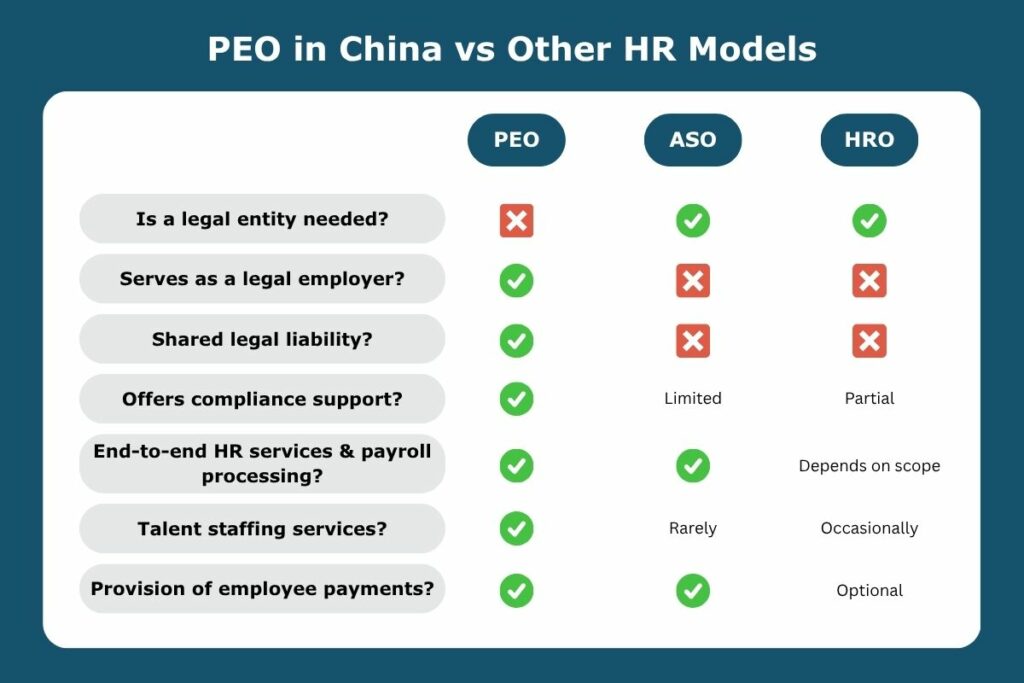
While the first table compares strategic factors, the next one highlights practical HR features such as legal responsibility, compliance support, and payroll processing. You can use this snapshot to determine which model best meets your company’s operational and legal needs in China. 

Feature  PEO  ASO  HRO 
Is a legal entity needed?  No  Yes  Yes 
Serves as a legal employer?  Yes  No  No 
Shared legal liability?  Yes  No  No 
Offers compliance support?  Yes  Limited  Partial 
End-to-end HR services & payroll processing?  Yes  Yes  Depends on scope 
Talent staffing services?  Yes  Rarely  Occasionally 
Provision of employee payments?  Yes  Yes  Optional 

Table 2: Features at a glance – PEO vs ASO and HRO 

These key features demonstrate that the PEO model delivers the broadest HR coverage while minimizing legal risk and administrative work. For most foreign companies entering the Chinese market, partnering with a PEO in China provides the smoothest path to hiring, payroll management, and full compliance from day one. Understanding these distinctions is essential for choosing the most suitable HR framework for your business. The next section explains when to choose each model and why PEO in China often provides the perfect balance between agility, compliance, and operational control. 

When to choose each model 

Choosing the right HR model depends on your organization’s size, level of market commitment, and appetite for legal responsibility. Here’s when each approach makes sense and why PEO in China often strikes the best balance between cost efficiency, control, and compliance. 

  • PEO in China: Best when you want speed, compliance, and shared HR management without establishing a local entity. 
  • ASO: Works for larger companies that already have an entity but need help with payroll administration.
  • HRO: Established firms outsource specific HR functions or projects. 

For most international SMEs expanding into China, the PEO model offers the ideal balance between control, cost, and compliance. 

4. How PEO Services Accelerate Business Expansion in China

Expanding to China requires speed, local knowledge, and compliance with Chinese labor laws. A PEO in China acts as your local HR engine. It helps you hire employees, manage payroll, and operate legally, all within a matter of weeks. By partnering with a China PEO service, you can: 

  • Recruit and onboard staff quickly. 
  • Avoid costly delays in entity registration. 
  • Reduce legal risk through compliant HR management. 
  • Focus resources on business development instead of administration. 

The approach is particularly valuable for companies testing new markets, establishing representative offices, or running pilot projects before setting up a subsidiary. 

5. How PEO Services Work in China

VVR International signs a local employment contract with the employee, ensuring full compliance with Chinese labor laws.

VVR International signs a local employment contract with the employee, ensuring full compliance with Chinese labor laws.

PEO services in China follow a well-defined structure that simplifies every stage of employment: 

  • Employment contract setup: 
    • VVR International signs a local employment contract with the employee, ensuring full compliance with Chinese labor laws. 
    • The client company retains operational control while VVR manages administrative obligations.
  • Payroll management: 
    • VVR handles all salary calculations, bonuses, benefits, and health insurance contributions. 
    • Each month, the company receives one clear invoice covering gross salary, taxes, and service fees. 
  • Compliance and taxation: 
    • The PEO ensures compliance with local tax rules, including withholding tax and mandatory social contributions.
    • All payments are made to government-approved channels in the employee’s registered city.
  • HR and administrative support: 
    • VVR RH manages onboarding, probation, performance records, and offboarding in accordance with local law. 
    • For foreign employees, the company also handles work visa and residence permit applications.
  • Continuous legal assurance: 
    • With regular policy updates and proactive HR advice, PEO services maintain long-term compliance and transparency. 

With this structure, foreign companies can hire employees in China confidently, focusing on growth while the organization PEO in China handles the rest. 

6. Why Choose VVR RH as Your Best PEO Services Partner

When choosing a PEO service in China, experience, licensing, and local insight matter. VVR International stands out as a trusted partner combining European reliability with on-the-ground Franco-Chinese expertise. 

VVR International RH handles: 

  • Drafting legally compliant employment contract. 
  • Comprehensive HR management, including onboarding and employee relations. 
  • Full payroll administration (salary, benefits, bonuses, reimbursements). 
  • Administrative tasks such as social protection, housing fund, and health insurance. 
  • Taxation and withholding handled accurately each month. 
  • Contract renewals, terminations, and exit procedures. 
  • Immigration support for foreign employees (work visa and residence permit).
VVR RH stands out as a trusted partner combining European reliability with on-the-ground Franco-Chinese expertise.

VVR RH stands out as a trusted partner combining European reliability with on-the-ground Franco-Chinese expertise.

Operational highlights: 

  • Monthly invoicing for salaries and service fees ensures transparency. 
  • Holds an official Labor Dispatch License, authorizing legal employment of Chinese and foreign staff. 
  • Pays all taxes and social charges in the employee’s registered city, as required by law. 

Additional support from VVR RH: 

  • Intercultural management helps align European and Chinese work cultures for smoother onboarding. 
  • VVR’s teams in France and China coordinate time zones and expectations. 
  • Expatriate assistance offers adaptation training, relocation help, and ongoing HR support. 

More than HR outsourcing, we provide a complete ecosystem for your success in China, ensuring your team operates confidently and compliantly from day one. 


Read more related articles:


7. Final Thoughts

To sum up, a PEO in China allows businesses to hire, manage, and pay employees without setting up a local entity, combining compliance, speed, and scalability. Compared to other HR models, the PEO/EOR approach offers shared control, lower risk, and complete transparency. Whether you’re entering China for the first time or expanding your presence, partnering with an experienced provider like VVR International helps you navigate every step of your journey. 

Are you ready to start your expansion in China? Contact VVR International today to learn how our PEO services in China can help you hire employees, manage payroll, and stay compliant, without the burden of establishing a legal entity.

Share your project with us via contact@vvrinternational.com.

CONTACT US

FAQ

  • What are the main HR challenges in China that outsourcing helps foreign companies solve?

The main HR challenges in China include compliance with labor contract law, managing payroll across different cities, handling social insurance and housing fund contributions, and navigating work permit requirements for foreign employees.

HR outsourcing for foreign companies in China addresses these issues by providing local expertise, payroll outsourcing services, contract management under mutual agreement rules, and support for work permits. This allows companies to operate smoothly while minimizing legal and operational risks.

  • How do HR outsourcing services in China support strategic HR management and long-term growth?

HR outsourcing services in China support strategic HR management, aligning with modern HR practices in China, including digital HR solutions, employee retention strategies, and ESG-focused HR policies. By outsourcing HR functions, companies gain access to market insights, salary benchmarks, and compliance monitoring, enabling them to build sustainable teams in China while adapting to workforce trends and long-term business objectives.

Related Posts

Read More