Can You Hire Employees Without Local Entity? A Complete Guide for Global Hiring

Can You Hire Employees Without a Local Entity? Global Hiring Guide (2026)

Can i hire employees without a local entity, global hiring guide in 2026

1. Introduction

You have named the right market and found the right candidate. Now comes the question that stops many global expansion plans in their tracks: “Do you need to set up a legal entity before you can hire employees in China?” A short answer is no. You can hire employees without setting up a local entity, and for most companies, testing a new market or building a lean international team, it is also the smarter path.

Solutions like Employer of Record (EOR), Professional Employer Organizations (PEO), and carefully structured contractor arrangements allow companies to hire compliantly in markets like China without the time and capital burden of entity incorporation. In this guide, we at VVR International break down every legal option available. Then it compares the true costs and explains what companies need to know specifically when hiring in China.

2. Key Takeaways

  • Companies can legally hire employees in China without establishing a local entity by using an EOR/PEO structure, which significantly reduces setup time, cost, and operational complexity.
  • In China, EOR/PEO is generally the safest and most compliant hiring model for foreign companies because Chinese labor law imposes strict obligations around contracts, social insurance, payroll, and employee protections.
  • Many international companies now use a phased market-entry approach: they first validate the market through EOR/PEO, then establish a local entity only after commercial traction and operational scale are proven.

3. Do You Need a Local Entity to Hire Globally?

Before choosing a hiring structure, it is important to understand what a local entity enables and when it is truly necessary. A local entity is a legally registered business structure in a foreign country, such as a Wholly Foreign-Owned Enterprise (WFOE) or Joint Venture (JV) in China. It gives a company the legal standing to sign contracts, issue invoices, and directly employ staff under local law. 

Setting up a local entity in China typically takes 6 to 12 months and costs between $15,000 and $50,000 in legal, accounting, and registration fees, before you have hired a single person. Ongoing compliance adds further operational overhead: annual audits, tax filings, registered capital requirements, and dedicated local management. So, do you need one? The answer is not necessarily. Here are the determining factors that you need to know: 

  • Headcount and timeline: Hiring 1–5 people quickly? An entity is overkill. Planning for 20+ over 3 years? An entity may eventually make sense. 
  • Revenue generation: If your China operation will sign contracts and generate local revenue, a WFOE is typically required. 
  • IP and control sensitivity: Companies with highly proprietary products may prefer the direct control that an entity provides. 
  • Market commitment: Testing a new market before committing? Starting without an entity reduces your exit cost significantly. 

For most companies in the early-to-mid stages of international expansion, our answer is to start without an entity and build the infrastructure once the market justifies it. 

4. Two Legal Ways to Hire Employees Without a Local Entity in China

Companies that want to hire quickly without incorporation usually rely on two practical legal routes. Each comes with different levels of control, cost, and compliance risk.

4.1. Employer of Record (EOR) /Professional Employer Organization (PEO)

For most international hiring plans, this is the safest and fastest solution. An EOR or PEO is a third-party company that becomes the legal employer of your staff on paper. It handles payroll, tax withholding, social insurance contributions, and labor contract compliance while you retain operational control over day-to-day work.

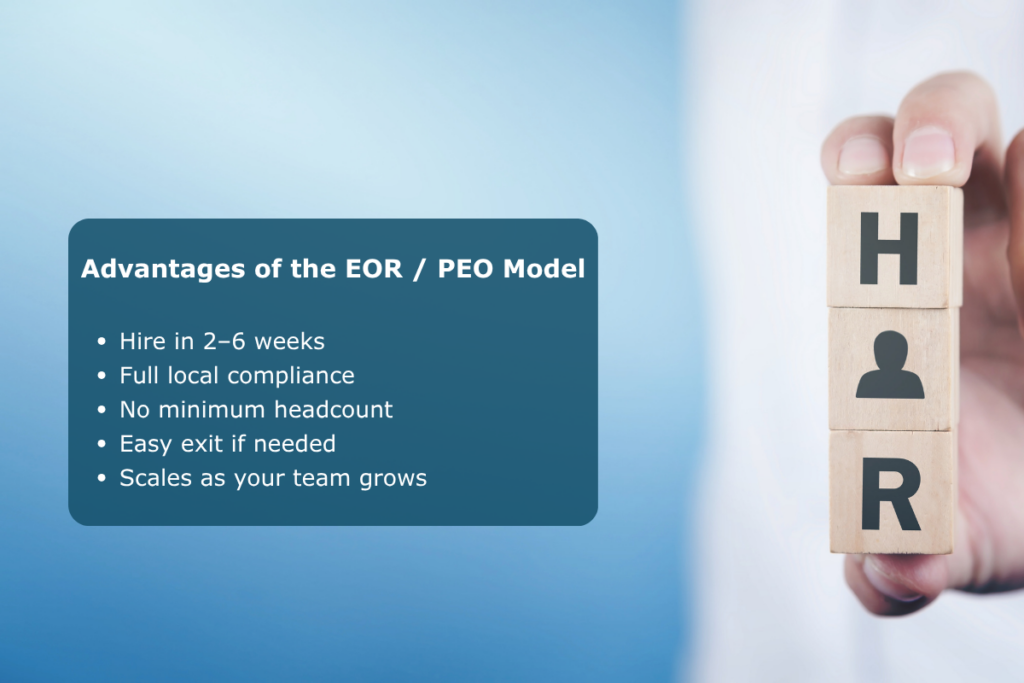
This is the most widely used and legally robust solution for hiring without a local entity. In China specifically, where labor law is stringent and non-compliance carries significant penalties, an EOR/PEO drops the risk of misclassification or administrative violations. The EOR/PEO model brings some advantages: 

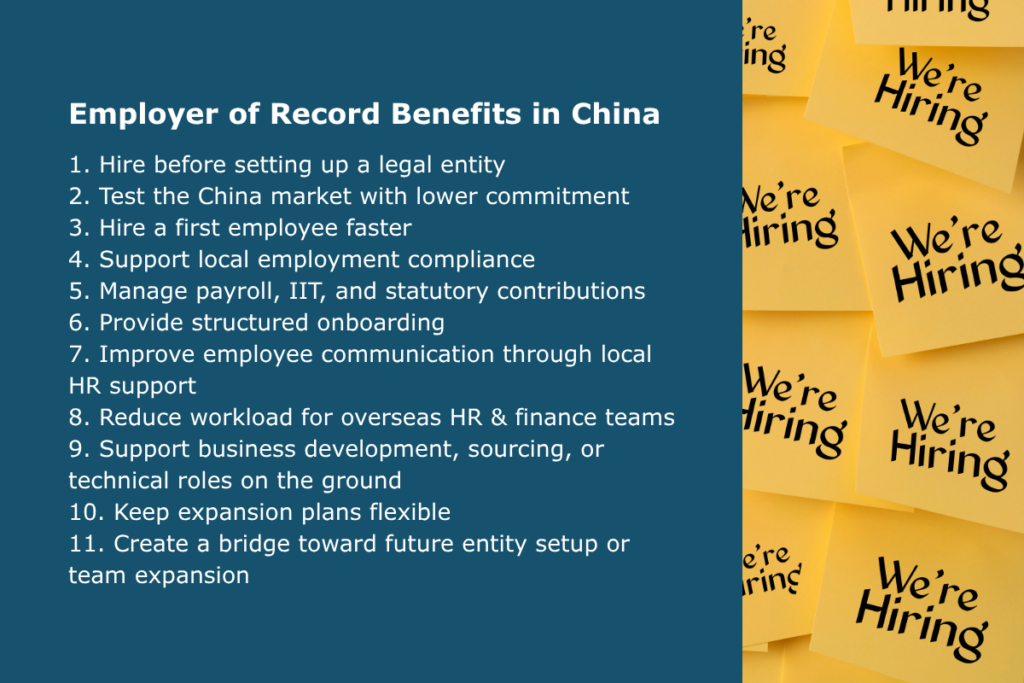
  • Hire in 2 to 6 weeks instead of waiting months for entity approval;
  • Full compliance with local labor law, social insurance, and tax obligations;
  • No minimum headcount – suitable for hiring even a single employee;
  • Straightforward offboarding if the market does not perform as expected;
  • Scales seamlessly as your team grows.

VVR International provides direct EOR/PEO services across China, acting as the legal employer while your team works under your direction. In case you already have a registered entity in China but want to outsource the operational burden of employment administration, an EOR/PEO is still a strong choice.

EOR and PEO solutions help companies hire internationally faster, stay compliant, and scale teams without setting up a local entity.

Both EOR and PEO solutions help companies hire internationally faster, stay compliant, and scale teams without setting up a local entity.

4.2. Independent Contractors

Engaging independent contractors is the fastest and lowest-cost way to access talent abroad, but it carries significant legal risk, particularly in China. Chinese labor law distinguishes sharply between employees and contractors. If a contractor works exclusively for your company, follows your schedule, and uses your equipment. In that case, Chinese authorities may reclassify them as full-time employees. The consequences include back payment of social insurance contributions, tax penalties, and potential fines. 

However, contractors are appropriate for genuinely project-based, time-limited engagements with professionals who serve multiple clients. They are not a compliant substitute for full-time employment in China.

5. How Much Does It Cost to Hire an Employee Without a Local Entity in China?

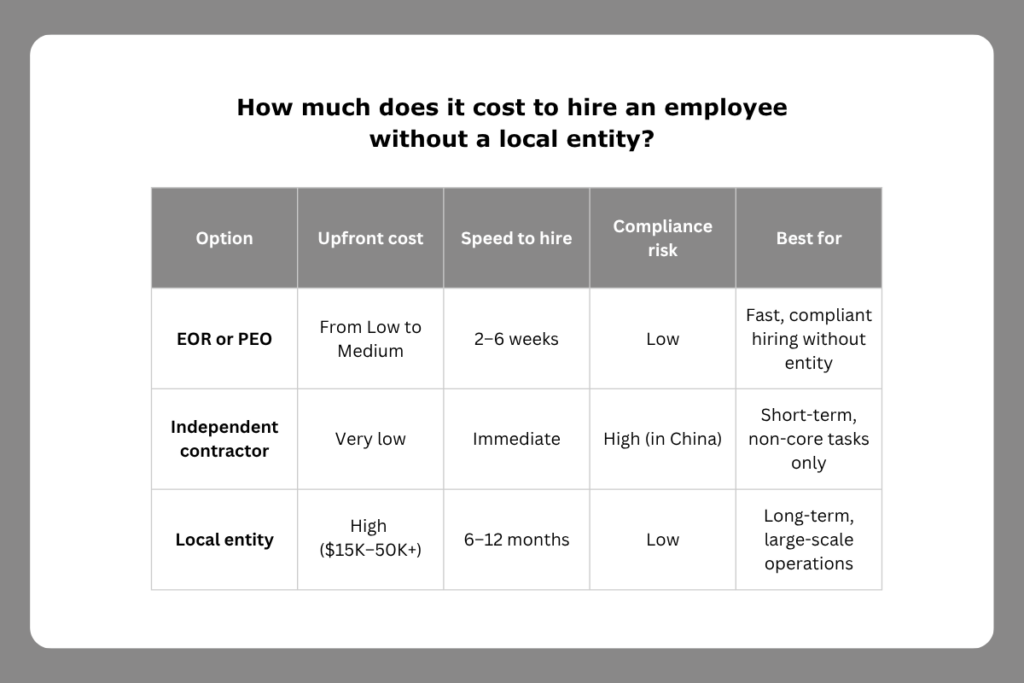
Cost is often the deciding factor. However, the cheapest option on paper is not always the lowest risk option in practice. Below is a practical breakdown to answer the question “How much does it cost to hire an employee without a local entity?”: 

Option 

Upfront Cost  Speed to Hire  Compliance Risk 

Best For 

EOR/PEO 

From Low to Medium 

2–6 weeks  Low  Fast, compliant hiring without an entity 

Contractor 

Very low 

Immediate 

High (in China) 

Short-term, non-core tasks only 

Local entity  High ($15K–50K+)  6–12 months  Low 

Long-term, large-scale operations 

Beyond the table, consider the hidden costs of entity setup: registered capital requirements (often RMB 100,000–500,000 in China), ongoing annual audit fees, dedicated local accounting and legal retainers, and the management time diverted to compliance rather than growth. In practice, for most companies with fewer than 15 employees in a new market, EOR fees are substantially cheaper than maintaining a local entity.

Comparing EOR, contractor, and local entity models helps companies choose the most cost-effective path for international hiring.

Comparing EOR, contractor, and local entity models helps companies choose the most cost-effective path for international hiring.

6. Hiring Employees in China Without a Local Entity: What You Need to Know

While China offers a major commercial opportunity, it also has one of the most structured labor compliance systems in Asia. Indeed, China presents a unique combination of opportunity and regulatory complexity. It is the world’s largest manufacturing base, a growing consumer market, and an increasingly important source of technical talent, but its labor law framework leaves little room for shortcuts. 

Several features of Chinese employment law are especially important for foreign companies hiring without an entity: 

  • Mandatory written labor contracts: Required within one month of employment commencement. Failure to provide a written contract within that window triggers automatic double-salary liability. 
  • Social insurance and housing fund: Employers must contribute to five mandatory social insurance streams (pension, medical, unemployment, work injury, maternity) plus a housing provident fund. Rates vary by city but typically add 30–40% to base salary costs. 
  • Probation period limits: Capped by law based on contract duration—maximum 6 months for contracts of 3 years or more. 
  • Termination protections: Chinese labor law provides strong employee protections. Termination without cause requires severance based on years of service. Unlawful termination can trigger double severance of liability. 
  • Stricter contractor environment: Unlike some markets, China does not have a well-established compliant contractor framework for core employment roles. Thus, the EOR is the appropriate structure. 

For foreign nationals being hired into China roles, additional work permit requirements apply, including the tiered work permit system (Categories A, B, and C) introduced in 2017. Additionally, processing typically takes 4 to 8 weeks and requires documentation, including degree certificates, work history, and background checks. 

7. When Should You Set Up a Local Entity Instead?

For a long-term plan, EOR/PEO is not the right answer forever. As your China operations mature, the calculus shifts. You need to consider moving to a local entity when: 

  • Headcount reaches 10–15 employees, depending on salary levels and market: At this scale, entity costs often become competitive with monthly EOR fees. 
  • Revenue generation is the goal: If your team signs contracts, issues invoices, or collects payments locally, a WFOE or equivalent structure is typically required. 
  • IP protection is a priority: Holding patents, trademarks, or proprietary technology through a local entity provides stronger legal protection. 
  • Long-term strategic commitment: If China is central to your 5-year plan, the investment in a proper legal structure pays off over time. 

As a result, many companies use EOR/PEO as a bridge. They enter the market quickly through EOR/PEO, validate the business case, and establish a local entity once operations reach the scale that justifies it. Consequently, this sequenced approach reduces risk and preserves capital during the critical early phase. 

8. Conclusion

To sum up, you do not need a local entity to hire compliantly in China. An EOR/PEO gives you speed, compliance, and flexibility to build international teams without the capital commitment and operational complexity of entity incorporation, and without putting your company at legal risk.

Therefore, for founders and HR leaders navigating global expansion, the question is not whether EOR/PEO works. It is whether you have the right partner – one with genuine local expertise, in-country teams, and a track record of navigating complex labor environments like China. 

VVR International provides direct EOR/PEO services across China.


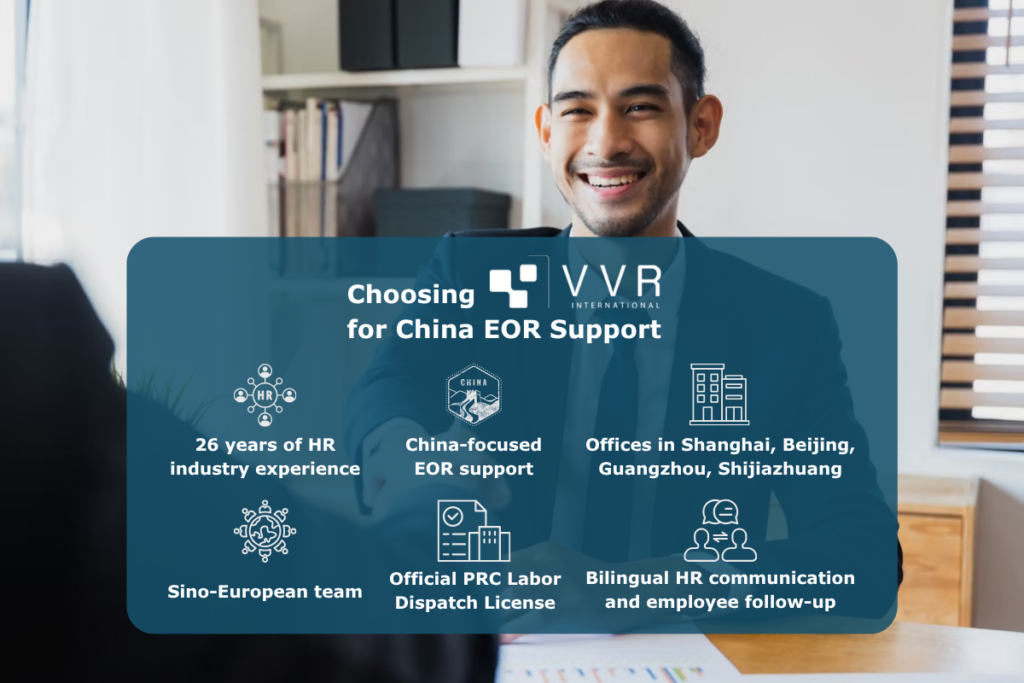
Why should you choose VVR International? 

With 26 years of experience in the HR industry, VVR International supports companies hiring and expanding across China through a strong Sino-European team that understands both local execution and international business standards. 

We are proudly one of the very few non-Chinese firms holding an official Labor Dispatch License issued by the PRC government. This license authorizes us to act as the legal employer for dispatched staff across China, providing a compliant and secure route for hiring local or expatriate employees. Clients also benefit from our 5-star customer service and on-the-ground support through offices in Shanghai, Beijing, Guangzhou, and Shijiazhuang. 


If you are ready to hire internationally without setting up a local entity, fill in the contact form below. Then, our team will outline the fastest, most compliant path forward for your specific market and role. 

Share your project with us via contact@vvrinternational.com.

CONTACT US

FAQ

  • Can I hire a full-time employee in China without registering a company? 

Yes. Through an Employer of Record (EOR) like VVR International, you can hire full-time employees in China without setting up a local entity. The EOR becomes the legal employer and handles all payroll, tax, and social insurance obligations on your behalf. 

  • How long does it take to hire through an EOR/PEO in China? 

Most EOR onboarding processes in China take between 2 and 4 weeks from signed agreements to the employee’s first day. This compares 6 to 12 months for entity setup. 

  • Is it legal to use contractors in China instead of employees? 

It is legal, but high-risk for ongoing, full-time roles. Chinese authorities can reclassify contractors as employees if the working relationship resembles standard employment, triggering back-payment of social insurance and tax penalties. For core team members, EOR employment is the compliant solution. 

Related Posts

Read More
Global EOR vs Local EOR: What’s Best for Hiring in China?

Global EOR vs Local EOR: What’s the Difference?

Global EOR vs Local EOR: What’s Best for Hiring in China?

1. Introduction

As companies expand into China, one question comes up early in nearly every conversation: Should we use a global EOR platform or partner with a local EOR specialist? On the surface, both solve the same problem, which is that they allow you to hire employees in a foreign country without setting up a local entity. But the differences in how they run, how deep their compliance knowledge runs, and how they price up their services can significantly affect your expansion outcomes. 

In this article, we, VVR International, break down the global EOR vs. local EOR debate in practical terms, with a specific focus on what matters when hiring in China, which is one of the most compliance-intensive labor markets in the world. 

2. Key Takeaways

  • Global EOR platforms simplify multi-country hiring through centralized systems, while local EOR specialists provide deeper compliance expertise and operational support within China.
  • For China-focused expansion, local EOR providers often offer stronger labor law knowledge, bilingual support, and more competitive pricing compared to global EOR platforms.
  • Choosing between a global EOR and a local EOR depends mainly on expansion scope, internal HR capabilities, and the level of compliance control required in China.

Insight for you: In China expansion, the real difference between a global EOR and a local EOR is not convenience versus geography, but platform standardization versus operational depth and compliance precision.

3. What Is an Employer of Record (EOR)?

An Employer of Record is a company that legally employs workers on behalf of another business. The EOR appears on employment contracts, handles payroll processing, withholds and remits taxes, manages social insurance contributions, and ensures compliance with local labor law, while the client company directs the employee’s work. 

The EOR model exists to solve a specific problem: how do you hire someone compliantly in a country where you have no legal presence? Without a registered entity, a company cannot legally employ staff directly. An EOR bridges that gap. 

In China, this is particularly relevant. Chinese labor law requires all employment relationships to be backed by a legally registered entity. Foreign companies that try to hire Chinese nationals directly, without a WFOE or EOR arrangement, risk significant legal exposure, including backdated social insurance liability and administrative penalties. 

For more details about the EOR model, check here!

An Employer of Record legally employs staff on behalf of another company while managing payroll, tax, and compliance obligations.

An Employer of Record legally employs staff on behalf of another company while managing payroll, tax, and compliance obligations.


4. Global EOR vs. Local EOR: Core Differences

The distinction between a global EOR and a local EOR is not just about geographical reflects fundamentally different business models, compliance infrastructure, and service philosophies. 

Factor 

Global EOR  Local EOR 

Geographic coverage 

Multi-country via a single platform 

Single country or region 

China compliance depth 

General – relies on owned entities, partner networks, or hybrid models depending on the country. 

Deep in-country expertise 

Speed to hire 

Fast (standardized processes) 

Fast (specialized local knowledge) 

Pricing 

Higher – multi-country premium 

More competitive for the single market 

HR platform 

Unified dashboard across countries 

May require separate tools 

Local support 

Centralized, often remote 

On-the-ground, bilingual teams 

PIPL / data compliance 

Varies by provider 

China-specific expertise 

Best for  Hiring across 3+ countries simultaneously 

China-first or China-focused expansion 


The table above captures the key trade-offs. The right choice depends on your expansion strategy, headcount, and how central China compliance is to your hiring needs. 

5. Advantages of a Global EOR

For companies expanding into multiple countries at once, a global EOR platform can reduce administrative complexity and create better cross-border visibility. 

A global EOR helps companies hire across multiple countries through one provider, standardized processes, and scalable international infrastructure.

A global EOR helps companies hire across multiple countries through one provider, standardized processes, and scalable international infrastructure.

Single vendor, multiple markets 

For companies expanding into three or more countries simultaneously, a global EOR platform offers meaningful operational efficiency. Instead of managing separate contracts, billing relationships, and onboarding processes with multiple local providers, HR teams work through a single dashboard covering all markets. 

This consolidation is especially valuable for companies with small central HR functions that lack the bandwidth to manage multiple regional vendors. A unified platform standardizes reporting, reduces administrative friction, and simplifies audits. 

Standardized processes and cross-border reporting 

Global EOR providers have invested heavily in technology platforms that automate payroll, benefits enrollment, contract generation, and compliance tracking across authorities. For multinationals that need consistent data formats and combined reporting across markets, this is a genuine advantage. 

CFOs and HR leaders who need a single view of global headcount, total employment costs, and compliance status often find global platforms significantly easier to manage than the patchwork of local providers. 

Scalable infrastructure for rapid multi-country expansion 

If your roadmap includes entering five markets in eighteen months, a global EOR can activate new countries without requiring you to source and vet a new local provider for each one. The infrastructure is already in place; you are effectively plugging in to an existing network. 

6. Advantages of a Local EOR Specialist

In this article, “local EOR” refers to an in-country provider with direct operational capability rather than a purely reseller model. When one market matters more than all others, local ability often creates more value than platform convenience. 

A local EOR offers deeper China compliance expertise, competitive pricing, and on-the-ground bilingual support for market-specific hiring.

A local EOR offers deeper China compliance expertise, competitive pricing, and on-the-ground bilingual support for market-specific hiring.

Deeper China compliance expertise 

China’s labor law is not uniform across the country. Social insurance contribution rates vary by city and province. Labor dispute resolution processes differ between municipalities. Probation rules, termination procedures, and housing fund requirements are all shaped by local regulations layered on top of national law. 

A local EOR that runs exclusively or primarily in China has invested in understanding these nuances at the ground level. They typically support in-country legal and HR teams, have proven relationships with local labor bureaus, and can identify city-specific considerations that a global platform’s standardized processes may not capture. For companies where China compliance is not just a checkbox but a genuine operational risk, this depth matters. 

More competitive pricing for a single-market focus 

Global EOR platforms price their services to reflect multi-country infrastructure, technology investment, and global account management. If you are hiring exclusively in China, you are paying for capabilities you are not using. Local EOR specialists’ price for their specific market. For China-focused hiring, this typically translates to more competitive monthly fees and greater flexibility on service customization. 

On-the-ground support and bilingual teams 

Employment issues in China — whether a labor dispute, a payroll discrepancy, or an unexpected regulatory change — require fast, accurate responses in Chinese. A local EOR with in-country teams can engage directly with employees, government offices, and legal counsel in Mandarin, without the delays introduced by centralized global support functions. 

This operational proximity is difficult to replicate from a global platform. When a sensitive HR issue arises in Shenzhen or Shanghai, having a team that is physically present and culturally fluent is a meaningful advantage. 

7. Which EOR Model Is Right for Your China Expansion? 

There is no universal best choice. The right EOR model depends on your hiring footprint, internal resources, and China growth plans. Besides, the answer depends primarily on the scope of your hiring across markets and the depth of compliance expertise your China operations require. 

Your Situation  Recommended EOR Type 
Hiring in China only  Local EOR 
Hiring in China + 1 other ASEAN country  Local EOR with regional reach 
Hiring across 3+ countries simultaneously  Global EOR platform 
Unsure/early stage  Start with local EOR, scale to global 
The HR team requires a unified dashboard  Global EOR (evaluate China compliance depth) 


A note of caution for companies defaulting to global EOR for China: the quality of China compliance support varies significantly between global providers. Some keep strong in-country partnerships; others rely on subcontracted local entities with limited accountability. Before committing to a global EOR for China hiring, verify their specific compliance infrastructure in-country – not just their platform’s feature list. 

8. What to Look for in a Global EOR Solution for China

Not every EOR provider is equally prepared for China. Before signing, companies should review operational depth, compliance capability, and real in-country execution. Whether you ultimately choose a global or local EOR, the following criteria are non-negotiable when running in China: 

  • Proven China compliance track record: Ask for reference clients in China and verify their experience with labor disputes, terminations, and regulatory changes. 
  • Province-level coverage: Tier 2 and Tier 3 city support often separates experienced local providers from global platforms. 
  • PIPL compliance: China’s Personal Information Protection Law has direct implications for HR data. Your EOR should have a clear data handling policy that complies with PIPL. 
  • Transparent all-in pricing: Ensure quotes include employer-side social insurance contributions, housing funds, and any local administration fees, not just the EOR service fee. 
  • Labor dispute support: China’s labor arbitration can be employee-protective in practice, making expert handling important. Your EOR should have a defined process for managing disputes and a track record of successful resolution. 
  • Onboarding timeline: A reliable EOR should be able to onboard a new hire in China within 2 to 4 weeks of receiving complete documentation. 

Why Companies Choose VVR International for China EOR?

With 26 years of HR industry experience, VVR International supports international companies through a strong Sino-European team that combines local execution with global business standards.

We are one of the few non-Chinese firms holding an official PRC Labor Dispatch License, allowing us to legally employ local and expatriate staff across China through a secure and approved structure. Clients also benefit from 5-star customer service and direct support through our offices in Shanghai, Beijing, Guangzhou, and Shijiazhuang.


9. Conclusion

To sum up, both models can work well when matched to the right expansion strategy. Indeed, global EOR vs local EOR are not competing products; they serve different expansion profiles. Global EOR platforms excel at multi-country consolidation and standardized reporting. Local EOR specialists deliver the compliance depth, in-country relationships, and cost efficiency that China-focused hiring demands. 

For companies where China is the primary or most strategically significant market, the compliance advantages of a specialist local EOR typically outweigh the convenience of a unified global platform, particularly in the early and mid-stages of market entry. 

VVR International provides direct local EOR services in China. If you are evaluating EOR options for your expansion, fill in the contact form now and our team will walk you through the compliance considerations and service model that fits your hiring roadmap. 

Share your project with us via contact@vvrinternational.com.

CONTACT US

FAQ

  • What does EOR stand for? 

EOR stands for Employer of Record. It refers to a company that legally employs workers on behalf of another business, handling payroll, tax, social insurance, and compliance obligations in the relevant jurisdiction. 

  • Is a global EOR compliant in China? 

It depends on the provider. Some global EOR platforms maintain strong in-country partnerships and compliance infrastructure in China; others subcontract to local entities with limited oversight. Always verify a provider’s specific China compliance track record before committing. 

  • Can I switch from a global EOR to a local EOR? 

Yes. Transitioning between EOR providers involves transferring employment contracts and payroll arrangements to the new provider. The process typically takes 4 to 8 weeks and should be managed carefully to avoid gaps in compliance or employee benefits. 

  • How is a local EOR different from setting up a WFOE in China? 

A WFOE (Wholly Foreign-Owned Enterprise) is a registered legal entity that you own and operate. A local EOR is a third-party company that employs staff on your behalf without you needing to register with a company. WFOE setup takes 6 to 12 months; EOR can be activated in 2 to 4 weeks. 

Related Posts

Read More
Hiring International Employees in China: How to Build Global Teams Without Borders

Hiring International Employees in China: How to Build Global Teams Without Borders

Hiring International Employees in China: How to Build Global Teams Without Borders

1. Introduction

China remains one of the most strategically important markets for companies building global teams. It is home to the world’s largest manufacturing base, a rapidly growing technology talent pool, and a consumer market that demands local presence to serve effectively. Yet for HR leaders and founders approaching China for the first time, the employment landscape can feel genuinely complex. 

Hiring international employees in China involves navigating layers of regulation that have no equivalent in Western markets: a national labor law framework that strongly favors employees, city-specific social insurance contribution rates, a tiered work permit system for foreign nationals, and strict data privacy obligations that affect how you manage employee information. 

In this guide, our VVR experts explain the legal options available, walk through the step-by-step process of hiring in China, cover work permit and visa requirements for foreign employees, and highlight the compliance considerations that catch international companies off guard. 

2. Understanding the Landscape: Two Types of International Hiring in China

When companies talk about hiring international employees in China, they are typically referring to one of two distinct situations, and the requirements for each are very different. 

  • Hiring Chinese nationals as part of an international team: A foreign company brings Chinese employees onto its global workforce, employing them locally under Chinese law. This is the most common scenario for companies expanding into China. 
  • Relocating foreign nationals to work in China: A company transfers an employee from another country, or hires a foreign candidate directly, to work on the ground in China. This triggers work permits and visa requirements. 

Both scenarios require a compliant employment structure in China. The key question is always the same: who is the legal employer? Foreign companies generally need a compliant employment structure, such as a local entity or licensed EOR arrangement, to hire staff in China. 

3. Legal Options for Hiring International Employees in China

Before making an offer, companies need to choose the right employment structure. This decision affects speed, cost, control, and long-term compliance. 

Companies can hire in China through several legal structures, including a WFOE, Employer of Record, Representative Office, or staffing agency.

Companies can hire in China through several legal structures, including a WFOE, Employer of Record, Representative Office, or staffing agency.

Option 1: Set up a legal entity (WFOE or Joint Venture) 

A Wholly Foreign-Owned Enterprise (WFOE) is the most common structure for foreign companies that want direct operational control in China. It allows the company to sign contracts, generate local revenue, and directly employ staff under Chinese labor law. 

The limitations are well-known: setup takes 6 to 12 months, costs between $15,000 and $50,000 in professional fees, and requires ongoing compliance investment in auditing, tax filing, and registered capital management. For companies at the early stages of China entry, this commitment is often premature. 

Option 2: Employer of Record (EOR) 

An Employer of Record is the fastest and most compliant route for hiring international employees in China without establishing a local entity. The EOR becomes the legal employer of record, handling payroll, social insurance contributions, labor contract execution, and tax withholding — while the client company keeps full operational direction of the employee’s work. 

For companies hiring overseas employees in China for the first time, or testing the market before committing to a WFOE, EOR is the standard professional approach. Onboarding typically takes 2 to 6 weeks. 

Learn more about how EOR simplifies recruitment in China now! 

Option 3: Representative Office (RO) 

A Representative Office allows a foreign company to prove a limited presence in China without full incorporation. However, ROs face significant restrictions: they cannot sign commercial contracts, generate revenue, or directly employ more than a small number of staff (typically managed through a licensed dispatch agency). 

ROs are proper for market research, liaison activities, and supporting a physical presence, not for building a functional operating team. 

Option 4: Labor Dispatch / Staffing Agency 

Labor dispatch is a historically common model in China where a staffing agency acts as the formal employer while the worker runs at a client company. Following 2013 labor reforms, its use has been restricted, such as: dispatched workers can only be placed in temporary, auxiliary, or substitute roles, and cannot exceed 10 percent of a company’s total workforce. 

For international companies hiring core team members, labor dispatch is restricted for core long-term workforce planning and should be assessed carefully under current regulations. Thus, the EOR still remains in the appropriate structure. 


Why Companies Choose VVR International for Hiring in China 

With 26 years of HR industry experience, VVR International helps international companies hire and scale teams in China through a strong Sino-European team that understands both local execution and international business expectations. 

We are one of the few non-Chinese firms holding an official PRC Labor Dispatch License, allowing us to legally employ local and expatriate staff across China through a secure and compliant structure. 

Clients also receive help from 5-star customer service and direct operational support through our offices in Shanghai, Beijing, Guangzhou, and Shijiazhuang. 


4. How to Hire International Employees in China: Step-by-Step 

Once the hiring model is clear, the next priority is execution. A structured onboarding process helps companies avoid delays and early compliance mistakes. 

A successful hiring process in China starts with the right employment structure, legal contracts, payroll setup, and ongoing compliance management.

A successful hiring process in China starts with the right employment structure, legal contracts, payroll setup, and ongoing compliance management.

  • Step 1: Determine your employment structure 

Before anything else, decide whether you will hire through a WFOE, EOR, or another structure. For most companies in the early stages of China expansion, EOR is the fastest compliant path. If you already have a WFOE, you can employ it directly. 

  • Step 2: Verify work authorization requirements 

For Chinese nationals, no work authorization is needed. For foreign nationals, decide which work permit category applies (see the Work Permit section below) and begin documentation collection early—the process takes a minimum of 4 to 6 weeks. 

  • Step 3: Execute a compliant labor contract 

Chinese law requires a written labor contract within one month of employment commencement. The contract must follow the Labor Contract Law and should be bilingual (Chinese and English) if the employee is a foreign national. The Chinese version governs in all legal disputes. 

Key terms to specify, including job title and duties, work location, compensation, probation period (if applicable), working hours arrangement, and confidentiality obligations. 

  • Step 4: Register social insurance and housing fund contributions 

Employers must register new employees with local social insurance and housing provident fund authorities. Contributions begin from the first month of employment. Rates vary by city, see the contribution table in the Compliance section below. 

  • Step 5: Set up compliant payroll 

Salaries in China must be paid in RMB. Employers must withhold an Individual Income Tax (IIT) at the source. For foreign employees, the tax treatment depends on their residency status and any applicable double-taxation treaties between China and their home country. 

  • Step 6: Onboard and maintain ongoing compliance 

Ongoing obligations include monthly payroll and tax filings, annual IIT reconciliation, social insurance payment records, and adherence to labor law requirements around working hours, leave entitlements, and termination procedures. 

5. Work Permit and Visa Requirements for Foreign Employees in China

China introduced a points-based work permit system in 2017, replacing the earlier two-tier system with a three-category framework. Foreign nationals require a work permit to be legally employed in China. 

Category 

Profile 

Typical Process Time 

Category A  High-end talents: Nobel laureates, globally recognized experts, senior executives of MNCs  Expedited; often 15 working days 
Category B  Professionals meeting point-based criteria: education, salary threshold, age, work experience  15–20 working days 
Category C  Non-skilled or service roles; subject to quotas and stricter review  20–30 working days 


Most professional hires for international companies fall into Category B. Key requirements for Category B work permits include: 

  • Bachelor’s degree or above (Master’s or higher preferred and awarded added points) 
  • At least two years of relevant professional work experience 
  • Salary meeting or exceeding the local minimum threshold (typically set by each city) 
  • Criminal background check from home country (apostilled and translated) 
  • Medical examination certificate from a designated Chinese medical facility 
  • No criminal record in China 

Processing typically takes 15 to 20 working days once a complete documentation package is submitted. The work permit must be obtained before the employee’s work visa (Z-visa) is issued, and both must be secured before the employee begins working in China. 

6. Key Compliance Considerations When Hiring in China

China hiring compliance goes far beyond payroll. Employers need to manage tax, insurance, contracts, and employee data correctly from day one. 

Social insurance and housing fund contributions 

All employees in China, including foreign nationals in most cities, must be enrolled in the mandatory social insurance system and housing provident fund. Contribution rates vary by city and are adjusted periodically. The table below reflects approximate rates based on common major cities; always verify current local rates before budgeting. 

Insurance Type  Employer Contribution (approx.)  Employee Contribution (approx.) 
Pension  16%  8% 
Medical insurance  8–10%  2% 
Unemployment insurance  0.5–1%  0.5% 
Work injury insurance  0.2–1.9%  0% 
Maternity insurance  0.5–1%  0% 
Housing provident fund  5–12%  5–12% 


For employers budgeting labor costs in China, add approximately 35 to 45 percent on top of gross salary to account for total employer-side contributions. This varies by city and salary level. 

Individual Income Tax (IIT) 

China uses a progressive IIT system with rates from 3 to 45 percent. Employers must withhold IIT monthly and remit it to the tax authority. For foreign employees, tax residency rules figure out the scope of taxable income: employees living in China for more than 183 days in a calendar year are taxed on worldwide income. 

The country has signed double-taxation treaties with many countries. Foreign employees may be eligible for treaty benefits that reduce their China tax burden, but this requires proper documentation and filing. 

Labor contract law protections 

China’s Labor Contract Law provides strong employee protections that international companies must understand before hiring. The most important rules include the following:

  • Written contract deadline: A written contract must be in place within one month of employment. Failure triggers automatic double-salary liability. 
  • Probation period caps: For contracts of 1 to 3 years, maximum probation is 2 months. For contracts of 3+ years, maximum is 6 months. Probation cannot be extended. 
  • Termination with cause: Allowed for specific reasons defined in law (serious misconduct, inability to perform duties after training, etc.). Documentation is critical. 
  • Termination without cause: Requires 30 days’ written notice or one month’s pay in lieu. Severance is payable at one month’s salary per year of service. 
  • Unlawful termination: Triggers double severance liability. Chinese labor arbitration can be employee-protective in practice, making documentation and compliant procedures especially important. 

Personal Information Protection Law (PIPL) 

China’s PIPL, effective November 2021, regulates how companies collect, process, store, and transfer personal data – including employee data. International companies hiring in China must ensure their HR systems and data transfer practices follow PIPL, particularly if employee data is processed outside China. 

Common Mistakes When Hiring International Employees in China 

Based on common patterns across international market entries, these are the mistakes that create the most significant compliance and financial exposure: 

  • Misclassifying employees as contractors. Using contractor agreements for effectively full-time employment relationships exposes companies to backdate social insurance liability and penalties. Chinese authorities look at the substance of the working relationship, not just the contract label. 
  • Ignoring city-specific contribution rates. Social insurance and housing fund rates differ significantly between Shanghai, Beijing, Shenzhen, and other cities. Budgeting based on national averages leads to underpayment and compliance violations. 
  • Not executing bilingual labor contracts. For foreign national employees, a bilingual contract is essential. In any dispute, the Chinese version controls. Contracts drafted only in English have limited enforceability. 
  • Underestimating termination complexity. International companies accustomed to at-will employment models are often surprised by China’s termination requirements. Severance, notice periods, and documentation requirements can significantly increase the cost of ending an employment relationship. 
  • Delaying work permit applications. Work permit processing for foreign nationals takes a minimum of 4 to 6 weeks. Starting the process late delays onboarding and, if an employee begins work before the permit is issued, creates immediate legal exposure. 
  • Not updating employment contracts after role changes. Chinese law requires that material changes to employment terms be documented in a written amendment or a new contract. Informal agreements have limited enforceability. 

Conclusion 

Hiring international employees in China is operationally demanding, but entirely manageable with the right structure and partners in place. The companies that navigate it successfully are those that treat compliance as a foundation rather than an afterthought, choose employment structures that fit their current stage of market development, and work with advisors who understand China’s labor landscape at the provincial and city level. 

For most companies entering China without an existing entity, an Employer of Record (EOR) provides the fastest, most compliant path to building a functioning local team without the capital commitment of a WFOE. 

VVR International specializes in compliant international hiring across China. Whether you are hiring your first employee in China or scaling an existing team, fill in the contact form, and our team will outline the right employment structure and timeline for your specific situation. 

Share your project with us via contact@vvrinternational.com.

CONTACT US

FAQ

  • Can a foreign company hire employees in China without an office? 

Yes. Through an Employer of Record (EOR), a foreign company can legally hire employees in China without setting up a local entity. The EOR acts as the legal employer, handling all payroll, tax, and compliance obligations. 

  • What is the difference between hiring a Chinese national and a foreign national in China? 

Hiring a Chinese national requires only a compliant employment structure (WFOE or EOR) and enrollment in the local social insurance system. Foreign nationals additionally require a work permit (Category A, B, or C) and a Z-visa before they can legally begin working in China.

  • How long does it take to hire an international employee in China? 

For Chinese nationals through an EOR, onboarding typically takes 2 to 6 weeks. Work permit processing for foreign nationals usually adds 4 to 6 weeks, making the total timeline approximately 6 to 10 weeks from offer acceptance to the first day. 

  • Do I need to pay social insurance for foreign employees in China? 

In most major Chinese cities, yes. Foreign nationals working in China are required to participate in the mandatory social insurance system. However, exemptions may apply if China has signed a social security totalization agreement with the employee’s home country. Check out the specific treaty status and local city regulations. 

  • What happens if I hire an employee in China without a proper employment structure? 

Hiring without a registered entity or EOR arrangement means there is no legal employer of record for the worker. This exposes the company to administrative penalties, backdated social insurance liability, and potential claims by the employee. In China, the absence of a proper employment structure does not protect the company — it increases its legal exposure. 

Related Posts

Read More
Fruit Consumption in China: Trends, Distribution, and Opportunities in 2026

Between 2014 and 2024, annual per capita consumption of fresh fruit in China rose from 38.9 kg to 61.6 kg, an increase of nearly 60% over ten years (National Bureau of Statistics of China 国家数据). Several factors explain this growth. First, increased awareness of the importance of a healthy diet—driven by the rise of the urban middle class and the government’s Healthy China 2030 campaign (launched in 2013)—has encouraged consumers to incorporate more fruit into their daily diets. Furthermore, the diversification of distribution channels (wholesale markets, e-commerce, and rapid delivery services) has significantly improved access to fruit. Finally, the expansion of domestic production has increased supply, offering a wider variety of fruits at more affordable prices, thereby helping to boost overall consumption.

Which fruits do Chinese consumers prefer?

Traditional fruits (apples, citrus fruits, pears) still hold a significant market share, although their proportion is gradually declining. Conversely, rarer or more innovative fruits are gaining popularity, particularly those rich in antioxidants, such as blueberries and blackcurrants. Certain fruits of foreign origin, now grown in China, are seeing their prices drop and are shifting from a high-end positioning to a more common consumer product, much like blueberries, which have become more widely available in recent years. At the same time, lightly processed fruits (cut fruits, fresh juices, fruit salads) are experiencing significant growth, in response to the fast-paced lifestyles of urban consumers.

Occasions and Habits of Fruit Consumption in China

Fruit consumption is now part of many moments in daily life. Fruits have become a common part of the diet, eaten for breakfast, as a snack, or after meals. Health remains a key driver of fruit consumption: fruits are consumed as a nutritional supplement to support one’s health. For working professionals, convenient formats (cut or processed fruit) are preferred, particularly at work or while on the go. Fruit can also be given as gifts, in the form of gift boxes during holidays and receptions, although this practice is declining today (to learn more about traditions and key dates on the calendar, see the article “Traditional and Commercial Holidays in China”). Finally, during family meals or gatherings, they are often presented in assortments to share.

Food Distribution in China: Segmented and Rapidly Evolving Channels

Distribution in China: Segmented and Rapidly Evolving Channels

In China, fruit distribution channels are highly segmented according to uses and consumer profiles. Modern mass retail is the main channel, with supermarkets accounting for 36.53% of sales. Retailers specializing in fresh produce, such as Hema (盒马)—a high-end supermarket chain launched by Alibaba in 2015 that combines in-store shopping with 30-minute delivery—offer a premium experience with curated products.

Mass retailers and specialty chains, the leading sales channels

Specialty chains, such as Baiguoyuan, China’s leading national fruit retail network and a Hong Kong-listed company, rank second with 34.80% of sales. They stand out for their wide assortment, quality, and a dense network of dedicated stores. Traditional food markets account for 28.67% of sales and remain essential for everyday shopping, thanks to their affordable prices and the ability to select products directly.

Traditional markets and e-commerce: complementary alternatives

Finally, e-commerce for fresh produce, featuring major platforms such as JD Fresh—the fresh produce division of Chinese e-commerce giant JD.com—and Meituan Maicai, a highly popular grocery and home delivery service in China, accounts for 28.32% of sales. This sector has grown significantly in recent years, driven by logistical innovations enabling rapid delivery of perishable goods. This diversification of the main distribution channels explains the high accessibility of fruit throughout the country, while catering to the varying preferences of consumers, who prioritize fresh fruit and place great importance on food safety.

Key figures: fruit consumption in China (2024)

  • 61.6 kg: annual per capita consumption (vs. 38.9 kg in 2014)
  • +58% growth over 10 years
  • 36.5% of sales via mass retail
  • 28.3% via fresh produce e-commerce

Conclusion: fruit, a booming market in China

The fruit market in China is experiencing sustained growth, driven by changing dietary habits, urbanization, and improved distribution channels that are permanently reshaping the eating habits of Chinese consumers. Fruit now plays a central role in the daily diet in China, for both health and convenience reasons. This transformation is accompanied by a diversification of offerings and uses, as well as a gradual restructuring of distribution channels. All of these factors point to a rapidly evolving market, where quality, accessibility, and consumer trust play an increasingly decisive role. Understanding these dynamics is essential for any company seeking to position itself in the Chinese agri-food market: choosing the right distribution channel, analyzing consumer trends in China, and mastering local regulatory constraints are essential for building an effective and sustainable strategy.

For over 25 years, VVR International has been supporting French and European companies in expanding into the Chinese market, particularly in the agri-food sector:

  • Target market research
  • Identification of partners (distributors, influencers, etc.)
  • Product adaptation and positioning for the Chinese market
  • Entry strategy for Chinese digital platforms (Tmall, JD, RED)
  • Regulatory monitoring and compliance with Chinese standards (e.g., NMPA)
Read More
The Chinese Wine Market in 2026: Trends and Consumption

The Chinese Wine Market in 2026: Trends and Consumption

Macroeconomic Trends and Overview of the Chinese Wine Market

The Chinese wine market is facing a slowdown in consumption and a structural shift in purchasing habits. After two decades of rapid growth, wine consumption in China has been declining since 2018. According to the International Organization of Vine and Wine (OIV), Chinese consumption fell from approximately 17.9 million hectoliters in 2017 to about 6.8 million hectoliters in 2023. Several factors explain this trend: the post-pandemic economic slowdown, declining consumer confidence following the real estate surplus crisis, growing competition from other alcohol categories—notably baijiu and premium beer—as well as a generational shift in consumer preferences. Indeed, wine’s share of China’s overall alcohol market has declined after peaking in 2017—when it had risen from 1% to 4% over fifteen years—to 1.3% in 2023. Young urban Chinese now prefer beverages perceived as more accessible, such as cocktails, imported spirits, or low-alcohol drinks.

At the same time, the market structure continues to evolve due to import dynamics and changes in distribution. Trade tensions between China and certain wine-producing countries have notably reshaped the supplier landscape. This situation has opened up opportunities for other exporting countries, notably France, Chile, Italy, and Spain. France thus remains one of the leading suppliers by value, driven by the strong reputation of its appellations.

China remains one of the world’s largest wine markets, with growth projected to exceed $74 billion by 2033—a level that would make China the world’s largest wine market. From 2025 to 2033, the market is expected to grow at an average annual rate (CAGR) of 10.5%, indicating steady growth in value over the medium term.[1]

Challenges and Opportunities for Wine Exporters in China

Evidence of Growth: Potential for Increased Alcohol Consumption

Certain factors point to future growth in the Chinese wine market, as China is still far below the global average for per capita alcohol consumption (See the recent article The Chinese Wine Market: Recent Shocks, Long-Term Outlook published in the Journal of Wine Economics)[2].

The Rise of Domestic Wine Production in China

In the early 2000s, massive investments and rising per capita wine consumption led to rapid development of the domestic wine industry, particularly in Shandong and Ningxia provinces.

However, despite the boom in Chinese wine production in the early 2000s, growth began to slow after 2013. Conversely, consumption of imported wine has continued to rise since that year, increasing from 19.1% of total alcohol consumption in China to 53.7% in 2023. [3]

Political Uncertainty and Fluctuations in Wine Imports to China: Volatile Market Shares

The Chinese wine market is highly dependent on political statements, policies, and taxation. The introduction of unilateral tariffs has contributed to fluctuations in the sources of imported wine in China. In 2021, China banned imports of Australian wine. France then filled the void left by Australian wines, allowing it to increase its market share by nearly 50%. However, this effect was short-lived, as the French market share returned to its pre-2021 level once Australian imports resumed in 2024.

Consumption habits: younger, more discerning customers seeking new tasting experiences

Chinese wine consumers are getting younger, with most aged 30 to 49, and their consumption behavior is heavily influenced by digital advertising.

They are seeking new tasting experiences and prefer more modern, youthful brands. Chinese instant retail channels, such as e-commerce platforms (Tmall, JD.com, Pinduoduo, etc.) or social media mini-programs (WeChat, Douyin), are now essential for engaging with Chinese consumers. Live streaming and key opinion leaders (KOLs) play an important role in brand awareness and shaping consumer behavior.

Their preferences have shifted from traditional dry red wine to more diverse wine types. According to the Pro Wine Business Report 2025, most of the merchants surveyed (52%) expect a decline in sales of imported still wines by 2027, while forecasting growing popularity for sparkling wines. For 2027, producers and merchants surveyed by Pro Wine forecast the strongest overall sales performance for low-alcohol or alcohol-free wines, dry still white wines, and sparkling wines.[4]Nevertheless, demand for high-end, well-established imported brands persists, as Chinese consumers become increasingly knowledgeable about wine.

Beyond wine, Chinese consumers are also seeking new taste experiences. Innovative and concept-driven bars are growing in popularity and are becoming a key distribution channel for imported wines.

Targeting new young customers, creating new tasting experiences, and promoting a digital cultural narrative: strategic outlook for 2026


The 2025 Pro Wine China Report highlights three essential growth factors for the wine market in China:

  • Targeting new consumers, particularly younger generations,
  • Creating new tasting experiences,
  • Promoting a digital cultural narrative that resonates with the public.

Selling wine in China requires agility. Success depends on adapting channels, communication, and marketing to highlight storytelling rooted in local culture and aligned with key moments of the year or holidays (find the main holidays and celebrations to know in China in our article “Traditional and Commercial Holidays in China: Public Holidays, Vacations, and Business Opportunities in 2026”).


Creativity is also essential for designing an innovative and memorable experience for an audience constantly seeking novelty and lasting impressions.

Sources:

[1] Size and Outlook of the Chinese Wine Market, 2033

[2] Anderson K. China’s wine market: Recent shocks, long-term prospects. Journal of Wine Economics. 2025;20(4):291-305. doi:10.1017/jwe.2025.10070 The Chinese Wine Market: Recent Shocks, Long-Term Prospects | Journal of Wine Economics | Cambridge Core

[3] Xingxing Verification | Industrial Research Database (hanghangcha.com)

[4] Young consumers breathe new life into China’s slowing wine market (yicaiglobal.com)

Read More
Traditional and commercial holidays in China: public holidays, vacations, and business opportunities in 2026

Traditional and commercial holidays in China: public holidays, vacations, and business opportunities in 2026

This year, Chinese New Year is celebrated on February 17 and marks the beginning of a new year under the sign of the Fire Horse. In China, traditional festivals punctuate the year, accompanied by public holidays, family celebrations, and moments of conviviality. In addition to these festivals, there are more recent celebrations focused on consumption. Whether traditional or commercial, these key dates structure the economy, influence logistics flows, are accompanied by peaks in consumption, and offer business opportunities for companies that anticipate and adapt their strategy.

A detailed understanding of these periods is therefore essential for any development project in China, whether it be to manage supplier relationships, plan production, adjust marketing campaigns, or organize the work of local teams. In this article, you will find the key dates in the calendar for the coming year!

TRADITIONAL HOLIDAYS: CULTURAL AND FAMILY PILLARS

CHINESE NEW YEAR: February 15 to 23 (PUBLIC HOLIDAYS)

Chinese New Year, known in China as the Spring Festival (春节 – Chūnjié), celebrates the first day of the lunar year. As it is based on the lunar calendar, the date varies each year. In 2026, Chinese New Year falls on Tuesday, February 17, ushering in the Year of the Horse.

This period is synonymous with family gatherings, convivial meals, and traditional rituals such as cleaning houses to ward off evil spirits and setting off fireworks. The holidays officially run from February 15 to 23, although the festivities often last for a fortnight.

Every year, millions of Chinese people travel across the country to reunite with their families. With more than 9 billion interregional trips planned by the authorities over a 40-day period, this phenomenon, known as Chunyun (春运), is the largest human migration in the world.

While this holiday is accompanied by an increase in consumption, particularly in the food, electronics, and connected appliances sectors, it also means an economic slowdown across the country. For a period of six to eight weeks, from mid-January to early March, activity slows down in businesses and government agencies as workers take time off. It is therefore advisable to anticipate this slowdown by placing orders with suppliers in advance for any deliveries that may be affected by Chinese New Year, starting in October.

LANTERN FESTIVAL: MARCH 3, 2026

The Lantern Festival (元宵节 – Yuánxiāo jié) is celebrated after Chinese New Year and marks the first full moon of the lunar new year. This year, it will take place on March 3, 2026. Colorful lanterns light up the streets, where lion dances and parades are held.


Tangyuan (glutinous rice balls) are one of the traditional specialties enjoyed on this occasion.

QINGMING FESTIVAL: APRIL 4, 2026 (PUBLIC HOLIDAY)

The Qingming Festival, or Festival of the Dead (清明节Qīngmíng jié), is dedicated to the memory of ancestors. During this festival, Chinese families visit cemeteries to make offerings and tend to graves. In 2026, Qingming falls on Saturday, April 4, and the weekend will be extended until April 6.

DRAGON BOAT FESTIVAL: JUNE 19-21, 2026 (PUBLIC HOLIDAY)

The Dragon Boat Festival will take place from June 19 to 21, 2026. This traditional celebration commemorates the poet Qu Yuan every year. This poet is a symbol of patriotism in ancient China. During these three days, dragon boat races are held. This celebration is accompanied by the tasting of sticky rice pyramids wrapped in bamboo leaves called zongzi. These three days will be public holidays.

MID-AUTUMN FESTIVAL: SEPTEMBER 25-27, 2026 (PUBLIC HOLIDAY)

The Mid-Autumn Festival (Zhōngqiū jié), also known as the Moon Festival, is celebrated on the fifteenth day of the eighth lunar month, which falls on September 25 this year, and is a public holiday. It commemorates the separation of two lovers, Houyi and Chang’e, the goddess of the moon separated from her beloved for eternity, who is only allowed to see him once a year, on the fifteenth day of the eighth lunar month.

Considered the second most important holiday after Chinese New Year, it is marked by family gatherings to admire the full moon while enjoying moon cakes.

It is common to exchange gifts during the Mid-Autumn Festival, whether with family, friends, or colleagues. Some companies give gifts to their employees on this occasion, including moon cakes.

NATIONAL DAY: OCTOBER 1 TO 7, 2026 (GOLDEN WEEK)

National Day (国庆节 – Guóqìng jié), celebrated on October 1, marks the founding of the People’s Republic of China in 1949. It gives rise to a week of holidays, called Golden Week. This is a key period for tourism, both within and outside the country.

COMMERCIAL HOLIDAYS: BETWEEN INNOVATION AND CONSUMPTION

CHINESE VALENTINE’S DAY: AUGUST 10, 2026

Chinese Valentine’s Day, or Qixi (七夕节), falls on August 10, 2026. Inspired by a romantic legend about two lovers separated by the Milky Way, this holiday is increasingly embraced by younger urban generations, who celebrate love with gifts and romantic dinners.

It represents a commercial opportunity, particularly for beauty, luxury, jewelry, and connected appliance brands, provided they opt for special marketing for the occasion. Limited editions for the Qixi festival are hugely successful. Online sales and live streaming are the most promising sales channels during this holiday.

SINGLES’ DAY: NOVEMBER 11, 2026

Known as Double 11 (双十一 – Shuāngshíyī or Shuang Eleven), or Singles’ Day (光棍节 – Guānggùn jié), November 11 has established itself in recent years as the flagship shopping day in China.

Originally conceived as a day of massive promotions on Taobao, the main platform of e-commerce giant Alibaba, Double 11 has since been adopted by many Chinese retailers to become a day of mass consumption throughout China. Every year, Shuang Eleven is marked by record sales on online shopping platforms, attracting millions of shoppers looking for bargains.

DOUBLE TWELVE: DECEMBER 12, 2026

Riding on the success of November 11, Double Twelve (双十二) is a commercial event. One month after Singles’ Day, this day allows retailers to offer new promotions to sell off their stock.

HOLIDAY ORGANIZATION IN 2026: BETWEEN WORK AND REST

In 2026, public holidays in China will follow a specific pattern. In order to maximize rest periods, the authorities often adjust the weekends preceding or following public holidays. For example, for Chinese New Year or Golden Week, working days may be moved to allow for longer holiday periods. Here is a summary of public holidays in 2026:

  • Lunar New Year: February 15 to 23, with make-up days on Saturday, February 14 and Sunday, February 28
  • Qingming: Saturday, April 4 to Monday, April 6
  • Labor Day: Friday, May 1 to Tuesday, May 5, with a make-up day on Saturday, May 9
  • Dragon Boat Festival: Friday, June 19 to Sunday, June 21
  • Mid-Autumn Festival: Friday, September 25 to Sunday, September 27, 2026
  • National Day: Thursday, October 1 to Wednesday, October 7, with make-up days on Sunday, September 20 and Saturday, October 10

Mastering the Chinese calendar: a strategic lever for your development in China

There are many traditional and commercial holidays in China. For foreign companies, being familiar with these holidays, public holidays, and the specific consumer practices associated with them not only helps avoid logistical or organizational surprises, but also seize the opportunities they offer in terms of communication, commercial strategy, and customer relations.

Do you have a development project in the Chinese market? Contact our experts. We would be delighted to assist you with your projects in the Chinese market. contact@vvrinternational.com

Download our 2026 calendar:

Read More
Learning expedition in China: an immersion to understand the innovation and culture of a changing market

Why is immersion becoming an essential step before launching a business in China?

Understanding the Chinese market from within China

The Chinese market attracts companies from around the world due to its size, capacity for innovation, sustained growth, and vast opportunities in cutting-edge sectors. But China is also a complex market with its own dynamics, unique business culture, and rapid changes. For foreign companies, it is not always enough to consult reports or follow trends from a distance. Field experience can therefore be an asset in preparing for expansion in China, enabling informed decisions to be made and strategies to be adjusted.

This is why learning expeditions are a valuable tool for better understanding the Chinese market. At VVR International, our teams in France and China design and organize these immersive trips tailored to each project, in order to offer groups of companies a precise and strategic vision of the Chinese market.

What is a learning expedition in China?

The concept of a “learning expedition” is a short trip (usually between 4 and 8 days) during which a group of decision-makers, executives, or business managers meet with key players in an ecosystem: companies, institutions, incubators, start-ups, R&D centers, etc.

A learning expedition is not just a business trip punctuated by a series of visits; it is designed to be an immersive experience, with strategic objectives defined in advance with the help of our teams of Chinese market experts:

  • Explore a sector or market,
  • Identify opportunities,
  • Understand local practices,
  • Draw inspiration from models of innovation,
  • Establish initial contacts.

This format is particularly relevant in China. The country is vast, diverse, evolving at a rapid pace, and often operates according to principles that are very different from those of Western markets. Immersion, direct observation, and contextualization provide a better understanding of China and its potential for development in this market.

It should be noted that for nationals of many countries, including France, visas are no longer required to enter China for stays of 30 days or less (for more information, read our article “Making a success of your first business trip to China”).

Immersion in the heart of the Chinese industrial ecosystem: what are the objectives for foreign companies?

The learning expedition enables companies to reduce uncertainty about the Chinese market by providing a concrete understanding of it. Each mission is built around several key objectives that enable participants to improve their understanding of China:

1. Decoding the specificities of the Chinese market

Chinese consumers do not have the same expectations, purchasing practices, and preferences as consumers in European countries. Regulations and the competitive landscape are also very different from those in European countries. By meeting with local companies, experts, and institutions, participants gain a direct understanding of the realities on the ground:

  • How do consumers make their decisions?
  • What are the rules for accessing the market in a given sector?
  • How are local partnerships built?

2. Draw inspiration from Chinese innovations

China is now a global driver of innovation in sectors such as green tech, automotive, smart cities, energy, healthcare, and logistics. Seeing these innovations at work, both in industry and manufacturing and in marketing and distribution, allows participants to challenge their own models and identify opportunities for collaboration or adaptation.

3. Make useful contacts

A learning expedition opens doors. Whether through B2B meetings, site visits, or informal exchanges, companies can forge initial links with potential partners, suppliers, customers, or local influencers.

4. Become familiar with Chinese business culture

In China, understanding cultural customs, negotiation mechanisms, and social codes is important for success. Immersion allows you to grasp these subtleties, which are often invisible from a distance but crucial for building a relationship of trust.

5. Refine your development strategy in China

Upon returning from China, participants have tangible elements to adjust their strategy: which regions to target? Which entry model to adopt (distribution, partnership, JV, subsidiary, license)? Which products or services to adapt? The learning expedition thus becomes a decision-making tool. The VVR International teams then assist participants in analyzing and adjusting their development strategy in China.

China: a laboratory for innovation and a market of the future

China is a leading technological player. It invests heavily in R&D, actively supports the emergence of cutting-edge companies in many strategic fields, and develops innovation hubs across all its regions.

Some particularly innovative sectors:

  • Tech and digital: ultra-integrated e-commerce, mobile payment, AI, connected objects.
  • Mobility and energy: electric cars, batteries, shared mobility solutions.
  • Industry 4.0: automation, robotics.
  • Smart cities: urban flow management, big data, connected infrastructure.
  • Agri-food: traceability, food safety, food tech.
  • Medicine

Observing these trends from the inside allows foreign companies to better understand market expectations and potential levers for differentiation.

How does VVR International support companies in their learning expeditions?

A tailor-made and locally-based approach

Organizing an effective learning expedition in China cannot be improvised. VVR International offers federations, professional organizations, business associations, and clusters tailor-made support. Our experts have in-depth knowledge of China and its industry, mobilize the right contacts, and provide high-quality cultural support.

With more than 25 years of experience in China, VVR International designs learning expeditions that are tailored to the objectives, sector, level of international maturity, and schedule of each group of participants.

Our services include:

  • Upstream strategic framing: understanding objectives, selecting priority geographical areas and sectors.
  • Complete program organization: identifying companies to visit, experts to meet, and building an optimized itinerary.
  • On-site support: professional interpreters, intercultural consultants, turnkey logistics (transportation, accommodation, catering).
  • Daily debriefings and final summary: putting things into perspective, key lessons learned, strategic recommendations.
  • Post-mission follow-up: connecting with partners, analyzing identified opportunities, support for the next phase.

What participants take away from a learning expedition

Learning expeditions are often “trigger” moments, allowing you to move from intention to action, or, conversely, to readjust a strategy and avoid costly mistakes. The strength of a learning expedition lies in the combination of concrete observations, informal exchanges, cultural discoveries, and collective reflection.

Understanding China to effectively prepare for development

Expanding into the Chinese market requires serious and meticulous preparation. Learning expeditions are a strategic step in the process of reflection and acculturation. These well-prepared trips, accompanied by experts in the Chinese market, are a valuable tool for field analysis that can be decisive when considering or initiating a development project in China.

For more than 25 years, we have been helping foreign companies succeed in their industrial or commercial development in China, supporting them at every stage of their project: market analysis, identification of opportunities, search for partners, institutional networking, legal and operational structuring, intercultural management, etc.

Contact our experts to build a strategy tailored to your sector and the realities on the ground in order to secure each stage of your project in China and thus sustain your activities in the Chinese market.

Read More
VVR International advises TRASIS on the acquisition of its distributor and the creation of its joint venture in China

VVR International advises TRASIS on the acquisition of its distributor and the creation of its joint venture in China

VVR International assisted TRASIS, a global leader in nuclear medicine equipment, in structuring, negotiating and signing the acquisition of its distributor, as well as setting up a joint venture with its long-standing Chinese partner, Beijing PET Technology.

This signing marks a decisive step in TRASIS‘ international development strategy. It is the result of a comprehensive support mission led by VVR International, aimed at transforming a distribution relationship into a lasting structural presence.

Access the full press release:

Read More
China’s railway network: rapid development to support domestic mobility

China’s railway network: rapid development to support domestic mobility

China’s rail network: beyond compare

China now has the largest rail network in the world, with over 162,000 kilometers of track, including 48,000 km dedicated to high-speed rail.

The network is designed to efficiently serve the entire country, connecting major cities such as Beijing, Shanghai, Guangzhou, Shenzhen, and Chengdu, as well as secondary cities that were previously underserved.

The iconic Beijing–Shanghai line, inaugurated in 2011, illustrates this ambition: 1,318 km long, it connects the country’s two largest cities in less than 4.5 hours, with commercial speeds reaching 350 km/h. The longest high-speed line, Beijing-Guangzhou (2,298 km), takes 8 to 10 hours.

An ambitious rail development plan for 2035

China’s rail development shows no signs of slowing down. The Chinese government has set targets in its 2021–2035 rail master plan, a major strategic policy supported by significant public investment aimed at developing a national rail network:

  • 200,000 km of railways planned by 2035,
  • including 70,000 km of high-speed lines, making high-speed trains accessible to cities with more than 500,000 inhabitants, with a very dense network covering all key economic regions.
  • Systematic rail connection of cities with more than 200,000 inhabitants,
  • Increasing the maximum speed of high-speed trains to 400 km/h, while improving comfort, reducing energy consumption, and lowering long-term operating costs.
  • Reduction in travel times: the ongoing development of ultra-high-speed trains (up to 400 km/h from 2027) should further accelerate travel times on major lines.

The aim is to enable widespread access to high-speed trains, with increasingly fast and optimized interurban journeys. This project is part of a drive to strengthen territorial cohesion and support regional economic development, particularly in the interior and western parts of the country, by promoting low-carbon mobility for people and freight transport.

Cutting-edge rail technologies to strengthen the Chinese network

China is also investing in innovation to enhance the efficiency and safety of its network:

  • The Shanghai Maglev train, which entered service in 2004, remains one of the fastest trains in commercial operation in the world, reaching 431 km/h on a 30 km line between Pudong Airport and the city.
  • Planned investments in 2025: 590 billion yuan (approximately $80.8 billion) to develop and modernize infrastructure.[1]
  • China is working on the commercial operation of ultra-high speed (400 km/h) trains and is also investing in Hyperloop and smart rail technologies.[2]
  • In 2021, the manufacturer China Railway Rolling Stock Corporation CRRC presented a prototype of a 600 km/h Maglev train, which is currently in the testing phase before entering service in the coming years.
  • Many Chinese stations are being modernized and integrated into metro networks, with automated services to streamline passenger flows.

The metro has also undergone extremely rapid development over the past 20 years, growing from just four cities with metro systems before 2000 to around 50 in 2025, with numerous projects and extensions currently underway.

A lever for development in inland regions

The expansion of the rail network also benefits regions in the interior of the country, which have historically been less developed. Provinces such as Guizhou, Gansu, and Yunnan have seen the arrival of high-speed lines connecting them to major economic centers.

This is particularly true of the Chengdu–Guiyang line, which crosses a mountainous region and opens up several rural areas. The journey time has been reduced from 11 hours to just 3 hours, encouraging tourist and business travel.

These infrastructures help to reduce the gap between coastal and inland regions by stimulating mobility, employment, and investment.

A booming mode of transport for both people and goods

Rail transport in China is now one of the most widely used in the world:

In 2023, more than 3.6 billion trips were made by rail in the country, according to the Ministry of Transport, a sharp increase after the end of Covid-19 restrictions.

Trains are now preferred to planes for many domestic routes, thanks to their punctuality, affordable prices, and smooth user experience.

Trains are also used extensively for freight:

  • From January to September 2025, 3.03 billion tons of goods were transported, an increase of 3.4% year-on-year.[3]
  • High priority for essential freight: in 2025, 1.553 billion tons of coal were transported, including more than 1 billion for electricity production. The flow of metallurgical materials (+9.4%) and cereals (+10.8%) increased significantly. [4]

Railways: a showcase for China and a lever for economic development

The development of the railways illustrates China’s ability to carry out large-scale infrastructure projects that are fundamental to its territory and economy.

It also demonstrates a desire to connect all regions and facilitate human, commercial, and logistical exchanges on a national scale. With increasingly ambitious projects, China is confirming its position as a world leader in rail transport, both in terms of infrastructure and transport volumes.

VVR International supports you in your development in China

At VVR International, we are closely monitoring these major transformations that are impacting territorial networks, logistics flows, and urban dynamics in China.

Our expertise in the Chinese market, acquired over more than 25 years, enables us to support you in your development, establishment, or local partnership projects by providing you with precise knowledge of infrastructure, regions, and economic players.

Would you like to better understand the Chinese environment and adapt your strategy to the local context? Contact our teams.

Sources:

[1] China: railway investment up 5.5% in the first half of the year – Xinhua – french.news.cn

[2] China prepares for the era of 400 km/h rail travel | Le Rail

[3] http://french.china.org.cn/business/txt/2025-10/23/content_118138155.htm

[4] China: rail freight volume up 3.4% between January and September

Read More
Perfume in China 2025: a sector undergoing cultural and economic transformation

Perfume in China 2025: a sector undergoing cultural and economic transformation

In 2025, the perfume market in China is experiencing strong growth, with a significant increase in sales and changing consumer behavior. Here are the key points to remember:

Growth and potential of the Chinese perfume market

The Chinese perfume market is expected to reach 21.4 billion yuan (approximately $2.9 billion) in 2025, with an average annual growth rate of 13.4% between 2020 and 2025. This growth is well above the global average of 4-6% per year. China is on track to become the world’s second-largest market for fine perfumery in 2025, just behind the United States, driven by a young and affluent population that is increasing its consumption of luxury goods and perfumes. [1]

Consumer trends and changing habits

The market is dominated by young people aged 24 to 40, mostly women, with perfume penetration still low (around 5% of the population), leaving strong potential for growth. Chinese consumers prefer light, fruity, and floral scents, but demand for niche perfumes and different products is also growing. The use of men’s fragrances is increasing, reflecting a cultural shift towards greater acceptance of beauty products among men.[2] Finally, the niche fragrance segment is experiencing spectacular growth: +45% growth in 2024[3]. In this segment, unisex and customizable fragrances are very popular, in line with increased demand for individualization.

Foreign brands or local brands: what are the trends and success factors?

Shanghai[4] plays a central role in the growth of this sector, attracting large multinationals such as IFF and Givaudan, which have set up innovation and creative centers there. The city is positioning itself as a strategic economic and commercial hub with policies favorable to brand launches. The market is still largely dominated by international brands, particularly French ones, but they now need to adapt further:

  • Launch exclusive collections for China
  • Adapt formats (e.g., miniatures for travel retail)
  • Playing on local cultural references in their communication

Western niche brands such as Le Labo, Byredo, and Diptyque have managed to succeed, driven by an arty positioning and a high-end boutique experience.

The emergence of local brands investing in R&D and marketing is a notable phenomenon, particularly since the pandemic. Local brands enjoy strong consumer appeal and manage to combine quality, trends, and local cultural elements. This is the case, for example, with the brand To Summer, founded in 2020, which draws inspiration from the seasons and Chinese nature. It stands out for its elegant packaging and poetic fragrances. The brand recently launched an immersive boutique in Beijing, recreating a contemporary Chinese garden. Retail is becoming an experiential arena, combining art, design, and technology.

Distribution and digital marketing: how are perfumes sold in China?

Digital and e-commerce, via platforms such as Tmall, JD.com, and Red (XiaoHongShu), are essential marketing channels, supported by the strong influence of KOLs (influencers) and KOCs (Key Opinion Consumers) who contribute to brand awareness and guide consumer choices. This also facilitates the emergence of niche and local brands that are gradually gaining market share (see our infography on the perfume market).

What does the future hold for perfume in China?

In 2025, the Chinese perfume market is experiencing remarkable growth, driven by a young generation in search of personal expression, a confident move upmarket, and a high-performance digital ecosystem. China is becoming a laboratory for innovation and experimentation where both local and foreign brands must adapt their offerings, storytelling, and market entry strategies to a unique market.

For more than 25 years, VVR International has been helping French and European companies successfully establish themselves in the Chinese market, particularly in the luxury, cosmetics, and perfume sectors.

Our teams based in China and Paris support you at every stage of your development:

  • Targeted sector market research
  • Identification of partners (distributors, R&D centers, influencers)
  • Product adaptation and local positioning
  • Strategy for entering Chinese digital platforms (Tmall, JD, RED)
  • Regulatory monitoring and compliance with local standards (e.g., NMPA)

[1] french.shanghai+2

[2] staiirs+1

[3] Mintel China Fragrance Report, 2024

[4] https://french.shanghai.gov.cn/fr-Editorspick-DoBusiness/20250909/5dcc0ee33bd248dca66cdae4de556dbe.html

Read More