Employer of Record Benefits in China: When to Use EOR
An employer of record (EOR) is useful when foreign companies need to hire locally, test the market, support sales development, coordinate suppliers, or build a small team before committing to a permanent structure. An EOR can support local employment administration, payroll, benefits, HR documentation, and employee coordination. The client company still manages the employee’s daily work, business objectives, and performance. This distinction is important because an EOR is not a replacement for management. It is a structure that supports employment execution. This guide explains the main employer of record benefits in China, when an EOR makes business sense, when another structure may be more suitable, and what companies should verify before hiring.
| Quick answer
What are the main employer of record benefits in China? The main employer of record benefits in China include faster local hiring, lower setup commitment, payroll administration, statutory benefits coordination, employment compliance support, bilingual HR communication, and flexibility before setting up a local entity. EOR is especially useful when a company wants to hire its first employee in China, test the market, build a small local team, or support local business development before creating a larger structure. |
10+ Employer of Record Benefits in China
Let’s take a quick look at the key benefits of an Employer of Record (EOR) before exploring each one in more detail below.
|
Benefits of using an employer of record (EOR) |
Why it matters in China |
| Faster hiring | Help companies hire locally before entity setup |
| Lower setup commitment | Support market testing before a permanent structure |
| Local employment administration | Help manage contracts, payroll, benefits, and HR records |
| Payroll and tax support | Help coordinate salary, IIT withholding, and payroll reporting |
| Statutory benefits coordination | Support social insurance and housing fund administration |
| Bilingual HR communication | Help employees and headquarters understand HR matters clearly |
| Employee lifecycle support | Support onboarding, role changes, HR questions, and offboarding |
| Growth flexibility | Give companies time to decide whether to expand, pause, or set up an entity |
1. Hire before setting up a legal entity
One of the clearest employer of record benefits is the ability to hire locally before setting up a legal entity. For many foreign companies, creating a local structure in China requires time, budget, documentation, and internal approval. An EOR can provide a practical route when the company needs a local employee first. This may be relevant for sales development, sourcing coordination, distributor management, technical support, or project follow-up. This benefit is most useful when the company has a real business need in China but is still evaluating the scale and timing of its long-term presence.
2. Test the China market with lower commitment
EOR can help companies test the China market before making a larger investment. Instead of committing immediately to a full local structure, the company can hire one employee or a small team to validate demand, meet customers, coordinate suppliers, or assess local opportunities. This does not remove the need for strategy. It gives the company a more flexible execution model during the early phase. The company can collect market feedback, test sales assumptions, and understand operational requirements before deciding the next step.

An EOR allows companies to establish an initial local workforce and validate opportunities in China before committing to a permanent employment structure.
3. Hire a first employee faster
Hiring your first employee in China can be difficult when the company has no entity, no local HR team, and limited understanding of employment administration. EOR can reduce this gap by providing a local employment structure and HR process. This benefit matters when timing is important. A company may need a local representative to follow up with prospects, visit suppliers, support distributors, or manage a technical project. Waiting for full entity setup may slow execution. The EOR model helps the company move from opportunity to local hiring with a clearer employment process.
4. Support local employment compliance
Employment in China requires proper handling of employment contracts, payroll, statutory benefits, employee records, and lifecycle changes. China’s Labor Contract Law requires written labor contracts when establishing an employment relationship, and if no written contract is concluded at the start, it should be concluded within one month from the employment start date.
An EOR partner can help coordinate employment administration under the relevant local structure. This is useful for foreign headquarters that need to hire in China but do not have internal HR expertise in the country. Companies should still verify how the EOR arrangement is structured, who legally employs the worker, and whether the provider holds or works through the appropriate licensed employment structure.
5. Manage payroll, IIT, and statutory contributions
Payroll in China includes more than monthly salary payment. It may involve salary calculation, Individual Income Tax withholding, social insurance, housing fund coordination, pay slips, payroll reports, and employee payroll questions. For companies without a local payroll team, this is one of the most practical employer of record benefits. The EOR partner can support the administrative payroll process, while the client company provides salary inputs, approves compensation items, and funds the employment cost.

An EOR can coordinate local payroll administration, Individual Income Tax (IIT), and statutory contributions as part of compliant employee management in China.
This gives headquarters better visibility into gross salary, net salary, statutory contributions, and total employer cost.
6. Provide structured onboarding
A China-based employee needs more than a signed contract. They also need to understand the employment structure, payroll timeline, HR contact point, benefits, documents, reporting line, and communication process. EOR support can make onboarding more structured. The EOR partner can explain employment and HR administration, while the client company explains job expectations, business objectives, and performance standards. This split helps reduce confusion during the first weeks of employment, especially when the employee reports to a manager based outside China.
7. Improve employee communication through local HR support
Bilingual HR communication is important when hiring in China. Even when the employee works in English, HR topics may still require Chinese explanation. These topics may include payroll deductions, benefits, leave, documentation, probation, role changes, or offboarding.
A local EOR partner can help bridge communication between the China-based employee and overseas headquarters. This improves clarity for the employees and gives headquarters better context when HR questions arise. This benefit is especially valuable for first-hand hires, senior hires, or employees working remotely from the client’s main team.
8. Reduce workload for overseas HR and finance teams
Foreign HR and finance teams may not have the time or local knowledge to manage China employment administration directly. EOR can reduce this administrative load by coordinating payroll, benefits, documentation, reporting, and employee HR questions.
This does not mean the client company gives up control. The company still manages the employee’s work, objectives, and performance. The EOR partner supports employment administration and local HR coordination. This allows overseas teams to focus on business management instead of learning every local employment procedure from scratch.
9. Support business development, sourcing, or technical roles on the ground
Many companies use EOR in China because they need someone locally before building a full team. Common roles may include business development manager, sourcing coordinator, quality manager, technical support specialist, project coordinator, or country representative.
These roles often require local presence, customer meetings, supplier visits, distributor follow-up, or operational coordination. An EOR can support the employment structure while the client company directs the employees’ commercial or operational work. This makes EOR useful for companies that need practical market presence before deciding whether to expand further.
10. Keep expansion plans flexible
EOR can provide flexibility when the company is still deciding its long-term China roadmap. The company may later choose to set up an entity, expand the team, shift to another structure, or keep a smaller local presence.
This flexibility is valuable during early market entry because business assumptions may change. Sales progress, supplier performance, customer demand, hiring needs, and internal investment priorities can all influence the next step. A strong EOR partner should help the company think beyond the first hire and understand when a different structure may become relevant.

An EOR gives companies greater flexibility to build local teams as market needs evolve, without committing immediately to a permanent entity and full employment infrastructure.
11. Create a bridge toward future entity setup or team expansion
EOR can also act as a bridge between market testing and deeper market commitment. A company may begin with one or two employees, then gradually expand to a larger team or move toward a local entity. In this situation, the EOR partner should support continuity. This may include employee records, HR history, payroll information, employment documentation, and transition planning. The value is hiring faster. It creates a structured path from first hire to future growth.
When an EOR May Not Be the Best Fit
EOR has clear benefits, but it is not always the right structure. Companies should evaluate whether the model fits the size, complexity, and long-term purpose of their China operations.
- Large-scale local operations
If the company plans to hire a large team, manage multiple functions, or build a permanent operational base, setting up a local entity may become more suitable. EOR is often stronger for first hires, small teams, or transitional phases.
- Activities requiring specific business licenses
Some activities may require a specific local business license, operational approval, or regulated structure. In these cases, the company should confirm whether EOR is suitable for the planned work.
- Complex management structures
EOR may become less practical if the company needs several reporting lines, local managers, multiple departments, heavy operational control, or direct integration with local systems. A more permanent structure may provide better governance.
- Long-term China presence requiring deeper control
When China becomes a core strategic market, the company may want direct control over local employment, payroll, office setup, contracts, and management systems. In that case, entity setup may become the next step.
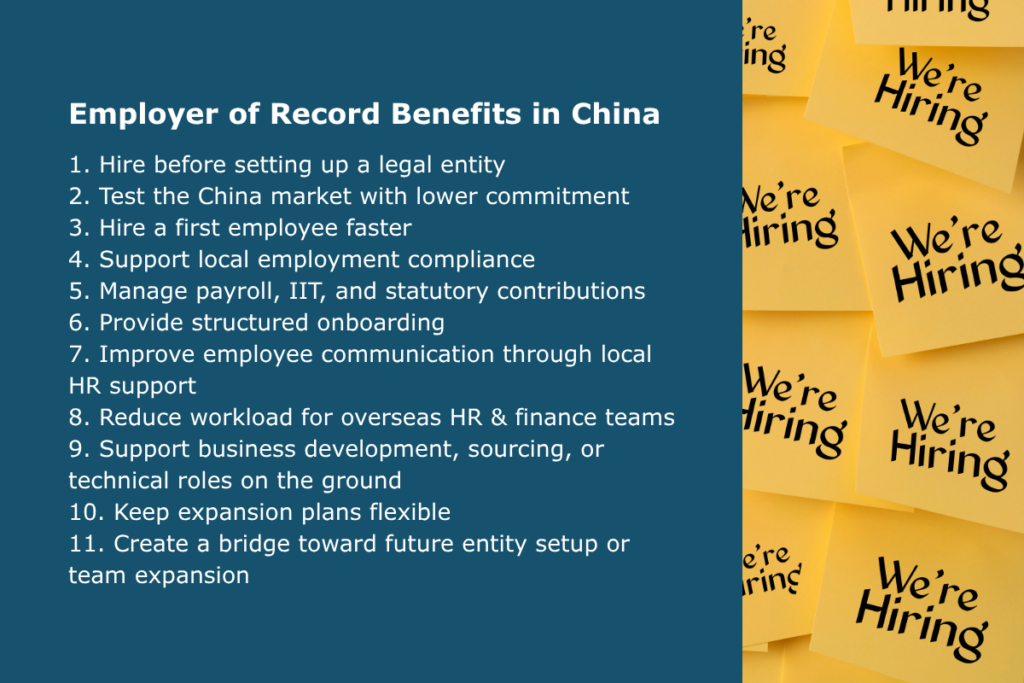
Using an EOR in China can provide a practical route to local hiring when a company is not yet ready to establish its own legal entity.
How to Decide Whether EOR Fits Your China Hiring Plan
Before using an EOR in China, companies should answer five practical questions.
|
Question |
Why it matters |
| What role are you hiring? | Determines whether the position fits an EOR structure |
| How long will the employee stay? | Helps assess whether EOR is temporary, transitional, or long term |
| Who will manage the employee daily? | Clarifies responsibility between the client and EOR partner |
| Will the team grow? | Helps decide whether future entity setup may be needed |
| What local support does the employee need? | Defines the level of HR communication, onboarding, and payroll support required |
A good decision should connect the hiring model with the company’s China roadmap. EOR works best when the company needs flexibility, local employment administration, and practical support before committing to a larger structure.
How VVR International Supports EOR Hiring in China
VVR International supports international companies with recruitment, EOR, HR outsourcing, payroll coordination, employment administration, and employee lifecycle support in China. Our Recruitment & Incubation solution combines recruitment with a legal EOR structure, compliant contracts, mandatory social benefits, labor law compliance support, and ongoing HR administration.
A key differentiator is VVR International’s official Labor Dispatch License issued by the PRC government. This supports a licensed local employment structure for companies hiring local or expatriate employees in China. VVR International can support companies using EOR for first hire, small team, market testing, sourcing coordination, business development, or transition planning. Our China-based support helps both headquarters and employees manage employment administration with clearer communication.
Conclusion
Employer of record benefits in China are strongest when they are linked to a clear business use case. EOR can help companies hire before setting up an entity, test the market, manage payroll and employment administration, support local employees, and keep expansion plans flexible. The model works best for first hires, small teams, early market entry, local business development, sourcing coordination, or transitional phases before entity setup. It may be less suitable when the company needs a large permanent team, specific business licenses, or deeper operational control.
VVR International helps international companies evaluate whether EOR fits their China hiring plan and supports local employment execution through recruitment, EOR, payroll coordination, HR administration, and employee lifecycle follow-up. Contact VVR International to discuss the right hiring structure for your China team.
FAQs
- What are the main benefits of an employer of record?
The main benefits of an employer of record include faster hiring, local employment administration, payroll and benefits support, compliance coordination, lower setup commitment, employee HR support, and flexibility before setting up a local entity.
- Is EOR useful for hiring a first employee in China?
Yes. EOR can be useful when a company wants to hire its first China-based employee before setting up a local entity. This can support market testing, sales development, sourcing coordination, or local project follow-up.
- Can EOR help companies test the China market?
Yes. EOR can help companies test the China market by hiring locally with lower setup commitment. A China-based employee can help validate demand, meet customers, coordinate suppliers, and provide market feedback before the company invests in a permanent structure.
- When should a company use EOR instead of setting up an entity?
A company may use EOR when it needs to be hired locally but is not ready to establish a legal entity. This is common for first hires, small teams, market testing, or transitional hiring before a larger China structure is approved.
- What are the limits of using an EOR in China?
EOR may be less suitable for large-scale operations, activities requiring specific business licenses, complex local management structures, or long-term operations requiring full local control. In these cases, setting up a local entity may become more appropriate.
Related Posts


Shanghai, Chine
7888 Humin Road, Minhang District
+86 21 3422 7164 103
contact@vvrchina.com

Guangzhou, China
Merchants City Home
495 Hanxi East Road,
Panyu District
+86 20 8332 1024
contact@vvrchina.com

Shijiazhuang, China
368 XinShi Bei Road,
Zhenxin Industry District
+86 3118 381 0103
contact@vvrchina.com

Sao Paulo, Brésil