How to Choose a Global Employer of Record Partner in China
Choosing a global employer of record partner in China requires more than checking international coverage. For companies hiring China-based employees, the right partner should combine global hiring standards with local employment knowledge, bilingual HR communication, and practical employee support on the ground.
An EOR can help companies hire faster, manage local employment administration, and support early market entry before setting up a legal entity. However, China requires careful local execution. Companies should verify how employment is legally structured, whether the provider has the appropriate local license or licensed employment arrangement, and how employment documents, HR communication, onboarding, employee questions, and lifecycle follow-up are managed.
This guide explains when companies need a global employer of record partner in China, the 8 criteria to check before choosing one, which red flags to avoid, and how local EOR support can help companies manage China-based employees more effectively.
Key Insights
|
When Do Companies Need a Global Employer of Record Partner in China?
International companies usually consider a global employer of record partner in China when they want to hire locally but are not ready to create a legal entity. This can happen during market testing, early sales development, sourcing coordination, technical support, or first-stage business expansion.
For example, a company may need one China-based employee to meet customers, manage local suppliers, support distributors, or coordinate projects. However, setting up a local entity may take time, budget, and internal approval. In this situation, an EOR structure can provide a practical route to hire while keeping the company’s market entry plan flexible.
Many companies first look for a global EOR partner because they want international hiring consistency. A global model may help centralize processes, contracts, and reporting across markets. However, for China-based hires, companies should also check how the provider manages local HR communication, documentation, and employee follow-up.
Using EOR does not remove the need for a clear process. The employee still needs onboarding, reporting lines, HR communication, employment documentation, and local support. This is why choosing the right EOR partner matters from the beginning.
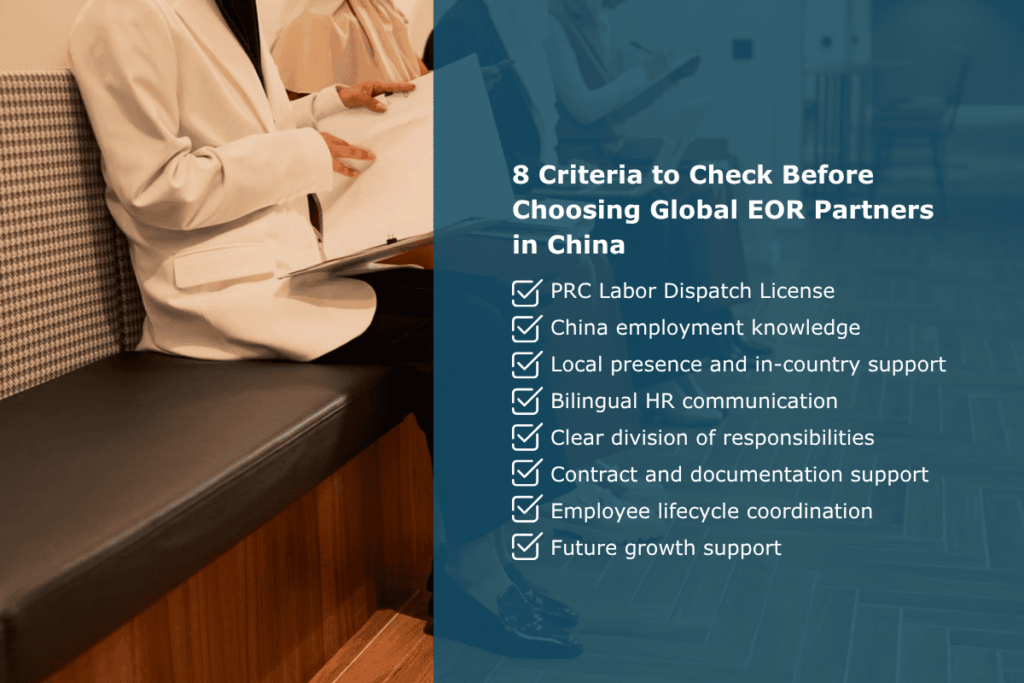
Key criteria international companies should consider when choosing a global employer-of-record partner in China.
8 Criteria to Check Before Choosing a Global Employer of Record Partner in China
Before choosing an EOR provider, companies should review whether the partner can support both global hiring standards and China-specific execution. The following criteria can help international companies evaluate the right fit.
1. Labor Dispatch License and legal employment structure
Before choosing an EOR partner in China, companies should verify how the employment arrangement is legally structured. This includes checking whether the provider holds an official PRC Labor Dispatch License or works through an appropriate licensed employment structure in China.
This matters because EOR support is not only about payroll or contract administration. The provider should be able to explain who legally employs the worker, how the employment structure works, and how local employment administration is handled.
A reliable partner should make this structure clear before the employee is hired. This helps headquarters understand the legal setup, reduces uncertainty for the employee, and supports a more secure employment arrangement in China.
Key questions to ask:
- Does the provider hold an official PRC Labor Dispatch License or work through an appropriate licensed local structure?
- Who is the legal employer of the China-based employee?
- Can the provider explain how the employment structure works in practice?
2. China employment knowledge
The partner should understand local employment practices, HR expectations, required documents, and employee communication norms in China.
This matters because employment practices in China may differ from the company’s home market. Contract coordination, onboarding, social insurance, employee questions, employment changes, and offboarding all require local understanding.
A strong EOR partner should be able to explain these requirements clearly to both headquarters and the employee. This helps reduce assumptions and prevents confusion during the hiring process.
Key questions to ask:
- Does the partner understand China-specific employment procedures?
- Can they explain local HR requirements clearly to foreign headquarters?
- Can they support employment changes, onboarding, and offboarding?
3. Local presence and in-country support
A global employer of record partner in China should have real local execution capacity. Some employment questions require fast communication with employees, local teams, or local authorities.
If the provider operates through a global platform, companies should check whether China support is handled by an in-country team, a local partner, or a centralized offshore support model. This distinction matters because employee experience depends on response time, language clarity, and local understanding.
A partner with in-country support can respond more quickly when questions arise. This can be especially useful for first hires, senior hires, or employees working closely with overseas managers.
Key questions to ask:
- Does the partner have a local team in China?
- Can they communicate directly with China-based employees?
- Is China support handled locally or through a centralized global team?
- Can they provide practical support during onboarding and follow-up?
4. Bilingual HR communication
Bilingual HR communication is one of the most important factors when hiring in China. Even when the employee works in English, HR topics may still require Chinese explanation.
Employment documents, benefits, payroll questions, onboarding steps, and local HR policies can be sensitive. If communication is unclear, the employee may feel confused or disconnected. At the same time, headquarters may struggle to understand China-specific questions.
A strong EOR partner should bridge this gap. They should help the employee understand local documents and processes. They should also help the foreign company understand local HR expectations.
Key questions to ask:
- Can the partner communicate with employees in Chinese and with headquarters in English?
- Can they explain HR documents and processes clearly?
- Can they help reduce misunderstanding between the employee and overseas manager?
5. Clear division of responsibilities
A good EOR arrangement requires a clear responsibility split. The client company manages the employee’s daily work, objectives, and performance. The EOR partner supports local employment administration, HR coordination, and employment-related documentation.
If this division is unclear, the employee may not know who to contact. The manager may also assume the EOR is handling topics that actually require company input.
Before choosing a partner, companies should clarify who manages each part of the employee journey. This includes onboarding, contract questions, payroll topics, HR communication, performance feedback, role changes, and offboarding.
Key questions to ask:
- Who manages the employee’s daily work and performance?
- Who explains employment documents and local HR processes?
- Who handles employee questions, employment changes, and offboarding?
- How are responsibilities communicated to the employee?
6. Contract and documentation support
Contract and documentation support should be structured, accurate, and easy to understand. In China, employment administration requires careful handling of documents and employee records.
The employee needs clear information about the employment structure. The company also needs proper internal records for HR, finance, and management purposes.
A reliable EOR partner should guide the company through the documentation process. They should explain what is needed, when it is needed, and how documents should be managed. This is especially important when the headquarters team is not familiar with China employment practices.
Key questions to ask:
- What documents are required before the employee starts?
- How does the partner manage employment records?
- Can the partner explain documents to both the employee and headquarters?
- How does the partner support documentation during role changes or offboarding?
7. Employee lifecycle coordination
EOR support should not stop after the employee starts. A China-based employee may need support during onboarding, probation, role changes, salary updates, HR questions, and offboarding.
This is especially important for remote employees or employees managed by a team outside China. Without regular support, the employee may feel isolated or unsure about HR processes.
A strong EOR partner should provide employee lifecycle coordination. This means supporting the employee from onboarding to ongoing HR follow-up and, when needed, exit coordination.
Key questions to ask:
- Does the partner support onboarding after the contract is signed?
- Can they respond to employee HR questions during the employment period?
- Can they support probation follow-up, role changes, and offboarding?
- How do they keep headquarters informed?
8. Future growth support
Many companies start with one employee in China, then expand into a small team. For this reason, EOR should not be treated as an isolated HR tool. It should fit the company’s broader China roadmap.
The right partner should help the company think beyond the first hire. They should understand whether the company may need a larger team, stronger local presence, or a more permanent structure in the future.
This does not mean every company using EOR must change its structure later. However, the partner should be able to support growth if the China operation expands.
Key questions to ask:
- Can the partner support team growth over time?
- Can they help the company understand when a larger structure may become relevant?
- Can they support transition planning if the company changes its approach?
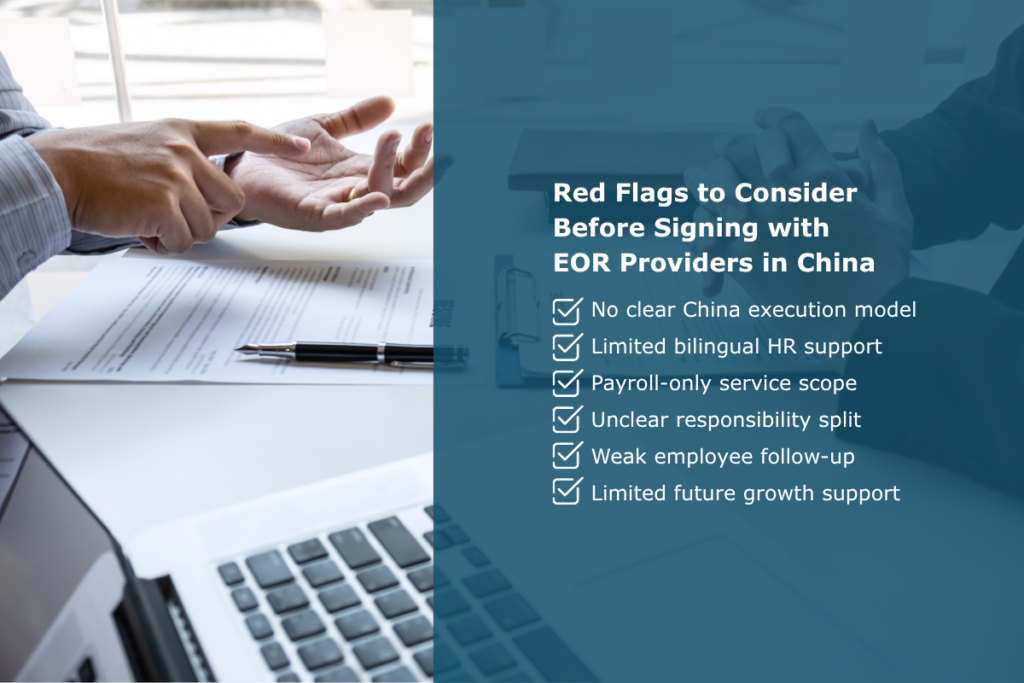
Before selecting an EOR provider in China, companies should review potential red flags related to local execution, communication, and employee support.
Red Flags to Watch Before Signing with an EOR Provider in China
Choosing an EOR partner should not be based only on price, brand recognition, or international coverage. Companies should also watch for signs that the provider may not offer enough local support.
Here are some common red flags:
- The provider promotes global coverage but cannot clearly explain its China execution model.
- The provider cannot clearly explain how employment is structured in China.
- The provider offers limited bilingual HR communication.
- The provider focuses only on payroll and contract setup, with little employee follow-up.
- The responsibility split between the company and the EOR partner is unclear.
- The provider cannot explain how employee questions, changes, or offboarding will be handled.
- The provider has limited understanding of the company’s China market entry plan.
- The provider cannot support future team growth or transition planning.
In conclusion, these red flags do not always mean the provider is unsuitable. However, they should prompt further questions before signing.
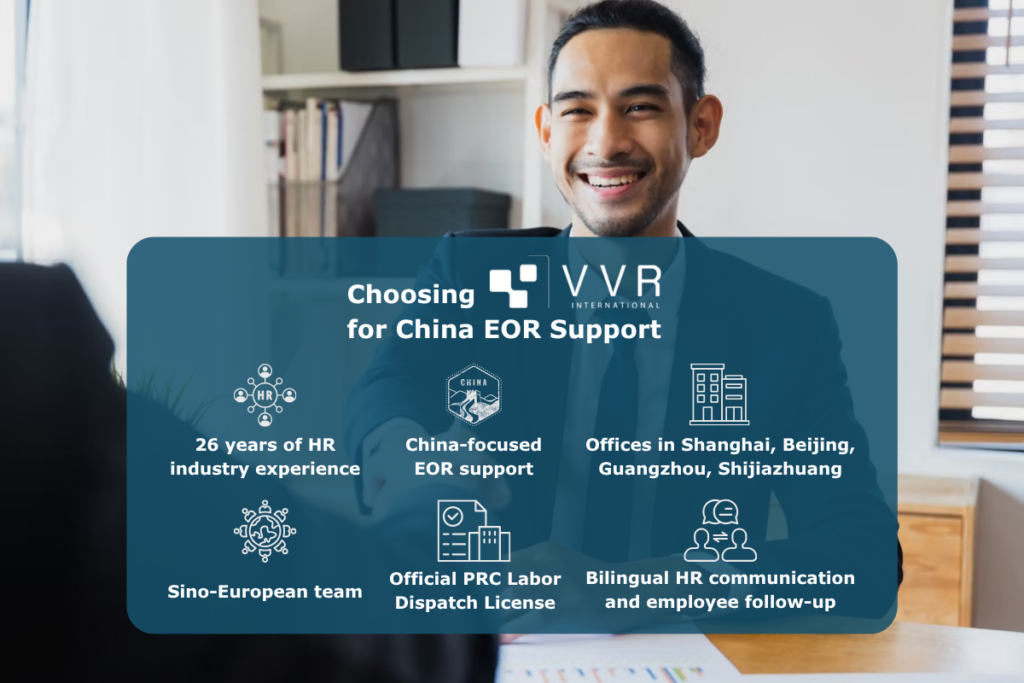
VVR International supports international companies in China with local EOR execution, bilingual HR coordination, and employee lifecycle follow-up.
Why Companies Choose VVR International for China EOR Support
VVR International supports international companies hiring in China through China-focused EOR support, recruitment coordination, local employment administration, HR communication, and employee lifecycle follow-up.
With 26 years of HR industry experience, VVR International combines local execution with international business standards. Our Sino-European team helps foreign companies manage hiring and employment coordination with a clearer understanding of China’s business environment.
VVR International is also one of the few non-Chinese firms holding an official PRC Labor Dispatch License. This allows us to legally employ local and expatriate staff in China through a secure and approved structure.
Clients benefit from direct support through our offices in Shanghai, Beijing, Guangzhou, and Shijiazhuang. This local presence helps us support both headquarters and China-based employees throughout the employment lifecycle.
Our role goes beyond employment administration. We help companies create a smoother experience for China-based employees, especially when the manager or HR team is overseas. This includes onboarding coordination, bilingual communication, HR follow-up, and practical support when employee questions arise.
This local HR coordination helps reduce misunderstanding between headquarters and employees. It also helps employees feel better supported after day one, which can improve confidence, engagement, and early performance.
Conclusion
Choosing a global employer of record partner in China is not only about finding a provider that can issue contracts and process payroll, but companies also need a partner that understands local employment practices, bilingual communication, documentation, employee follow-up, and future growth needs.
For international companies, the right EOR partner can make first stage hiring in China more structured and easier to manage. It can also help headquarters support China-based employees with more clarity.
A global EOR model can be useful for international hiring consistency. However, China hiring still requires strong local execution. The quality of this execution will strongly influence employee experience and the company’s ability to manage the hire effectively.
VVR International helps companies evaluate the right hiring structure for their China team. Contact us to discuss your hiring plans and build a smoother employment process in China.
FAQs
- What is a global employer of record partner in China?
A global employer of record partner in China helps international companies hire China-based employees before setting up a local entity. The EOR partner supports local employment administration, while the client company manages the employee’s daily work, goals, and performance.
- When should a company use a global EOR partner in China?
A company may use a global EOR partner in China when hiring its first local employee, testing the market, or building a small local team before creating a larger local structure. EOR is useful when the company needs flexibility and structured local employment support.
- How do you choose a global employer of record partner in China?
Companies should check China employment knowledge, local presence, bilingual HR communication, contract and documentation support, responsibility split, employee lifecycle coordination, and future growth support.
- Why is local support important when using a global EOR partner in China?
Local support helps China-based employees understand employment documents, HR processes, and local expectations. It also helps foreign headquarters understand China-specific questions and reduce misunderstanding.
Related Posts


Shanghai, Chine
7888 Humin Road, Minhang District
+86 21 3422 7164 103
contact@vvrchina.com

Guangzhou, China
Merchants City Home
495 Hanxi East Road,
Panyu District
+86 20 8332 1024
contact@vvrchina.com

Shijiazhuang, China
368 XinShi Bei Road,
Zhenxin Industry District
+86 3118 381 0103
contact@vvrchina.com

Sao Paulo, Brésil