EOR Compliance in China: Payroll & Employer Duties
EOR compliance in China covers how a China-based employee is legally employed, paid, taxed, insured, and supported throughout the employment lifecycle. For international companies, an Employer of Record can help hire locally before setting up a legal entity. However, the company still needs to verify the employment structure, Labor Dispatch License or licensed arrangement, responsibility split with the EOR partner. This guide explains what an EOR partner handles in China, what remains with the client company, and which compliance risks to check before hiring.
| Quick answer
What does EOR compliance mean in China? EOR compliance in China means managing the local employment requirements connected to a China-based employee. This includes the employment structure, labor contract, payroll administration, IIT withholding, social insurance, housing fund, benefits administration, employee documentation, onboarding, role changes, and offboarding. In an EOR arrangement, the EOR partner usually acts as the local employment administrator or legal employer under the relevant structure. The client company remains responsible for managing the employees’ work, tasks, reporting line, business goals, and performance expectations. The practical goal is that the employee should be hired through a locally compliant structure, receive accurate salary and benefits administration, and have access to clear HR communication during the employment period. |
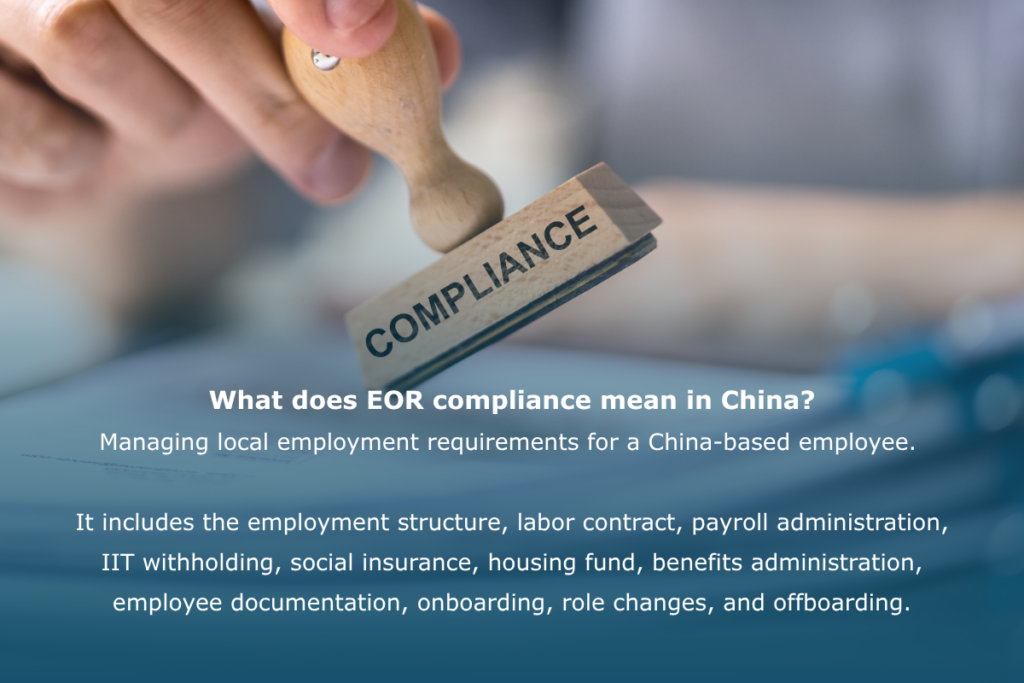
EOR compliance involves coordinating the key local employment requirements that apply throughout a China-based employee’s lifecycle.
Why EOR Compliance in China Requires a Clear Employment Structure
Before choosing an EOR provider in China, companies should first understand how the employment relationship will be structured. This is the foundation of EOR compliance. A reliable provider should explain who legally employs the worker, how the contract is issued, how payroll is processed, and how employment records are maintained. This matters because an EOR is not only a payroll tool. It is an employment structure that affects contracts, statutory contributions, employee communication, and lifecycle management.
Companies should also verify whether the provider holds an official PRC Labor Dispatch License or works through an appropriate licensed employment arrangement. VVR International states that it holds an official Labor Dispatch License issued by the PRC government, which allows it to support legal employment structures for local and expatriate staff in China. This verification step helps foreign headquarters avoid uncertainty. It also gives the employee a clearer understanding of the employment relationship, the HR contact point, and the structure supporting their employment in China.
Core EOR Compliance Areas in China
EOR compliance in China extends across several stages of the employment lifecycle, from hiring and onboarding to payroll and ongoing workforce administration. The following are the core compliance areas foreign companies should pay particular attention to when working with an EOR partner.
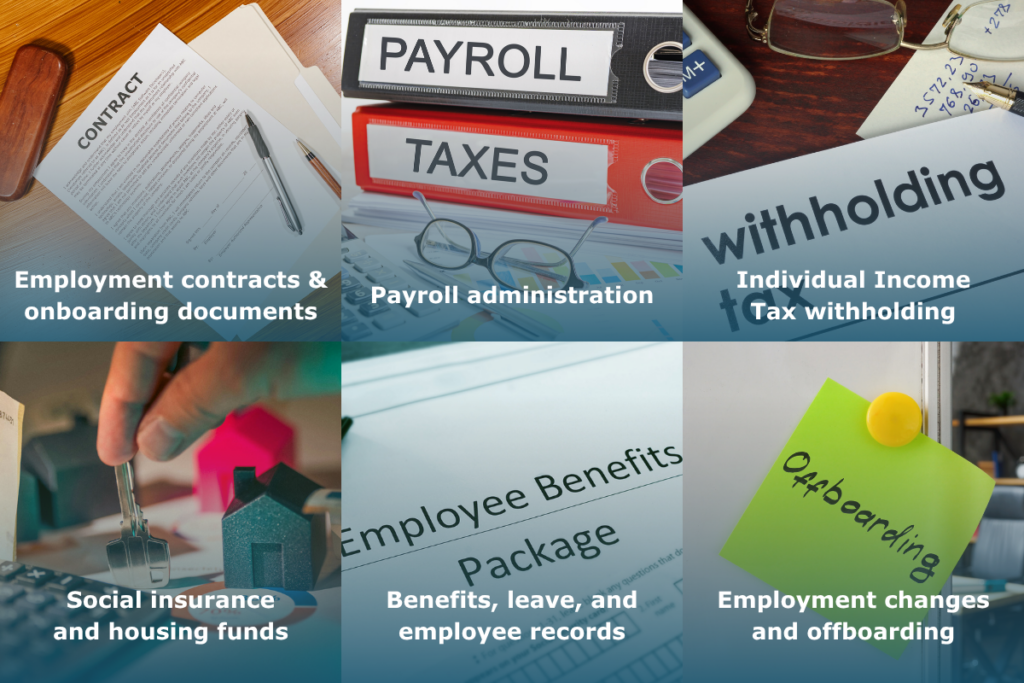
EOR compliance in China covers the full employment lifecycle, from contracts and onboarding to payroll, statutory contributions, employee records, and offboarding.
Employment contracts and onboarding documents
Employment documentation is one of the first compliance areas to review. China’s Labor Contract Law states that when a labor relationship is established and no written labor contract has been concluded at that time, the contract should be concluded within one month from the employment start date. For companies using EOR partners, this means the onboarding process should be structured before the employee starts. The EOR partner should explain which documents are required, who prepares them, who signs them, and how the employee will receive guidance on the employment structure.
The client company should also align role title, job scope, salary terms, reporting line, working location, probation terms, benefits, and onboarding expectations before the contract process begins.
Payroll administration
Payroll compliance covers monthly salary calculation, salary payment, deductions, statutory contributions, payroll records, pay slips, and employee payroll questions.
A China EOR partner should help headquarters understand the difference between gross salary, net salary, employer cost, statutory contributions, and service fees. This is especially important for foreign companies hiring their first employee in China, as the total monthly employment cost may differ from the gross salary agreed in the offer.
Payroll also depends on accurate inputs. These may include salary, bonus, allowances, reimbursements, working days, leave, contribution base, city requirements, and employee tax information. A structured monthly payroll calendar helps prevent delays and misunderstandings.
Individual Income Tax withholding
Individual Income Tax, or IIT, is a core part of payroll compliance in China. For salary and wage income paid to resident individuals, China’s State Taxation Administration states that withholding agents calculate tax using the cumulative withholding method and file the withholding return monthly.
For an EOR arrangement, companies should check how the partner manages IIT withholding, reporting, employee tax-related questions, and annual reconciliation support where relevant. The EOR partner should also explain what information the employee may need to provide and how tax-related matters are communicated.
The client company should avoid making assumptions about net salary, allowances, or reimbursement treatment without payroll review. Salary structure should be clarified before onboarding because it affects payroll calculation, employee expectation, and internal budgeting.
Social insurance and housing funds
China employment compliance also includes statutory contributions. These usually include pension, medical care, unemployment, work injury, maternity insurance, and the housing fund, often referred to in practice as “five social insurances and one housing fund.” Shanghai’s tax authority refers to combined declaration procedures for social insurance contributions, including pension, medical care, unemployment, work injury, maternity, and housing fund contribution wages.
For foreign companies, the key issue is that social insurance and housing fund coordination can vary by city. Contribution bases, local procedures, and administration requirements should be checked based on the employee’s location and employment arrangement.
An EOR partner should provide a clear employer cost breakdown and explain how contributions are handled. This helps headquarters budget correctly and helps employees understand their benefits.
Benefits, leave, and employee records
Benefits administration includes statutory benefits, paid leave records, sick leave coordination, employee files, employment changes, and HR documentation. These items may look administrative, but they support employment compliance and employee experience.
A China-based employee should understand where to ask questions about salary, benefits, leave, documents, or HR procedures. Headquarters should also receive clear records for finance, HR, and management purposes. This is where local HR communication becomes important. Even when the employee works in English, HR topics may require Chinese-language explanation to avoid confusion.
Employment changes and offboarding
EOR compliance continues after onboarding. Employees may go through probation review, salary updates, role changes, location changes, bonus payments, performance concerns, resignation, or termination. Each change should be coordinated properly between the client company and the EOR partner. The client company provides business input, while the EOR partner supports local employment administration and documentation.
Offboarding requires particular care. Final salary, unused leave, documents, equipment return, handover, and employment records should be managed through a clear process. A strong EOR partner should help both headquarters and the employee understand the steps involved.
EOR vs. Client Company: Who Is Responsible for What?
A good EOR arrangement depends on a clear responsibility split. The EOR partner supports local employment administration. The client company manages the employee’s role, performance, and business contribution.
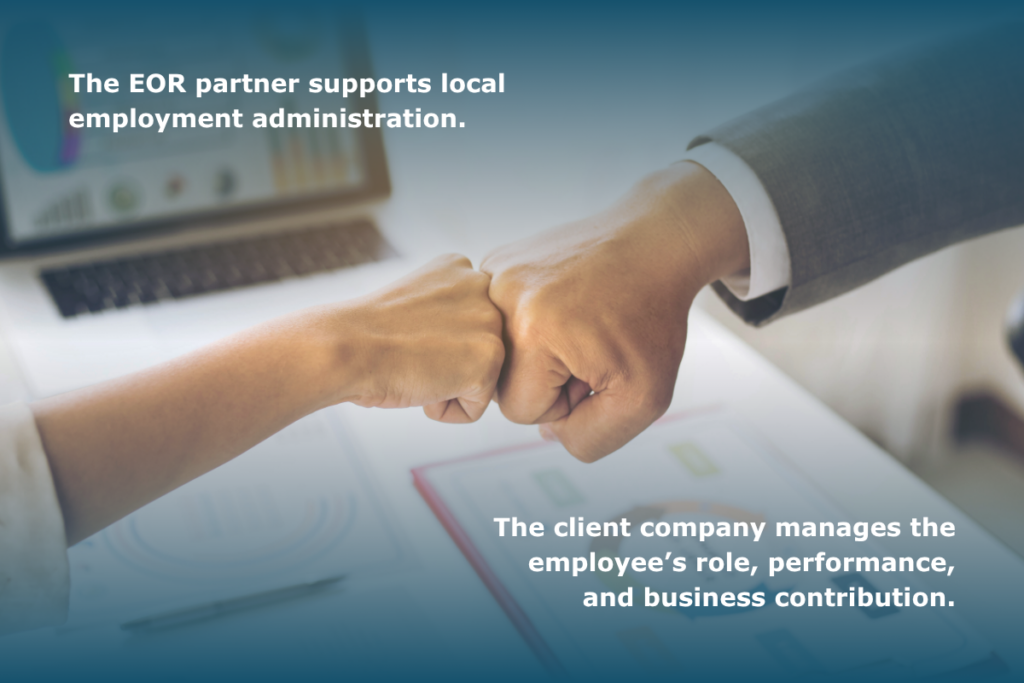
The EOR partner supports local employment administration, while the client company remains responsible for the employee’s day-to-day role, performance, and contribution to the business.
| Area | Usually handled by EOR partner | Usually handled by client company |
| Legal employment structure | Yes | Review and approval |
| Labor contract and employment documents | Yes | Role and offer input |
| Monthly payroll calculation | Yes | Payroll input approval |
| IIT withholding coordination | Yes | Provide required employee or compensation information |
| Social insurance and housing fund coordination | Yes | Budget approval |
| Pay slip and payroll reporting | Yes | Internal review |
| Daily work management | No | Yes |
| Business targets and priorities | No | Yes |
| Performance feedback | Support documentation if needed | Yes |
| Role changes | Documentation and HR coordination | Business decision and approval |
| Offboarding | HR process and documentation | Business reasons, timing, and internal decision |
This split should be explained to the employee before or during onboarding. It helps the employee know who to contact and helps headquarters avoid gaps between business management and employment administration.
Compliance Risks to Check Before Choosing an EOR Partner
Companies should review potential compliance risks before signing with an EOR provider in China.
- Unclear legal employment structure
The provider should explain who legally employs the worker, what structure is used, and how the employment documents are managed. A vague explanation at this stage can create confusion later.
- No clear explanation of Labor Dispatch License or licensed arrangement
Companies should ask whether the provider holds an official PRC Labor Dispatch License or works through an appropriate licensed local structure. This should be treated as a verification criterion, not a secondary detail.
- Limited local HR communication
A global platform may provide standardized processes, but China-based employees often need local HR explanations. Bilingual communication helps reduce misunderstanding between the employee, headquarters, and the EOR partner.
- Payroll handled separately from HR documentation
Payroll, benefits, contracts, and employee records should work together. If payroll is separated from HR documentation, the company may face inconsistent information and unclear employee support.
- Weak city-level contribution coordination
Social insurance and housing fund matters can vary by city. The provider should be able to explain how local contribution requirements are checked and administered for the employee’s location.
- Limited employee lifecycle support
EOR support should continue after the contract is signed. Companies should verify whether the provider supports onboarding, probation follow-up, salary changes, HR questions, and offboarding.
How VVR International Supports EOR Compliance in China
VVR International supports international companies hiring in China through recruitment, EOR, HR outsourcing, payroll coordination, local employment administration, and employee lifecycle support. Our Recruitment & Incubation service includes recruitment combined with a legal EOR structure, compliant contracts, mandatory social benefits, and labor law compliance support.
A key differentiator is VVR International’s official PRC Labor Dispatch License. This helps companies structure employment locally through a secure and approved arrangement, while receiving support from a China-focused team.
VVR International also supports the practical side of EOR compliance. This includes bilingual communication, employment documentation, onboarding coordination, payroll follow-up, and support for employee questions during the employment period.
For foreign headquarters, this local support helps make the employment arrangement clearer and easier to manage. For China-based employees, it creates a more structured HR experience from onboarding to ongoing employment support.
Conclusion
EOR compliance in China should be evaluated as a complete employment operating structure. Companies should review the legal employment arrangement, labor contract process, payroll administration, IIT withholding, social insurance and housing fund coordination, benefits, documentation, employee lifecycle support, and responsibility split with the client company.
The right EOR partner gives headquarters a clear view of how employment is structured and gives the employee reliable HR support in China. This is especially important for first hires, small local teams, market testing, sourcing coordination, business development, and early-stage expansion.
VVR International helps companies evaluate the right hiring and EOR structure for China-based employees. Contact VVR International to discuss your China hiring plan and build a compliant employment process.
FAQs
- Does an EOR handle payroll and tax compliance in China?
An EOR partner usually supports payroll administration, salary payment, IIT withholding coordination, statutory contribution administration, payslips, and payroll reporting. Companies should confirm the exact scope before signing.
- Why should companies check the Labor Dispatch License when choosing an EOR partner in China?
Companies should check the Labor Dispatch License because it helps clarify how the employment arrangement is structured locally. A reliable provider should explain whether it holds or works through an appropriate licensed structure, who legally employs the worker, and how employment administration is managed.
- What responsibilities remain with the client company?
The client company usually remains responsible for the employee’s daily work, business objectives, reporting line, performance expectations, and internal management. The EOR partner supports local employment administration and HR coordination.
- Why is local China support important for EOR compliance?
Local China support helps manage employment documents, payroll questions, benefits explanations, employee communication, and lifecycle changes. It also helps foreign headquarters understand China-specific HR requirements more clearly.
Related Posts


Shanghai, Chine
7888 Humin Road, Minhang District
+86 21 3422 7164 103
contact@vvrchina.com

Guangzhou, China
Merchants City Home
495 Hanxi East Road,
Panyu District
+86 20 8332 1024
contact@vvrchina.com

Shijiazhuang, China
368 XinShi Bei Road,
Zhenxin Industry District
+86 3118 381 0103
contact@vvrchina.com

Sao Paulo, Brésil