Hiring International Employees in China: How to Build Global Teams Without Borders
1. Introduction
China remains one of the most strategically important markets for companies building global teams. It is home to the world’s largest manufacturing base, a rapidly growing technology talent pool, and a consumer market that demands local presence to serve effectively. Yet for HR leaders and founders approaching China for the first time, the employment landscape can feel genuinely complex.
Hiring international employees in China involves navigating layers of regulation that have no equivalent in Western markets: a national labor law framework that strongly favors employees, city-specific social insurance contribution rates, a tiered work permit system for foreign nationals, and strict data privacy obligations that affect how you manage employee information.
In this guide, our VVR experts explain the legal options available, walk through the step-by-step process of hiring in China, cover work permit and visa requirements for foreign employees, and highlight the compliance considerations that catch international companies off guard.
2. Understanding the Landscape: Two Types of International Hiring in China
When companies talk about hiring international employees in China, they are typically referring to one of two distinct situations, and the requirements for each are very different.
- Hiring Chinese nationals as part of an international team: A foreign company brings Chinese employees onto its global workforce, employing them locally under Chinese law. This is the most common scenario for companies expanding into China.
- Relocating foreign nationals to work in China: A company transfers an employee from another country, or hires a foreign candidate directly, to work on the ground in China. This triggers work permits and visa requirements.
Both scenarios require a compliant employment structure in China. The key question is always the same: who is the legal employer? Foreign companies generally need a compliant employment structure, such as a local entity or licensed EOR arrangement, to hire staff in China.
3. Legal Options for Hiring International Employees in China
Before making an offer, companies need to choose the right employment structure. This decision affects speed, cost, control, and long-term compliance.
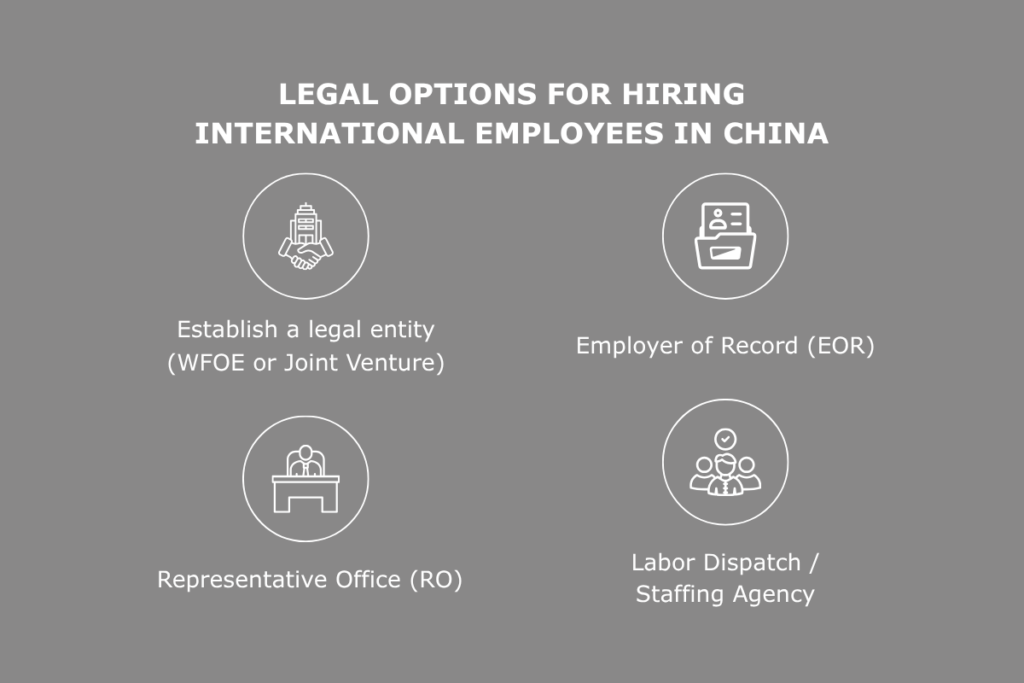
Companies can hire in China through several legal structures, including a WFOE, Employer of Record, Representative Office, or staffing agency.
Option 1: Set up a legal entity (WFOE or Joint Venture)
A Wholly Foreign-Owned Enterprise (WFOE) is the most common structure for foreign companies that want direct operational control in China. It allows the company to sign contracts, generate local revenue, and directly employ staff under Chinese labor law.
The limitations are well-known: setup takes 6 to 12 months, costs between $15,000 and $50,000 in professional fees, and requires ongoing compliance investment in auditing, tax filing, and registered capital management. For companies at the early stages of China entry, this commitment is often premature.
Option 2: Employer of Record (EOR)
An Employer of Record is the fastest and most compliant route for hiring international employees in China without establishing a local entity. The EOR becomes the legal employer of record, handling payroll, social insurance contributions, labor contract execution, and tax withholding — while the client company keeps full operational direction of the employee’s work.
For companies hiring overseas employees in China for the first time, or testing the market before committing to a WFOE, EOR is the standard professional approach. Onboarding typically takes 2 to 6 weeks.
Learn more about how EOR simplifies recruitment in China now!
Option 3: Representative Office (RO)
A Representative Office allows a foreign company to prove a limited presence in China without full incorporation. However, ROs face significant restrictions: they cannot sign commercial contracts, generate revenue, or directly employ more than a small number of staff (typically managed through a licensed dispatch agency).
ROs are proper for market research, liaison activities, and supporting a physical presence, not for building a functional operating team.
Option 4: Labor Dispatch / Staffing Agency
Labor dispatch is a historically common model in China where a staffing agency acts as the formal employer while the worker runs at a client company. Following 2013 labor reforms, its use has been restricted, such as: dispatched workers can only be placed in temporary, auxiliary, or substitute roles, and cannot exceed 10 percent of a company’s total workforce.
For international companies hiring core team members, labor dispatch is restricted for core long-term workforce planning and should be assessed carefully under current regulations. Thus, the EOR still remains in the appropriate structure.
Why Companies Choose VVR International for Hiring in China
With 26 years of HR industry experience, VVR International helps international companies hire and scale teams in China through a strong Sino-European team that understands both local execution and international business expectations.
We are one of the few non-Chinese firms holding an official PRC Labor Dispatch License, allowing us to legally employ local and expatriate staff across China through a secure and compliant structure.
Clients also receive help from 5-star customer service and direct operational support through our offices in Shanghai, Beijing, Guangzhou, and Shijiazhuang.
4. How to Hire International Employees in China: Step-by-Step
Once the hiring model is clear, the next priority is execution. A structured onboarding process helps companies avoid delays and early compliance mistakes.
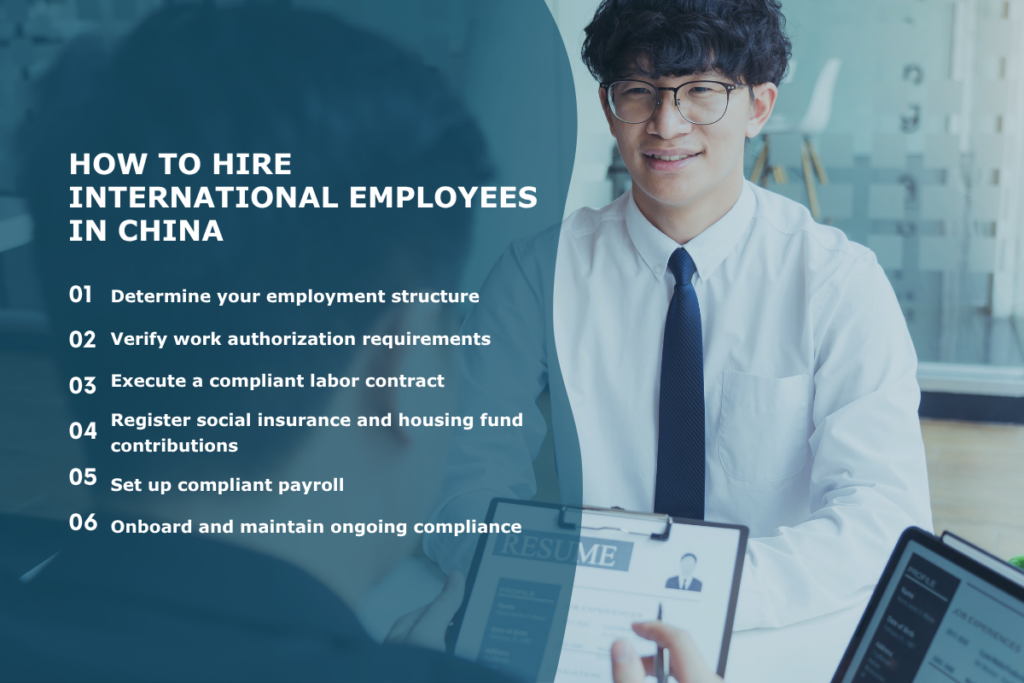
A successful hiring process in China starts with the right employment structure, legal contracts, payroll setup, and ongoing compliance management.
-
Step 1: Determine your employment structure
Before anything else, decide whether you will hire through a WFOE, EOR, or another structure. For most companies in the early stages of China expansion, EOR is the fastest compliant path. If you already have a WFOE, you can employ it directly.
-
Step 2: Verify work authorization requirements
For Chinese nationals, no work authorization is needed. For foreign nationals, decide which work permit category applies (see the Work Permit section below) and begin documentation collection early—the process takes a minimum of 4 to 6 weeks.
-
Step 3: Execute a compliant labor contract
Chinese law requires a written labor contract within one month of employment commencement. The contract must follow the Labor Contract Law and should be bilingual (Chinese and English) if the employee is a foreign national. The Chinese version governs in all legal disputes.
Key terms to specify, including job title and duties, work location, compensation, probation period (if applicable), working hours arrangement, and confidentiality obligations.
-
Step 4: Register social insurance and housing fund contributions
Employers must register new employees with local social insurance and housing provident fund authorities. Contributions begin from the first month of employment. Rates vary by city, see the contribution table in the Compliance section below.
-
Step 5: Set up compliant payroll
Salaries in China must be paid in RMB. Employers must withhold an Individual Income Tax (IIT) at the source. For foreign employees, the tax treatment depends on their residency status and any applicable double-taxation treaties between China and their home country.
-
Step 6: Onboard and maintain ongoing compliance
Ongoing obligations include monthly payroll and tax filings, annual IIT reconciliation, social insurance payment records, and adherence to labor law requirements around working hours, leave entitlements, and termination procedures.
5. Work Permit and Visa Requirements for Foreign Employees in China
China introduced a points-based work permit system in 2017, replacing the earlier two-tier system with a three-category framework. Foreign nationals require a work permit to be legally employed in China.
|
Category |
Profile |
Typical Process Time |
| Category A | High-end talents: Nobel laureates, globally recognized experts, senior executives of MNCs | Expedited; often 15 working days |
| Category B | Professionals meeting point-based criteria: education, salary threshold, age, work experience | 15–20 working days |
| Category C | Non-skilled or service roles; subject to quotas and stricter review | 20–30 working days |
Most professional hires for international companies fall into Category B. Key requirements for Category B work permits include:
- Bachelor’s degree or above (Master’s or higher preferred and awarded added points)
- At least two years of relevant professional work experience
- Salary meeting or exceeding the local minimum threshold (typically set by each city)
- Criminal background check from home country (apostilled and translated)
- Medical examination certificate from a designated Chinese medical facility
- No criminal record in China
Processing typically takes 15 to 20 working days once a complete documentation package is submitted. The work permit must be obtained before the employee’s work visa (Z-visa) is issued, and both must be secured before the employee begins working in China.
6. Key Compliance Considerations When Hiring in China
China hiring compliance goes far beyond payroll. Employers need to manage tax, insurance, contracts, and employee data correctly from day one.
Social insurance and housing fund contributions
All employees in China, including foreign nationals in most cities, must be enrolled in the mandatory social insurance system and housing provident fund. Contribution rates vary by city and are adjusted periodically. The table below reflects approximate rates based on common major cities; always verify current local rates before budgeting.
| Insurance Type | Employer Contribution (approx.) | Employee Contribution (approx.) |
| Pension | 16% | 8% |
| Medical insurance | 8–10% | 2% |
| Unemployment insurance | 0.5–1% | 0.5% |
| Work injury insurance | 0.2–1.9% | 0% |
| Maternity insurance | 0.5–1% | 0% |
| Housing provident fund | 5–12% | 5–12% |
For employers budgeting labor costs in China, add approximately 35 to 45 percent on top of gross salary to account for total employer-side contributions. This varies by city and salary level.
Individual Income Tax (IIT)
China uses a progressive IIT system with rates from 3 to 45 percent. Employers must withhold IIT monthly and remit it to the tax authority. For foreign employees, tax residency rules figure out the scope of taxable income: employees living in China for more than 183 days in a calendar year are taxed on worldwide income.
The country has signed double-taxation treaties with many countries. Foreign employees may be eligible for treaty benefits that reduce their China tax burden, but this requires proper documentation and filing.
Labor contract law protections
China’s Labor Contract Law provides strong employee protections that international companies must understand before hiring. The most important rules include the following:
- Written contract deadline: A written contract must be in place within one month of employment. Failure triggers automatic double-salary liability.
- Probation period caps: For contracts of 1 to 3 years, maximum probation is 2 months. For contracts of 3+ years, maximum is 6 months. Probation cannot be extended.
- Termination with cause: Allowed for specific reasons defined in law (serious misconduct, inability to perform duties after training, etc.). Documentation is critical.
- Termination without cause: Requires 30 days’ written notice or one month’s pay in lieu. Severance is payable at one month’s salary per year of service.
- Unlawful termination: Triggers double severance liability. Chinese labor arbitration can be employee-protective in practice, making documentation and compliant procedures especially important.
Personal Information Protection Law (PIPL)
China’s PIPL, effective November 2021, regulates how companies collect, process, store, and transfer personal data – including employee data. International companies hiring in China must ensure their HR systems and data transfer practices follow PIPL, particularly if employee data is processed outside China.
Common Mistakes When Hiring International Employees in China
Based on common patterns across international market entries, these are the mistakes that create the most significant compliance and financial exposure:
- Misclassifying employees as contractors. Using contractor agreements for effectively full-time employment relationships exposes companies to backdate social insurance liability and penalties. Chinese authorities look at the substance of the working relationship, not just the contract label.
- Ignoring city-specific contribution rates. Social insurance and housing fund rates differ significantly between Shanghai, Beijing, Shenzhen, and other cities. Budgeting based on national averages leads to underpayment and compliance violations.
- Not executing bilingual labor contracts. For foreign national employees, a bilingual contract is essential. In any dispute, the Chinese version controls. Contracts drafted only in English have limited enforceability.
- Underestimating termination complexity. International companies accustomed to at-will employment models are often surprised by China’s termination requirements. Severance, notice periods, and documentation requirements can significantly increase the cost of ending an employment relationship.
- Delaying work permit applications. Work permit processing for foreign nationals takes a minimum of 4 to 6 weeks. Starting the process late delays onboarding and, if an employee begins work before the permit is issued, creates immediate legal exposure.
- Not updating employment contracts after role changes. Chinese law requires that material changes to employment terms be documented in a written amendment or a new contract. Informal agreements have limited enforceability.
Conclusion
Hiring international employees in China is operationally demanding, but entirely manageable with the right structure and partners in place. The companies that navigate it successfully are those that treat compliance as a foundation rather than an afterthought, choose employment structures that fit their current stage of market development, and work with advisors who understand China’s labor landscape at the provincial and city level.
For most companies entering China without an existing entity, an Employer of Record (EOR) provides the fastest, most compliant path to building a functioning local team without the capital commitment of a WFOE.
VVR International specializes in compliant international hiring across China. Whether you are hiring your first employee in China or scaling an existing team, fill in the contact form, and our team will outline the right employment structure and timeline for your specific situation.
FAQ
-
Can a foreign company hire employees in China without an office?
Yes. Through an Employer of Record (EOR), a foreign company can legally hire employees in China without setting up a local entity. The EOR acts as the legal employer, handling all payroll, tax, and compliance obligations.
-
What is the difference between hiring a Chinese national and a foreign national in China?
Hiring a Chinese national requires only a compliant employment structure (WFOE or EOR) and enrollment in the local social insurance system. Foreign nationals additionally require a work permit (Category A, B, or C) and a Z-visa before they can legally begin working in China.
-
How long does it take to hire an international employee in China?
For Chinese nationals through an EOR, onboarding typically takes 2 to 6 weeks. Work permit processing for foreign nationals usually adds 4 to 6 weeks, making the total timeline approximately 6 to 10 weeks from offer acceptance to the first day.
-
Do I need to pay social insurance for foreign employees in China?
In most major Chinese cities, yes. Foreign nationals working in China are required to participate in the mandatory social insurance system. However, exemptions may apply if China has signed a social security totalization agreement with the employee’s home country. Check out the specific treaty status and local city regulations.
-
What happens if I hire an employee in China without a proper employment structure?
Hiring without a registered entity or EOR arrangement means there is no legal employer of record for the worker. This exposes the company to administrative penalties, backdated social insurance liability, and potential claims by the employee. In China, the absence of a proper employment structure does not protect the company — it increases its legal exposure.
Related Posts


Shanghai, Chine
7888 Humin Road, Minhang District
+86 21 3422 7164 103
contact@vvrchina.com

Guangzhou, China
Merchants City Home
495 Hanxi East Road,
Panyu District
+86 20 8332 1024
contact@vvrchina.com

Shijiazhuang, China
368 XinShi Bei Road,
Zhenxin Industry District
+86 3118 381 0103
contact@vvrchina.com

Sao Paulo, Brésil