EOR Payroll in China: Salary, IIT & Social Insurance
EOR payroll in China covers the monthly process of calculating salary, withholding Individual Income Tax, coordinating social insurance and housing fund contributions, preparing payslips, reporting payroll costs, and answering employee payroll questions. For international companies hiring China-based employees through an Employer of Record, payroll should be clarified before the employee starts. This guide explains how EOR payroll works in China, what companies should verify before hiring, and how a local EOR partner can support monthly payroll administration.
| Quick answer
What does EOR payroll include in China? EOR payroll in China usually includes monthly salary calculation, salary payment administration, Individual Income Tax withholding, social insurance and housing fund coordination, payslip preparation, payroll reporting, and employee payroll support. The EOR partner usually manages local payroll administration under the employment structure. The client company provides payroll input, approves salary terms, confirms bonuses or allowances, and manages the employee’s work and performance. A good payroll process should answer four questions clearly: |
| Payroll question | Why it matters |
| What is the employee’s gross salary? | Defines the salary basis before deductions |
| What is the employee’s net salary? | Shows what the employee receives after deductions |
| What is the total employer cost? | Helps headquarters budget accurately |
| What statutory contributions apply? | Supports payroll compliance and benefits administration |
How Monthly EOR Payroll Works in China
Monthly payroll should follow a structured process. This reduces payroll errors, late approvals, and confusion between the employee, the EOR partner, and the overseas headquarters.
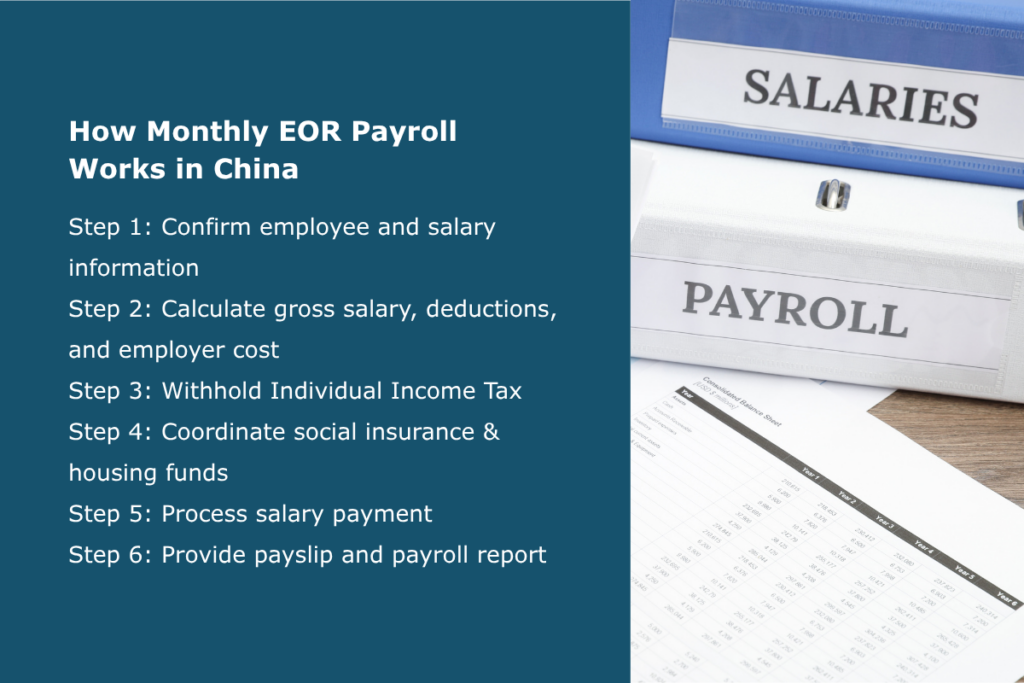
A typical monthly EOR payroll cycle coordinates employee data, gross salary and deductions, Individual Income Tax, social insurance and housing fund contributions, salary payment, and payroll reporting.
Step 1: Confirm employee and salary information
Before payroll starts, the EOR partner should collect and confirm the employee’s key information. This may include legal name, identification details, work location, employment start date, salary, probation terms, benefits, bank details, tax information, and social insurance or housing fund details.
The client company should also confirm whether compensation includes only fixed salary or additional items such as bonus, commission, allowance, reimbursement, or one-off payment. This step matters because payroll accuracy depends on clean input. If salary structure is unclear at the start, later payroll calculations may create confusion for both the employee and headquarters.
Step 2: Calculate gross salary, deductions, and employer cost
The next step is to calculate the payroll breakdown. Companies should distinguish between gross salary, employee deductions, net salary, employer contributions, and total employer cost.
| Item | Meaning |
| Gross salary | Salary before employee-side deductions |
| Employee deductions | Items deducted from the employee’s salary, such as IIT and employee-side statutory contributions |
| Net salary | Amount paid to the employee after deductions |
| Employer contributions | Employer-side statutory contributions and related costs |
| Total employer cost | Gross salary plus employer-side contributions and service-related costs |
This distinction is important for budgeting. A company may agree to a gross salary with the employee, but the full employment cost can be higher once employer-side statutory contributions and EOR service fees are included.
Step 3: Withhold Individual Income Tax
Individual Income Tax, or IIT, is a core part of payroll administration in China. For resident individuals receiving salary and wage income, China’s State Taxation Administration states that withholding agents calculate tax using the cumulative withholding method and file the withholding return monthly.
For companies using an EOR, the partner should explain how IIT withholding is managed, what information is required from the employee, and how tax-related questions are handled.
Headquarters should avoid making assumptions about net salary, allowances, or reimbursement treatment without payroll review. Salary structure should be clarified before onboarding because it affects payroll calculation, employee expectations, and internal budgeting.
Step 4: Coordinate social insurance and housing funds
China payroll also involves statutory contribution administration. In practice, this often refers to social insurance and housing fund contributions. Shanghai’s tax authority refers to combined declaration procedures for “five social insurances and one housing fund,” including pension, medical care, unemployment, work injury, maternity insurance, and housing fund contribution wages.
For foreign companies, the key point is that contribution coordination is local. Payroll requirements, contribution bases, procedures, and administration details can differ by city. A payroll estimate for one city should not be applied automatically to another location.
A strong EOR payroll partner should explain the contribution logic based on the employee’s work location and employment arrangement.
Step 5: Process salary payment
After payroll calculation and approvals, the salary payment is processed. The employee should receive the correct net salary according to the agreed payroll timeline.
The client company should understand the approval deadline. Late payroll inputs can affect calculation, reporting, and salary payment timing. This is especially important when compensation includes variable items such as commission, bonus, overtime, allowance, or reimbursement. A clear payroll calendar helps headquarters prepare information on time and gives the employee confidence that salary payment is handled properly.
Step 6: Provide payslip and payroll report
Payroll should produce two clear outputs:
- A payslip for the employee
- A payroll report for the client company
The payslip helps the employee understand salary, deductions, contributions, and net payment. The payroll report helps headquarters track cost, budget, approvals, and accounting records. For international companies, the payroll report should be easy to understand. It should separate gross salary, employee deductions, employer contributions, EOR service fees, and total employment cost.
This is especially useful when the finance or HR team is outside China and needs payroll visibility without managing local administration directly.
Salary Calculation Through an EOR
Salary calculation should be clarified before the employment contract and onboarding process are completed. This avoids mismatched expectations between the employee and the overseas employer.
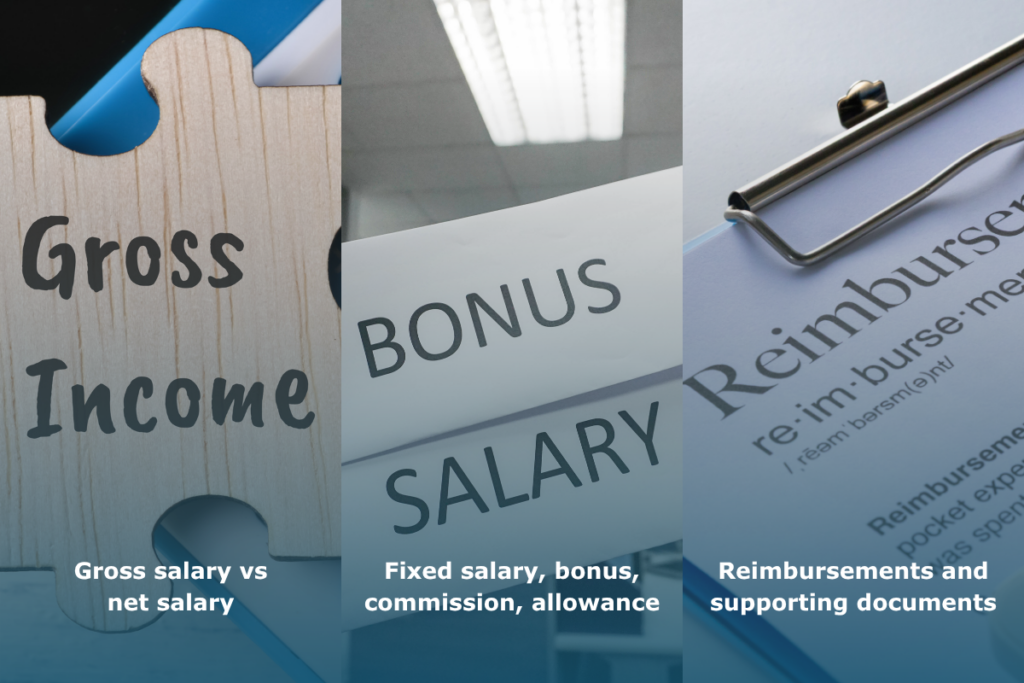
EOR payroll calculations should distinguish between gross and net salary while correctly accounting for fixed pay, variable compensation, allowances, and documented employee reimbursements.
Gross salary vs net salary
Gross salary is the agreed salary before deductions. Net salary is what the employee receives after employee-side deductions and IIT withholding. Foreign headquarters should avoid discussing only net salary unless the payroll structure has been reviewed. Net salary expectations can create confusion if tax and statutory contributions are not clearly explained.
Fixed salary, bonus, commission, and allowance
Payroll becomes more complex when compensation includes variable items. These may include:
- Monthly fixed salary
- Annual bonus
- Sales commission
- Performance bonus
- Meal, transport, or housing allowance
- Reimbursements
- One-off payments
Each item should be classified correctly before payroll processing. The EOR partner should help confirm which items are taxable, which require documentation, and how they should appear in payroll records.
Reimbursements and supporting documents
Reimbursements should be made with proper supporting documents. Companies should define what can be reimbursed, what approval is required, and when reimbursement information must be submitted for payroll processing. This is important because unclear reimbursement practices can create payroll errors, accounting gaps, and employee dissatisfaction.
EOR Payroll vs Payroll Outsourcing in China
EOR payroll and payroll outsourcing are related, but they are not the same.
| Model | Best fit | Key difference |
| EOR payroll | Company has no China entity and hires through an EOR | The EOR supports the employment structure and payroll administration |
| Payroll outsourcing | Company already has a China entity | The company remains the employer and outsources payroll processing |
| In-house payroll | Company has a local HR/payroll team | Payroll is managed internally by the company |
This distinction matters because payroll cannot be separated from the employment structure. A company without a China entity may need an EOR to legally employ the worker and administer payroll. A company with a China entity may only need payroll outsourcing or HR administration support.
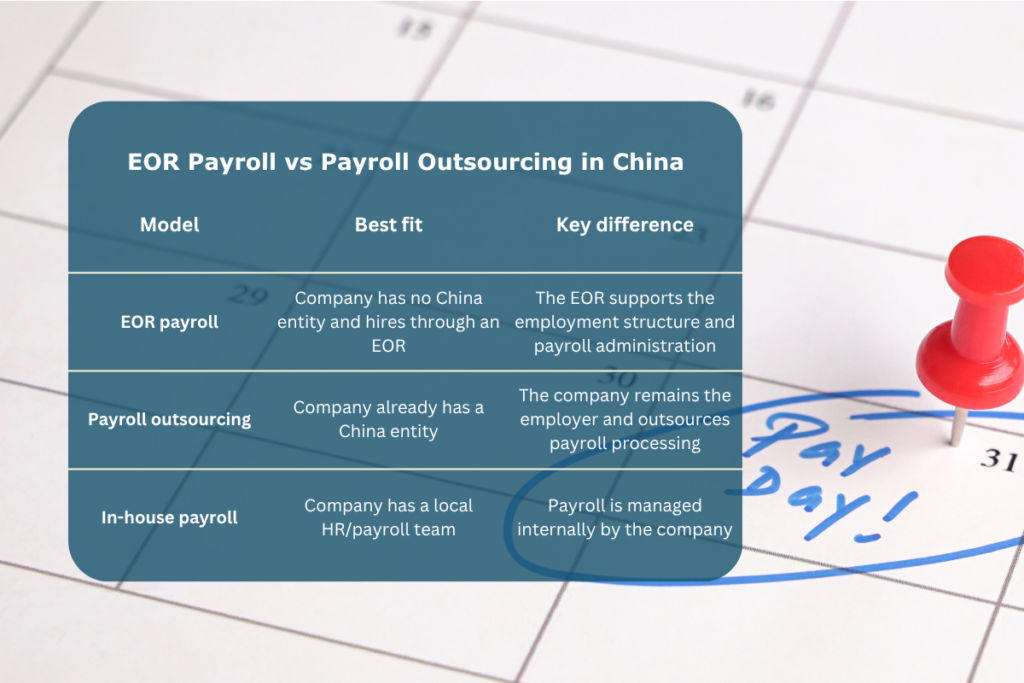
EOR payroll is designed for companies hiring through an EOR, while payroll outsourcing and in-house payroll generally apply when the company already has its own employing entity in China.
What Headquarters Should Check Before Running EOR Payroll
Before hiring through an EOR in China, headquarters should confirm the following:
| Area to check | Key question |
| Employment structure | Who legally employs the worker? |
| Payroll calendar | What are the monthly input and approval deadlines? |
| Salary structure | Is compensation fixed, variable, or mixed? |
| IIT withholding | How is IIT calculated and communicated? |
| Social insurance and housing fund | What applies based on the employee’s city? |
| Payslip | What will the employee receive each month? |
| Payroll report | What will headquarters receive for finance and HR review? |
| Employee support | Who answers payroll questions in Chinese or English? |
This checklist helps companies manage EOR payroll as a controlled process rather than a black-box service.
How VVR International Supports EOR Payroll in China
VVR International supports international companies hiring in China through recruitment, EOR, HR outsourcing, payroll coordination, employment compliance, and employee lifecycle support. VRR’s Recruitment & Incubation solution combines recruitment with a legal EOR structure, compliant contracts, mandatory social benefits, labor law compliance support, and ongoing HR administration.
For payroll, VVR International supports the practical administration behind China-based employment. This includes payroll coordination, mandatory social benefits, employment documentation, employee communication, and ongoing HR follow-up.
VVR International also states that it holds an official Labor Dispatch License issued by the PRC government. This helps companies use a licensed employment structure when hiring local or expatriate employees in China. This local support is useful for foreign headquarters that need payroll visibility without managing China payroll directly. It also helps employees understand salary, benefits, deductions, and HR processes through clearer communication.
Conclusion
EOR payroll in China should be treated as a structured monthly process, not only a salary payment. Companies need to understand how gross salary, net salary, IIT withholding, social insurance, housing funds, benefits, pay slips, payroll reports, and employer costs work together.
The right EOR payroll partner should provide clear calculations, local administration, employee explanations, and reporting for headquarters. This is especially important when hiring a first employee, building a small China team, or managing China-based employees from overseas.
VVR International provides EOR support for China-based employees. Contact VVR International to discuss your China hiring and requirements.
FAQs
- Who pays the employee when using an EOR in China?
In an EOR arrangement, the EOR partner usually manages the local employment and payroll administration. The client company funds the employment cost and manages the employee’s work, objectives, and performance.
- Does EOR payroll include IIT withholding?
Yes, EOR payroll usually includes IIT withholding coordination. Companies should confirm how the EOR partner calculates withholding, files payroll-related tax information and explain deductions to the employee.
- Does EOR payroll include social insurance and housing funds?
Yes, EOR payroll usually includes coordination of statutory contributions such as social insurance and housing funds. The exact contribution process should be checked based on the employee’s location and employment arrangement.
- Why can payroll cost vary by city in China?
Payroll costs can vary by city because social insurance and housing fund administration may depend on local contribution bases, procedures, and requirements. Companies should confirm city-level payroll assumptions before hiring.
Related Posts


Shanghai, Chine
7888 Humin Road, Minhang District
+86 21 3422 7164 103
contact@vvrchina.com

Guangzhou, China
Merchants City Home
495 Hanxi East Road,
Panyu District
+86 20 8332 1024
contact@vvrchina.com

Shijiazhuang, China
368 XinShi Bei Road,
Zhenxin Industry District
+86 3118 381 0103
contact@vvrchina.com

Sao Paulo, Brésil