Can You Hire Employees Without a Local Entity? Global Hiring Guide (2026)
1. Introduction
You have named the right market and found the right candidate. Now comes the question that stops many global expansion plans in their tracks: “Do you need to set up a legal entity before you can hire employees in China?” A short answer is no. You can hire employees without setting up a local entity, and for most companies, testing a new market or building a lean international team, it is also the smarter path.
Solutions like Employer of Record (EOR), Professional Employer Organizations (PEO), and carefully structured contractor arrangements allow companies to hire compliantly in markets like China without the time and capital burden of entity incorporation. In this guide, we at VVR International break down every legal option available. Then it compares the true costs and explains what companies need to know specifically when hiring in China.
2. Key Takeaways
- Companies can legally hire employees in China without establishing a local entity by using an EOR/PEO structure, which significantly reduces setup time, cost, and operational complexity.
- In China, EOR/PEO is generally the safest and most compliant hiring model for foreign companies because Chinese labor law imposes strict obligations around contracts, social insurance, payroll, and employee protections.
- Many international companies now use a phased market-entry approach: they first validate the market through EOR/PEO, then establish a local entity only after commercial traction and operational scale are proven.
3. Do You Need a Local Entity to Hire Globally?
Before choosing a hiring structure, it is important to understand what a local entity enables and when it is truly necessary. A local entity is a legally registered business structure in a foreign country, such as a Wholly Foreign-Owned Enterprise (WFOE) or Joint Venture (JV) in China. It gives a company the legal standing to sign contracts, issue invoices, and directly employ staff under local law.
Setting up a local entity in China typically takes 6 to 12 months and costs between $15,000 and $50,000 in legal, accounting, and registration fees, before you have hired a single person. Ongoing compliance adds further operational overhead: annual audits, tax filings, registered capital requirements, and dedicated local management. So, do you need one? The answer is not necessarily. Here are the determining factors that you need to know:
- Headcount and timeline: Hiring 1–5 people quickly? An entity is overkill. Planning for 20+ over 3 years? An entity may eventually make sense.
- Revenue generation: If your China operation will sign contracts and generate local revenue, a WFOE is typically required.
- IP and control sensitivity: Companies with highly proprietary products may prefer the direct control that an entity provides.
- Market commitment: Testing a new market before committing? Starting without an entity reduces your exit cost significantly.
For most companies in the early-to-mid stages of international expansion, our answer is to start without an entity and build the infrastructure once the market justifies it.
4. Two Legal Ways to Hire Employees Without a Local Entity in China
Companies that want to hire quickly without incorporation usually rely on two practical legal routes. Each comes with different levels of control, cost, and compliance risk.
4.1. Employer of Record (EOR) /Professional Employer Organization (PEO)
For most international hiring plans, this is the safest and fastest solution. An EOR or PEO is a third-party company that becomes the legal employer of your staff on paper. It handles payroll, tax withholding, social insurance contributions, and labor contract compliance while you retain operational control over day-to-day work.
This is the most widely used and legally robust solution for hiring without a local entity. In China specifically, where labor law is stringent and non-compliance carries significant penalties, an EOR/PEO drops the risk of misclassification or administrative violations. The EOR/PEO model brings some advantages:
- Hire in 2 to 6 weeks instead of waiting months for entity approval;
- Full compliance with local labor law, social insurance, and tax obligations;
- No minimum headcount – suitable for hiring even a single employee;
- Straightforward offboarding if the market does not perform as expected;
- Scales seamlessly as your team grows.
VVR International provides direct EOR/PEO services across China, acting as the legal employer while your team works under your direction. In case you already have a registered entity in China but want to outsource the operational burden of employment administration, an EOR/PEO is still a strong choice.
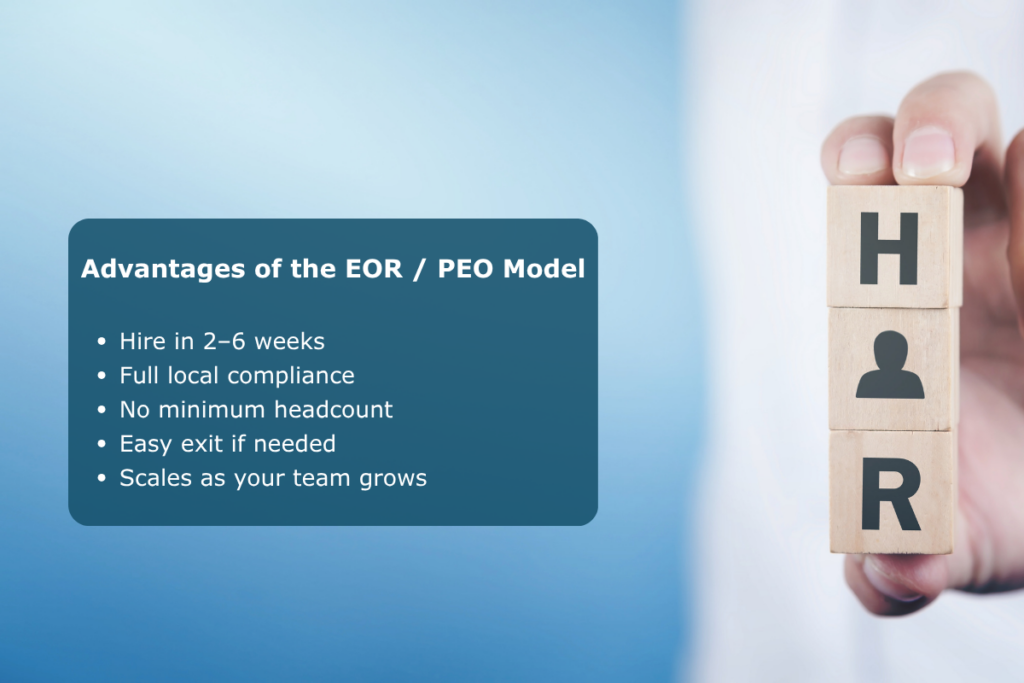
Both EOR and PEO solutions help companies hire internationally faster, stay compliant, and scale teams without setting up a local entity.
4.2. Independent Contractors
Engaging independent contractors is the fastest and lowest-cost way to access talent abroad, but it carries significant legal risk, particularly in China. Chinese labor law distinguishes sharply between employees and contractors. If a contractor works exclusively for your company, follows your schedule, and uses your equipment. In that case, Chinese authorities may reclassify them as full-time employees. The consequences include back payment of social insurance contributions, tax penalties, and potential fines.
However, contractors are appropriate for genuinely project-based, time-limited engagements with professionals who serve multiple clients. They are not a compliant substitute for full-time employment in China.
5. How Much Does It Cost to Hire an Employee Without a Local Entity in China?
Cost is often the deciding factor. However, the cheapest option on paper is not always the lowest risk option in practice. Below is a practical breakdown to answer the question “How much does it cost to hire an employee without a local entity?”:
|
Option |
Upfront Cost | Speed to Hire | Compliance Risk |
Best For |
|
EOR/PEO |
From Low to Medium |
2–6 weeks | Low | Fast, compliant hiring without an entity |
|
Contractor |
Very low |
Immediate |
High (in China) |
Short-term, non-core tasks only |
| Local entity | High ($15K–50K+) | 6–12 months | Low |
Long-term, large-scale operations |
Beyond the table, consider the hidden costs of entity setup: registered capital requirements (often RMB 100,000–500,000 in China), ongoing annual audit fees, dedicated local accounting and legal retainers, and the management time diverted to compliance rather than growth. In practice, for most companies with fewer than 15 employees in a new market, EOR fees are substantially cheaper than maintaining a local entity.
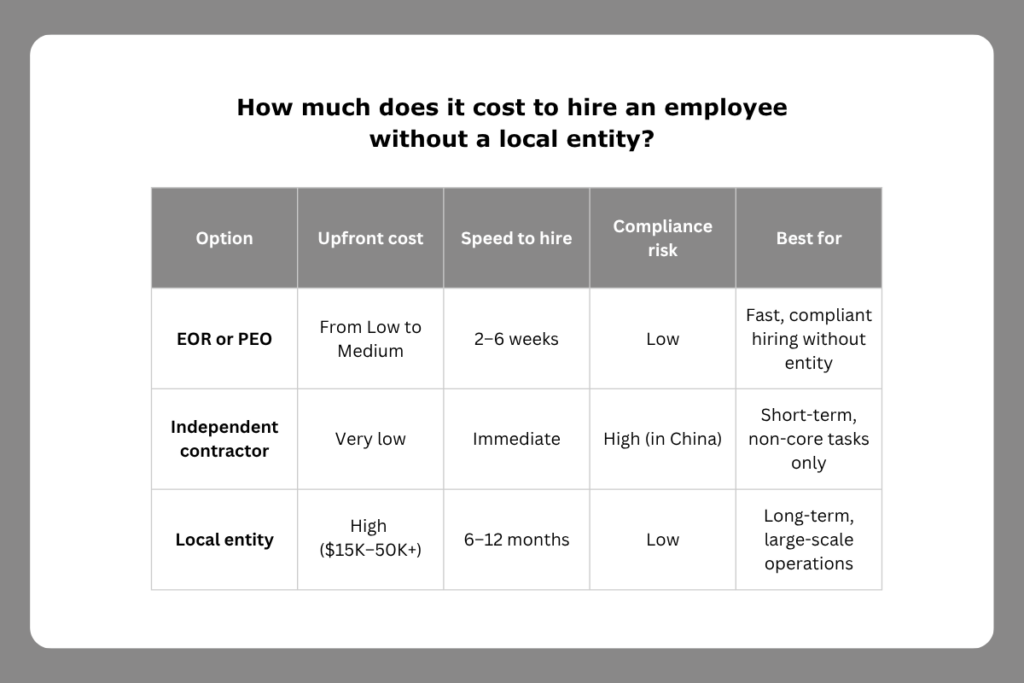
Comparing EOR, contractor, and local entity models helps companies choose the most cost-effective path for international hiring.
6. Hiring Employees in China Without a Local Entity: What You Need to Know
While China offers a major commercial opportunity, it also has one of the most structured labor compliance systems in Asia. Indeed, China presents a unique combination of opportunity and regulatory complexity. It is the world’s largest manufacturing base, a growing consumer market, and an increasingly important source of technical talent, but its labor law framework leaves little room for shortcuts.
Several features of Chinese employment law are especially important for foreign companies hiring without an entity:
- Mandatory written labor contracts: Required within one month of employment commencement. Failure to provide a written contract within that window triggers automatic double-salary liability.
- Social insurance and housing fund: Employers must contribute to five mandatory social insurance streams (pension, medical, unemployment, work injury, maternity) plus a housing provident fund. Rates vary by city but typically add 30–40% to base salary costs.
- Probation period limits: Capped by law based on contract duration—maximum 6 months for contracts of 3 years or more.
- Termination protections: Chinese labor law provides strong employee protections. Termination without cause requires severance based on years of service. Unlawful termination can trigger double severance of liability.
- Stricter contractor environment: Unlike some markets, China does not have a well-established compliant contractor framework for core employment roles. Thus, the EOR is the appropriate structure.
For foreign nationals being hired into China roles, additional work permit requirements apply, including the tiered work permit system (Categories A, B, and C) introduced in 2017. Additionally, processing typically takes 4 to 8 weeks and requires documentation, including degree certificates, work history, and background checks.
7. When Should You Set Up a Local Entity Instead?
For a long-term plan, EOR/PEO is not the right answer forever. As your China operations mature, the calculus shifts. You need to consider moving to a local entity when:
- Headcount reaches 10–15 employees, depending on salary levels and market: At this scale, entity costs often become competitive with monthly EOR fees.
- Revenue generation is the goal: If your team signs contracts, issues invoices, or collects payments locally, a WFOE or equivalent structure is typically required.
- IP protection is a priority: Holding patents, trademarks, or proprietary technology through a local entity provides stronger legal protection.
- Long-term strategic commitment: If China is central to your 5-year plan, the investment in a proper legal structure pays off over time.
As a result, many companies use EOR/PEO as a bridge. They enter the market quickly through EOR/PEO, validate the business case, and establish a local entity once operations reach the scale that justifies it. Consequently, this sequenced approach reduces risk and preserves capital during the critical early phase.
8. Conclusion
To sum up, you do not need a local entity to hire compliantly in China. An EOR/PEO gives you speed, compliance, and flexibility to build international teams without the capital commitment and operational complexity of entity incorporation, and without putting your company at legal risk.
Therefore, for founders and HR leaders navigating global expansion, the question is not whether EOR/PEO works. It is whether you have the right partner – one with genuine local expertise, in-country teams, and a track record of navigating complex labor environments like China.
VVR International provides direct EOR/PEO services across China.
Why should you choose VVR International?
With 26 years of experience in the HR industry, VVR International supports companies hiring and expanding across China through a strong Sino-European team that understands both local execution and international business standards.
We are proudly one of the very few non-Chinese firms holding an official Labor Dispatch License issued by the PRC government. This license authorizes us to act as the legal employer for dispatched staff across China, providing a compliant and secure route for hiring local or expatriate employees. Clients also benefit from our 5-star customer service and on-the-ground support through offices in Shanghai, Beijing, Guangzhou, and Shijiazhuang.
If you are ready to hire internationally without setting up a local entity, fill in the contact form below. Then, our team will outline the fastest, most compliant path forward for your specific market and role.
FAQ
-
Can I hire a full-time employee in China without registering a company?
Yes. Through an Employer of Record (EOR) like VVR International, you can hire full-time employees in China without setting up a local entity. The EOR becomes the legal employer and handles all payroll, tax, and social insurance obligations on your behalf.
-
How long does it take to hire through an EOR/PEO in China?
Most EOR onboarding processes in China take between 2 and 4 weeks from signed agreements to the employee’s first day. This compares 6 to 12 months for entity setup.
-
Is it legal to use contractors in China instead of employees?
It is legal, but high-risk for ongoing, full-time roles. Chinese authorities can reclassify contractors as employees if the working relationship resembles standard employment, triggering back-payment of social insurance and tax penalties. For core team members, EOR employment is the compliant solution.
Related Posts


Shanghai, Chine
7888 Humin Road, Minhang District
+86 21 3422 7164 103
contact@vvrchina.com

Guangzhou, China
Merchants City Home
495 Hanxi East Road,
Panyu District
+86 20 8332 1024
contact@vvrchina.com

Shijiazhuang, China
368 XinShi Bei Road,
Zhenxin Industry District
+86 3118 381 0103
contact@vvrchina.com

Sao Paulo, Brésil