HR Outsourcing in China: Trends, Challenges, and Strategic Solutions (2025 – 2026)
HR Outsourcing in China: Trends, Challenges, and Strategic Solutions (2025 – 2026)
1. Introduction
HR outsourcing China has become one of the most strategic tools for foreign companies entering or expanding in the Chinese market. Managing payroll, benefits, and compliance locally is complex, and building an in-house HR team requires heavy investment. Outsourcing allows companies to hire employees in China faster, remain compliant with local laws, and focus on growth instead of administration.
China remains a global business hub in 2026, with a labor force of more than 770 million people and a fast-changing workforce. At the same time, HR policies in China, strict labor contract laws, and varying payroll systems across cities make human resources management difficult for newcomers. By partnering with HR outsourcing providers, companies reduce risk while benefiting from local expertise.
In this article, we, VVR International, examine the current HR landscape in China, the role of outsourcing, top challenges, strategic HR solutions for foreign businesses, and future trends shaping HR practices in 2026.
2. HR Management in China: A Current Landscape
To understand where things stand, we begin by looking at today’s HR landscape in China, including market size, regulations, and talent dynamics. China is not isolated from global trends. According to Insignia Resource, the global HR outsourcing industry is projected to grow from USD 276.44 billion in 2025 to USD 291.59 billion in 2026. In parallel, Deloitte reports that 62% of Chinese companies plan to increase investment in HR technology in 2025–2026, focusing on automation and analytics tools.
This shows that HR management in China is entering a new phase: balancing compliance with digital innovation.
HR management in China is influenced by strict labor laws, fast-changing workforce expectations, and regional disparities. On one hand, China offers a wide range of skilled employees, from IT engineers to manufacturing specialists. On the other hand, employers must deal with high compliance requirements, complex payroll rules, and rising benefit expectations.
For instance, HR policies in China are shaped by strict labor contract rules and mandatory benefits such as social insurance and the housing fund. Employers must sign written agreements with employees, contribute to insurance schemes, and respect probation and termination clauses. Mutual agreement is essential in resolving disputes.
Chinese firms and foreign investors alike now treat HR management as a strategic function. It is no longer only about hiring and payroll. Instead, HR policies in China emphasize employee retention, digital transformation, and compliance with social insurance rules. Strategic HR management ensures that companies can balance talent acquisition with long-term workforce development.
Foreign firms often struggle to adapt to local HR practices. Payroll systems differ by region, social insurance contributions vary by city, and employment contracts must comply with the labor contract law. For this reason, many foreign companies choose HR outsourcing services in China to avoid costly mistakes and reduce risks.
3. HR Outsourcing in China: Why It Matters
Given rising complexity in compliance and talent demands, HR outsourcing China matters now more than ever for foreign businesses. It offers solutions to the two main challenges: managing compliance with Chinese labor laws and handling payroll across regions.

HR outsourcing in China offers various benefits for international businesses.
Benefits of HR outsourcing for foreign companies in China
HR outsourcing in China offers clear benefits for international businesses:
- Compliance: Providers ensure contracts, social insurance, and payroll comply with Chinese labor law.
- Cost savings: Hiring a local HR team is expensive; outsourcing reduces overhead.
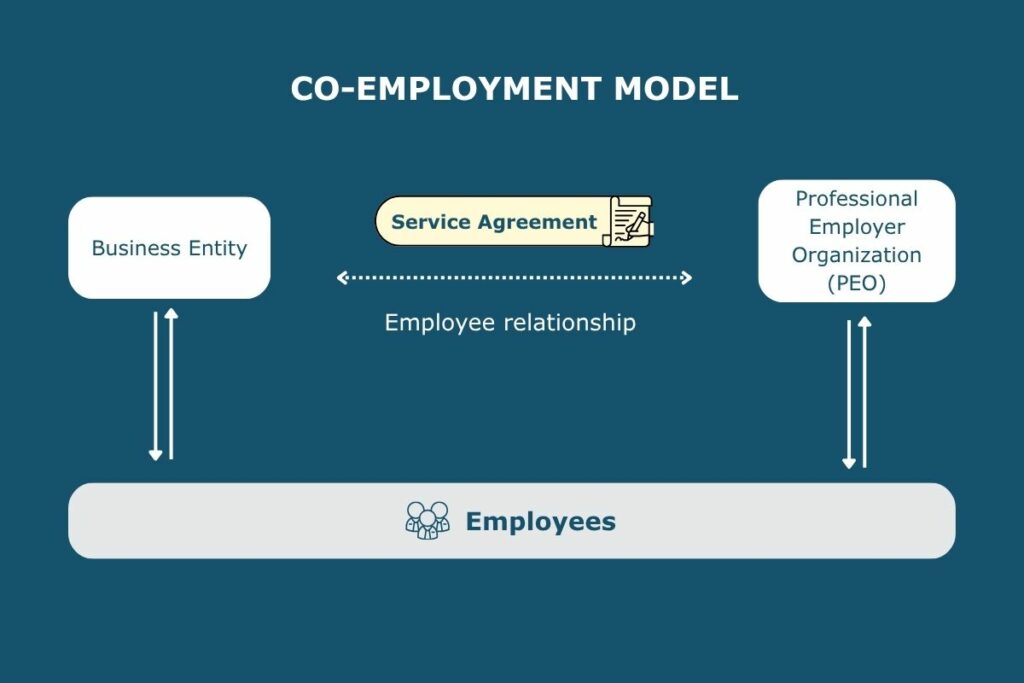
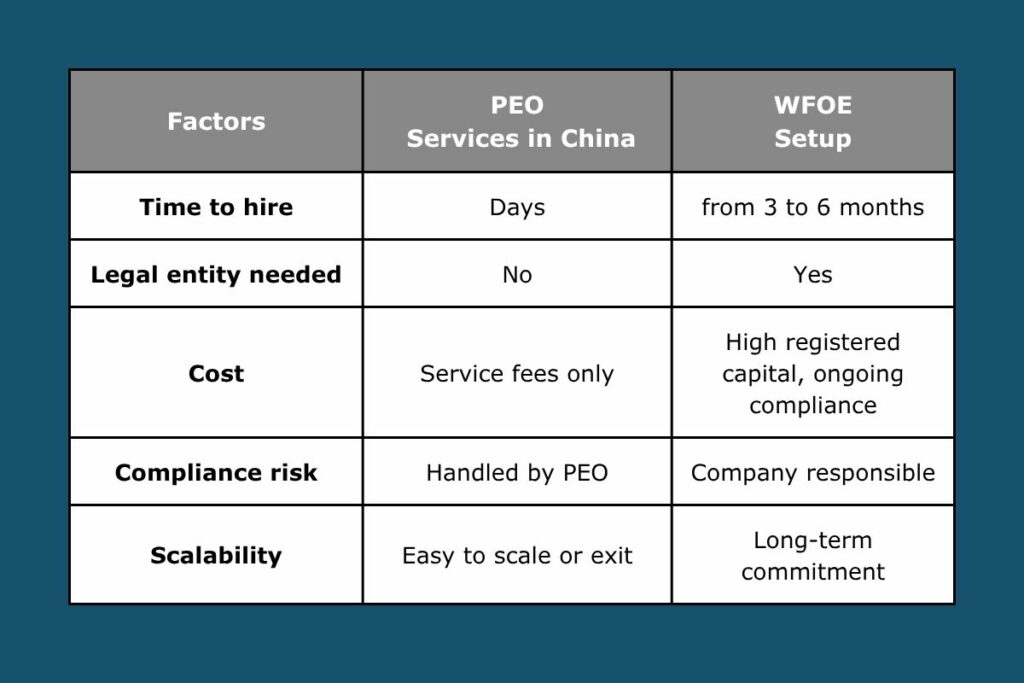
- Speed: Companies can hire employees in China without first creating a local entity.
- Flexibility: Scale operations up or down as business needs change.
- Local expertise: Providers understand HR policies in China and offer tailored solutions.
Outsourced HR services in China cover a wide range of functions, including:
- Payroll support.
- Social insurance and employee benefits management.
- Recruitment and onboarding support.
- Work permit processing for foreign employees.
- Labor contract management under mutual agreement rules.
By relying on an HR outsourcing company, foreign firms can focus on growth while ensuring compliance with Chinese regulations.
If you are considering between HR outsourcing and in-house HR, their pros and cons, let’s explore the below table.
| Factor | In-House HR in China | HR Outsourcing in China |
| Cost | High (salaries, training, systems) | Lower, predictable service fees |
| Compliance | Risk of errors | Provider ensures accuracy |
| Flexibility | Limited | High (easy to scale up/down) |
| Speed | Slower onboarding | Faster hiring process |
| Expertise | Dependent on internal team | Access to local experts |
👉 The verdict: HR outsourcing China is the preferred option for foreign SMEs and companies testing the market. It saves costs while reducing legal risks.
4. Top HR and Talent Management Challenges in Mainland China 2026
Despite the opportunities, HR management in China presents many challenges. These issues explain why outsourcing has grown so quickly.
- Complex HR policies in China
Chinese labor laws are detailed and strictly enforced. Employers must provide written contracts, pay social insurance, and contribute to the housing fund. Any mistake can lead to fines or employee claims. Mutual agreement clauses must also be clearly defined. HR outsourcing providers help foreign companies navigate these policies safely.
- Compliance and payroll
Payroll regulations vary across China, with each city applying its own social insurance rates, housing fund rules, and tax brackets. Managing employees in multiple locations requires strong local knowledge. This is one of the top challenges when your company operates in the China region.
Therefore, as an HR professional/provider, VVR can support you in ensuring employment practices are aligned with regional requirements.

The top HR challenges in China are compliance, payroll, and retention.
- Talent retention
China’s economy continues to evolve. Employees in China, especially younger professionals, expect higher salaries, better benefits, and career development. HR outsourcing partners can provide market insights, salary benchmarks, and benefits packages to help firms stay competitive.
- Work permits and foreign employees
Hiring expatriates in China involves strict work permit rules. Without expert guidance, the process can delay projects or prevent hires. HR outsourcing services include support for work permits, helping foreign companies hire smoothly.
👉 The verdict: The top HR challenges in China are compliance, payroll, and retention. Outsourcing offers solutions by combining expertise with local knowledge.
5. Strategic HR Solutions for Foreign Companies in China
Foreign companies, facing unique challenges in hiring and compliance, require strategic HR solutions to succeed in China.
Foreign businesses expanding to China often ask: How do we hire employees quickly and compliantly? Our HR outsourcing provides solutions such as:
- Recruitment support and access to local talent pools.
- Employment contracts are drafted under labor contract law.
- Social insurance and tax compliance.
- HR audits and compliance monitoring.
Outsourcing providers guide companies through work permit applications, ensuring expatriates can be legally employed. They also monitor compliance with mutual agreement rules, probation periods, and termination laws.
By outsourcing HR services, companies can align with China’s workforce trends. Providers ensure compliance but also deliver insights on HR practices in China, helping firms adapt to employee expectations.
👉 The verdict: For foreign companies, HR outsourcing in China is not just about cost savings. It is a strategic tool for compliance, talent retention, and long-term growth.
6. Opportunities from HR Outsourcing in China
Despite obstacles, HR outsourcing in China offers real opportunities, from cost savings to faster market entry.
Providers in China offer a wide range of HR solutions, from payroll to full employee lifecycle management. These include:
- Benefits administration and social insurance payments.
- Hiring services for foreign companies entering China.
- Compliance monitoring and HR audits.
Companies that outsource HR can focus on business growth instead of administrative work. Here are some examples of how to apply HR outsourcing solutions in a variety of industries:
- IT companies use HR outsourcing to recruit engineers quickly.
- Manufacturers rely on providers to manage payroll across multiple cities.
- Service firms outsource HR functions to reduce compliance risk.
👉 The verdict: HR outsourcing in China provides practical opportunities for all industries. It helps businesses scale while staying compliant.
7. The Future of HR Practices in China
Looking ahead, HR management in China will continue to evolve. By 2026, HR practices in China will be shaped by technology, big data, and digital transformation.
- Digital HR, AI and Big Data
By 2026, HR practices in China will lean further into big data, AI tools, and cloud-based HR platforms. Providers predict that AI-powered recruitment, payroll automation, employee analytics, and performance tracking tools will be adopted by most mid-to-large enterprises.
Insights from Deloitte and other tech-studies show digital HR spend growing by double digits in China. Moreover, with HR technology market rising strongly (global growth of ~12.8% CAGR), foreign firms must plan for digital adoption as part of their HR strategy

The future of HR practices in China is big data and AI transformation.
- Employee well-being and ESG
HR policies in China now emphasize employee well-being, diversity, and ESG standards. Outsourcing providers help companies align with these values by offering modern HR practices.
- Strategic HR management
HR is becoming a driver of growth, not just a support function. Strategic HR management helps businesses hire, retain, and motivate employees in China while adapting to new labor trends.
👉 The verdict: The future of HR management in China is digital, data-driven, compliance-focused, and employee-centered. Outsourcing providers will play a leading role in this transformation. Companies that adopt outsourcing with digital HR solutions will be best positioned for success.
You may also like
- Hiring in China vs Europe – What’s Different across regions.
- HR Outsourcing in China: Business Guide 2026
- Human Resources in China: Common Mistakes to Avoid
- EOR in China: How It Simplifies Recruitment
- Employee Benefits in China 2026
📩 Looking to expand your HR operations in China? Talk to VVR International experts today.
8. Look Ahead
HR outsourcing China has moved from being an optional service to a strategic necessity in 2026. It allows foreign companies to hire employees quickly, receive support for managing salaries in accordance with labor standards, and comply with strict HR policies in China. At the same time, it provides flexibility, scalability, and digital transformation.
For businesses, the choice is clear: HR outsourcing in China is not just about administration. It is a strategic tool that supports long-term success in a competitive market.
📩 Contact VVR International today to discover how our HR outsourcing services in China 2026 can help your business hire employees, manage payroll, and stay compliant.
FAQ
-
What are the main HR challenges in China that outsourcing helps foreign companies solve?
The main HR challenges in China include compliance with labor contract law, managing payroll across different cities, handling social insurance and housing fund contributions, and navigating work permit requirements for foreign employees.
HR outsourcing for foreign companies in China addresses these issues by providing local expertise, payroll outsourcing services, contract management under mutual agreement rules, and support for work permits. This allows companies to operate smoothly while minimizing legal and operational risks.
-
How do HR outsourcing services in China support strategic HR management and long-term growth?
HR outsourcing services in China support strategic HR management, aligning with modern HR practices in China, including digital HR solutions, employee retention strategies, and ESG-focused HR policies. By outsourcing HR functions, companies gain access to market insights, salary benchmarks, and compliance monitoring, enabling them to build sustainable teams in China while adapting to workforce trends and long-term business objectives.
Related Posts


Shanghai, Chine
7888 Humin Road, Minhang District
+86 21 3422 7164 103
contact@vvrchina.com

Guangzhou, China
Merchants City Home
495 Hanxi East Road,
Panyu District
+86 20 8332 1024
contact@vvrchina.com

Shijiazhuang, China
368 XinShi Bei Road,
Zhenxin Industry District
+86 3118 381 0103
contact@vvrchina.com

Sao Paulo, Brésil