Global EOR vs Local EOR: What’s the Difference?
1. Introduction
As companies expand into China, one question comes up early in nearly every conversation: Should we use a global EOR platform or partner with a local EOR specialist? On the surface, both solve the same problem, which is that they allow you to hire employees in a foreign country without setting up a local entity. But the differences in how they run, how deep their compliance knowledge runs, and how they price up their services can significantly affect your expansion outcomes.
In this article, we, VVR International, break down the global EOR vs. local EOR debate in practical terms, with a specific focus on what matters when hiring in China, which is one of the most compliance-intensive labor markets in the world.
2. Key Takeaways
- Global EOR platforms simplify multi-country hiring through centralized systems, while local EOR specialists provide deeper compliance expertise and operational support within China.
- For China-focused expansion, local EOR providers often offer stronger labor law knowledge, bilingual support, and more competitive pricing compared to global EOR platforms.
- Choosing between a global EOR and a local EOR depends mainly on expansion scope, internal HR capabilities, and the level of compliance control required in China.
Insight for you: In China expansion, the real difference between a global EOR and a local EOR is not convenience versus geography, but platform standardization versus operational depth and compliance precision.
3. What Is an Employer of Record (EOR)?
An Employer of Record is a company that legally employs workers on behalf of another business. The EOR appears on employment contracts, handles payroll processing, withholds and remits taxes, manages social insurance contributions, and ensures compliance with local labor law, while the client company directs the employee’s work.
The EOR model exists to solve a specific problem: how do you hire someone compliantly in a country where you have no legal presence? Without a registered entity, a company cannot legally employ staff directly. An EOR bridges that gap.
In China, this is particularly relevant. Chinese labor law requires all employment relationships to be backed by a legally registered entity. Foreign companies that try to hire Chinese nationals directly, without a WFOE or EOR arrangement, risk significant legal exposure, including backdated social insurance liability and administrative penalties.
For more details about the EOR model, check here!
An Employer of Record legally employs staff on behalf of another company while managing payroll, tax, and compliance obligations.
4. Global EOR vs. Local EOR: Core Differences
The distinction between a global EOR and a local EOR is not just about geographical reflects fundamentally different business models, compliance infrastructure, and service philosophies.
|
Factor |
Global EOR | Local EOR |
|
Geographic coverage |
Multi-country via a single platform |
Single country or region |
|
China compliance depth |
General – relies on owned entities, partner networks, or hybrid models depending on the country. |
Deep in-country expertise |
|
Speed to hire |
Fast (standardized processes) |
Fast (specialized local knowledge) |
|
Pricing |
Higher – multi-country premium |
More competitive for the single market |
|
HR platform |
Unified dashboard across countries |
May require separate tools |
|
Local support |
Centralized, often remote |
On-the-ground, bilingual teams |
|
PIPL / data compliance |
Varies by provider |
China-specific expertise |
| Best for | Hiring across 3+ countries simultaneously |
China-first or China-focused expansion |
The table above captures the key trade-offs. The right choice depends on your expansion strategy, headcount, and how central China compliance is to your hiring needs.
5. Advantages of a Global EOR
For companies expanding into multiple countries at once, a global EOR platform can reduce administrative complexity and create better cross-border visibility.
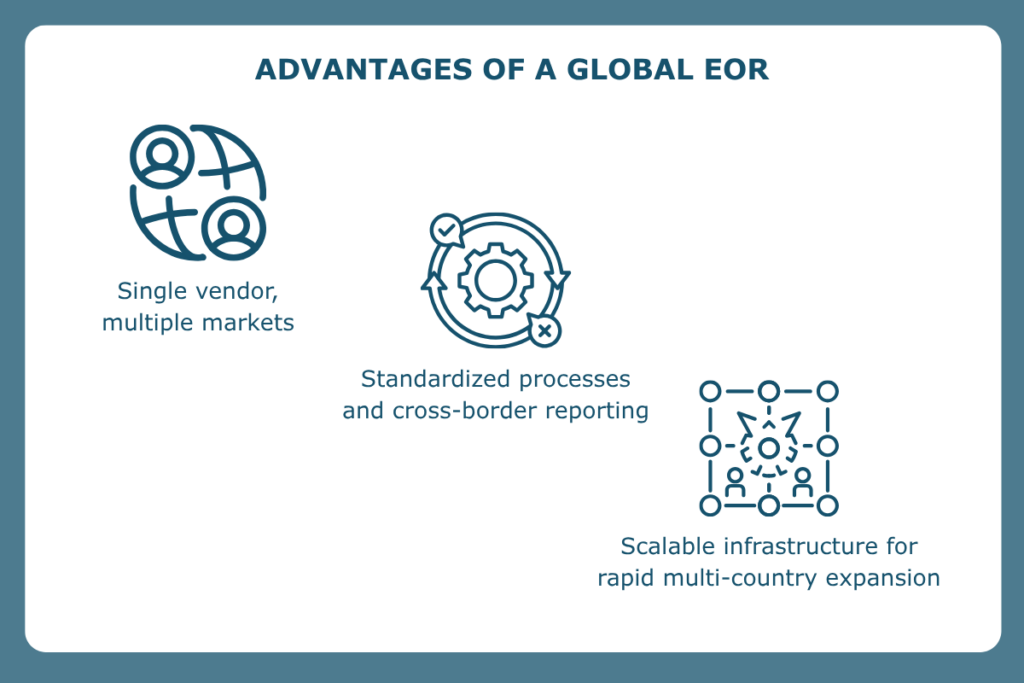
A global EOR helps companies hire across multiple countries through one provider, standardized processes, and scalable international infrastructure.
Single vendor, multiple markets
For companies expanding into three or more countries simultaneously, a global EOR platform offers meaningful operational efficiency. Instead of managing separate contracts, billing relationships, and onboarding processes with multiple local providers, HR teams work through a single dashboard covering all markets.
This consolidation is especially valuable for companies with small central HR functions that lack the bandwidth to manage multiple regional vendors. A unified platform standardizes reporting, reduces administrative friction, and simplifies audits.
Standardized processes and cross-border reporting
Global EOR providers have invested heavily in technology platforms that automate payroll, benefits enrollment, contract generation, and compliance tracking across authorities. For multinationals that need consistent data formats and combined reporting across markets, this is a genuine advantage.
CFOs and HR leaders who need a single view of global headcount, total employment costs, and compliance status often find global platforms significantly easier to manage than the patchwork of local providers.
Scalable infrastructure for rapid multi-country expansion
If your roadmap includes entering five markets in eighteen months, a global EOR can activate new countries without requiring you to source and vet a new local provider for each one. The infrastructure is already in place; you are effectively plugging in to an existing network.
6. Advantages of a Local EOR Specialist
In this article, “local EOR” refers to an in-country provider with direct operational capability rather than a purely reseller model. When one market matters more than all others, local ability often creates more value than platform convenience.
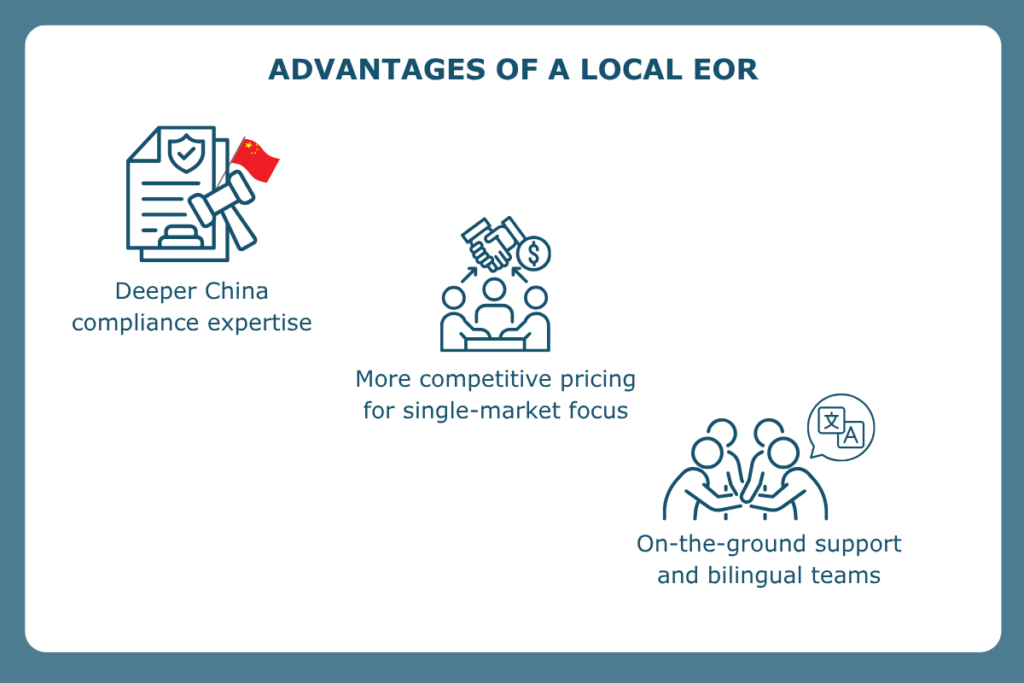
A local EOR offers deeper China compliance expertise, competitive pricing, and on-the-ground bilingual support for market-specific hiring.
Deeper China compliance expertise
China’s labor law is not uniform across the country. Social insurance contribution rates vary by city and province. Labor dispute resolution processes differ between municipalities. Probation rules, termination procedures, and housing fund requirements are all shaped by local regulations layered on top of national law.
A local EOR that runs exclusively or primarily in China has invested in understanding these nuances at the ground level. They typically support in-country legal and HR teams, have proven relationships with local labor bureaus, and can identify city-specific considerations that a global platform’s standardized processes may not capture. For companies where China compliance is not just a checkbox but a genuine operational risk, this depth matters.
More competitive pricing for a single-market focus
Global EOR platforms price their services to reflect multi-country infrastructure, technology investment, and global account management. If you are hiring exclusively in China, you are paying for capabilities you are not using. Local EOR specialists’ price for their specific market. For China-focused hiring, this typically translates to more competitive monthly fees and greater flexibility on service customization.
On-the-ground support and bilingual teams
Employment issues in China — whether a labor dispute, a payroll discrepancy, or an unexpected regulatory change — require fast, accurate responses in Chinese. A local EOR with in-country teams can engage directly with employees, government offices, and legal counsel in Mandarin, without the delays introduced by centralized global support functions.
This operational proximity is difficult to replicate from a global platform. When a sensitive HR issue arises in Shenzhen or Shanghai, having a team that is physically present and culturally fluent is a meaningful advantage.
7. Which EOR Model Is Right for Your China Expansion?
There is no universal best choice. The right EOR model depends on your hiring footprint, internal resources, and China growth plans. Besides, the answer depends primarily on the scope of your hiring across markets and the depth of compliance expertise your China operations require.
| Your Situation | Recommended EOR Type |
| Hiring in China only | Local EOR |
| Hiring in China + 1 other ASEAN country | Local EOR with regional reach |
| Hiring across 3+ countries simultaneously | Global EOR platform |
| Unsure/early stage | Start with local EOR, scale to global |
| The HR team requires a unified dashboard | Global EOR (evaluate China compliance depth) |
A note of caution for companies defaulting to global EOR for China: the quality of China compliance support varies significantly between global providers. Some keep strong in-country partnerships; others rely on subcontracted local entities with limited accountability. Before committing to a global EOR for China hiring, verify their specific compliance infrastructure in-country – not just their platform’s feature list.
8. What to Look for in a Global EOR Solution for China
Not every EOR provider is equally prepared for China. Before signing, companies should review operational depth, compliance capability, and real in-country execution. Whether you ultimately choose a global or local EOR, the following criteria are non-negotiable when running in China:
- Proven China compliance track record: Ask for reference clients in China and verify their experience with labor disputes, terminations, and regulatory changes.
- Province-level coverage: Tier 2 and Tier 3 city support often separates experienced local providers from global platforms.
- PIPL compliance: China’s Personal Information Protection Law has direct implications for HR data. Your EOR should have a clear data handling policy that complies with PIPL.
- Transparent all-in pricing: Ensure quotes include employer-side social insurance contributions, housing funds, and any local administration fees, not just the EOR service fee.
- Labor dispute support: China’s labor arbitration can be employee-protective in practice, making expert handling important. Your EOR should have a defined process for managing disputes and a track record of successful resolution.
- Onboarding timeline: A reliable EOR should be able to onboard a new hire in China within 2 to 4 weeks of receiving complete documentation.
Why Companies Choose VVR International for China EOR?
With 26 years of HR industry experience, VVR International supports international companies through a strong Sino-European team that combines local execution with global business standards.
We are one of the few non-Chinese firms holding an official PRC Labor Dispatch License, allowing us to legally employ local and expatriate staff across China through a secure and approved structure. Clients also benefit from 5-star customer service and direct support through our offices in Shanghai, Beijing, Guangzhou, and Shijiazhuang.
9. Conclusion
To sum up, both models can work well when matched to the right expansion strategy. Indeed, global EOR vs local EOR are not competing products; they serve different expansion profiles. Global EOR platforms excel at multi-country consolidation and standardized reporting. Local EOR specialists deliver the compliance depth, in-country relationships, and cost efficiency that China-focused hiring demands.
For companies where China is the primary or most strategically significant market, the compliance advantages of a specialist local EOR typically outweigh the convenience of a unified global platform, particularly in the early and mid-stages of market entry.
VVR International provides direct local EOR services in China. If you are evaluating EOR options for your expansion, fill in the contact form now and our team will walk you through the compliance considerations and service model that fits your hiring roadmap.
FAQ
-
What does EOR stand for?
EOR stands for Employer of Record. It refers to a company that legally employs workers on behalf of another business, handling payroll, tax, social insurance, and compliance obligations in the relevant jurisdiction.
-
Is a global EOR compliant in China?
It depends on the provider. Some global EOR platforms maintain strong in-country partnerships and compliance infrastructure in China; others subcontract to local entities with limited oversight. Always verify a provider’s specific China compliance track record before committing.
-
Can I switch from a global EOR to a local EOR?
Yes. Transitioning between EOR providers involves transferring employment contracts and payroll arrangements to the new provider. The process typically takes 4 to 8 weeks and should be managed carefully to avoid gaps in compliance or employee benefits.
-
How is a local EOR different from setting up a WFOE in China?
A WFOE (Wholly Foreign-Owned Enterprise) is a registered legal entity that you own and operate. A local EOR is a third-party company that employs staff on your behalf without you needing to register with a company. WFOE setup takes 6 to 12 months; EOR can be activated in 2 to 4 weeks.
Related Posts


Shanghai, Chine
7888 Humin Road, Minhang District
+86 21 3422 7164 103
contact@vvrchina.com

Guangzhou, China
Merchants City Home
495 Hanxi East Road,
Panyu District
+86 20 8332 1024
contact@vvrchina.com

Shijiazhuang, China
368 XinShi Bei Road,
Zhenxin Industry District
+86 3118 381 0103
contact@vvrchina.com

Pékin, Chine
Yard 48 Liangmaqiao Road,
Chaoyang District
contact@vvrinternational.com