PEO in China: Comparison with ASO, HRO, and How It Accelerates Business Expansion
1. Introduction
For many foreign companies, entering the Chinese market means facing complex employment laws, high administrative costs, and long registration procedures. However, expansion no longer has to wait months for entity creation to occur. So, what is the solution? PEO in China, a flexible, compliant, and efficient HR model that lets companies hire staff and operate in China without establishing a local entity. In this article, VVR International provides a comprehensive comparison between PEO/EOR and ASO/HRO models, highlighting their key differences and strategic applications. You’ll also discover how PEO services in China can accelerate business expansion by combining compliance, flexibility, and cost efficiency, helping you determine which HR model best fits your company’s needs and growth objectives.
2. What Is a PEO/EOR? Understanding the Model
A PEO (Professional Employer Organization) is a specialized HR partner that helps foreign companies hire employees in China while remaining compliant with Chinese labor laws. The PEO acts as a co-employer, managing HR administration, payroll, tax filings, and employment contracts, while the client company oversees day-to-day operations. This setup means you can operate in China without the need to establish a legal entity, while your employees receive full benefits and protection under local law. Moreover, working with a PEO/EOR offers:
- Hire and onboard employees in weeks, not months.
- Full alignment with Chinese labor, tax, and social insurance regulations.
- No need to register a Wholly Foreign-Owned Enterprise (WFOE).
- Local payroll, taxation, and health insurance managed seamlessly.
A Professional Employer Organization (PEO) is not just a payroll service provider. It’s a long-term HR partner ensuring smooth operations for international companies in China. Specifically, in a PEO relationship:
- The client company manages the employee’s work and goals.
- The PEO/EOR organization in China becomes the local employer of record for HR, payroll, and compliance.
- The employee signs a compliant employment contract with the PEO/EOR but works directly under the client’s management.
Essentially, a PEO in China bridges the gap between global expansion and local compliance. It enables companies to enter the market quickly and legally.
3. PEO in China vs Other HR Models
The HR landscape includes several models for managing employees abroad: PEO, ASO (Administrative Services Organization), and HRO (Human Resources Outsourcing). Each offers a different level of responsibility, cost, and control. Understanding their distinctions helps you choose the best fit for your company’s goals in China.
Understanding the key differences
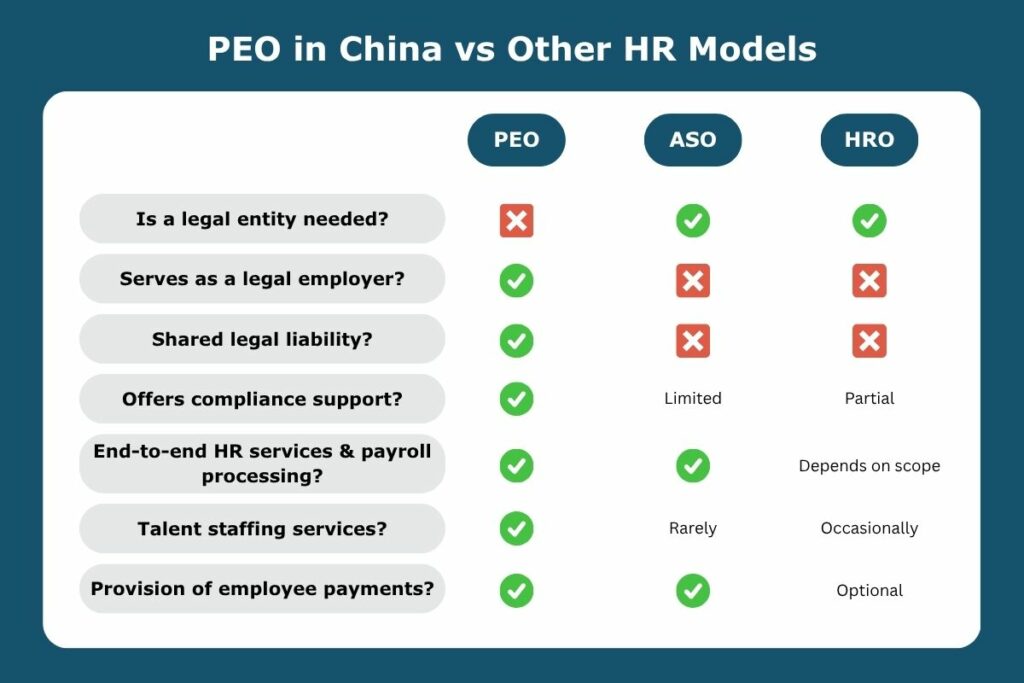
Understanding their distinctions helps you choose the best fit for your company’s goals in China.
To help you choose the right option for your company, the following overview explains how PEO in China differs from ASO and HRO models in terms of control, compliance, and scalability.
- PEO: Co-employment model. The client and the Professional Employer Organization share employer responsibilities.
- ASO: Provides HR administration but doesn’t assume legal responsibility.
- HRO: Handles specific HR tasks like payroll, recruitment, or training, but only as a service provider.
Table 1 below provides a side-by-side comparison of these four models. It outlines their core business factors, including structure, risk, scale, scope, cost, and services. Thus, you can quickly see which approach aligns with your expansion goals.
| Factor | PEO (Professional Employer Organization) | ASO (Administrative Services Organization) | HRO (Human Resources Outsourcing) |
| Structure | Co-employment between client and PEO. | Client retains employer status; ASO provides admin support. | Client retains full control, outsources selected HR tasks. |
| Risk | Shared compliance responsibility. | Client holds legal liability. | Client holds liability. |
| Scale | Ideal for SMEs or mid-size firms expanding abroad. | Best for large firms with internal HR teams. | Best for large enterprises seeking efficiency. |
| Scope | Covers employment, payroll, benefits, compliance. | Payroll and HR administration. | Training, recruitment, or HR consulting. |
| Cost | Moderate, shared employment costs. | Lower, minimal HR services. | Variable depending on the services. |
| Services | HR management, payroll, benefits and compliance. | Payroll and benefits admin. | Custom HR solutions. |
Table 1: Comparison Overview – PEO vs ASO and HRO
PEO in China stands out for combining shared compliance, cost efficiency, and local HR expertise, making it an ideal option for businesses seeking flexibility without sacrificing control.
While the first table compares strategic factors, the next one highlights practical HR features such as legal responsibility, compliance support, and payroll processing. You can use this snapshot to determine which model best meets your company’s operational and legal needs in China.
| Feature | PEO | ASO | HRO |
| Is a legal entity needed? | No | Yes | Yes |
| Serves as a legal employer? | Yes | No | No |
| Shared legal liability? | Yes | No | No |
| Offers compliance support? | Yes | Limited | Partial |
| End-to-end HR services & payroll processing? | Yes | Yes | Depends on scope |
| Talent staffing services? | Yes | Rarely | Occasionally |
| Provision of employee payments? | Yes | Yes | Optional |
Table 2: Features at a glance – PEO vs ASO and HRO
These key features demonstrate that the PEO model delivers the broadest HR coverage while minimizing legal risk and administrative work. For most foreign companies entering the Chinese market, partnering with a PEO in China provides the smoothest path to hiring, payroll management, and full compliance from day one. Understanding these distinctions is essential for choosing the most suitable HR framework for your business. The next section explains when to choose each model and why PEO in China often provides the perfect balance between agility, compliance, and operational control.
When to choose each model
Choosing the right HR model depends on your organization’s size, level of market commitment, and appetite for legal responsibility. Here’s when each approach makes sense and why PEO in China often strikes the best balance between cost efficiency, control, and compliance.
- PEO in China: Best when you want speed, compliance, and shared HR management without establishing a local entity.
- ASO: Works for larger companies that already have an entity but need help with payroll administration.
- HRO: Established firms outsource specific HR functions or projects.
For most international SMEs expanding into China, the PEO model offers the ideal balance between control, cost, and compliance.
4. How PEO Services Accelerate Business Expansion in China
Expanding to China requires speed, local knowledge, and compliance with Chinese labor laws. A PEO in China acts as your local HR engine. It helps you hire employees, manage payroll, and operate legally, all within a matter of weeks. By partnering with a China PEO service, you can:
- Recruit and onboard staff quickly.
- Avoid costly delays in entity registration.
- Reduce legal risk through compliant HR management.
- Focus resources on business development instead of administration.
The approach is particularly valuable for companies testing new markets, establishing representative offices, or running pilot projects before setting up a subsidiary.
5. How PEO Services Work in China

VVR International signs a local employment contract with the employee, ensuring full compliance with Chinese labor laws.
PEO services in China follow a well-defined structure that simplifies every stage of employment:
- Employment contract setup:
- VVR International signs a local employment contract with the employee, ensuring full compliance with Chinese labor laws.
- The client company retains operational control while VVR manages administrative obligations.
- Payroll management:
- VVR handles all salary calculations, bonuses, benefits, and health insurance contributions.
- Each month, the company receives one clear invoice covering gross salary, taxes, and service fees.
- Compliance and taxation:
- The PEO ensures compliance with local tax rules, including withholding tax and mandatory social contributions.
- All payments are made to government-approved channels in the employee’s registered city.
- HR and administrative support:
- VVR RH manages onboarding, probation, performance records, and offboarding in accordance with local law.
- For foreign employees, the company also handles work visa and residence permit applications.
- Continuous legal assurance:
- With regular policy updates and proactive HR advice, PEO services maintain long-term compliance and transparency.
With this structure, foreign companies can hire employees in China confidently, focusing on growth while the organization PEO in China handles the rest.
6. Why Choose VVR RH as Your Best PEO Services Partner
When choosing a PEO service in China, experience, licensing, and local insight matter. VVR International stands out as a trusted partner combining European reliability with on-the-ground Franco-Chinese expertise.
VVR International RH handles:
- Drafting legally compliant employment contract.
- Comprehensive HR management, including onboarding and employee relations.
- Full payroll administration (salary, benefits, bonuses, reimbursements).
- Administrative tasks such as social protection, housing fund, and health insurance.
- Taxation and withholding handled accurately each month.
- Contract renewals, terminations, and exit procedures.
- Immigration support for foreign employees (work visa and residence permit).

VVR RH stands out as a trusted partner combining European reliability with on-the-ground Franco-Chinese expertise.
Operational highlights:
- Monthly invoicing for salaries and service fees ensures transparency.
- Holds an official Labor Dispatch License, authorizing legal employment of Chinese and foreign staff.
- Pays all taxes and social charges in the employee’s registered city, as required by law.
Additional support from VVR RH:
- Intercultural management helps align European and Chinese work cultures for smoother onboarding.
- VVR’s teams in France and China coordinate time zones and expectations.
- Expatriate assistance offers adaptation training, relocation help, and ongoing HR support.
More than HR outsourcing, we provide a complete ecosystem for your success in China, ensuring your team operates confidently and compliantly from day one.
Read more related articles:
7. Final Thoughts
To sum up, a PEO in China allows businesses to hire, manage, and pay employees without setting up a local entity, combining compliance, speed, and scalability. Compared to other HR models, the PEO/EOR approach offers shared control, lower risk, and complete transparency. Whether you’re entering China for the first time or expanding your presence, partnering with an experienced provider like VVR International helps you navigate every step of your journey.
Are you ready to start your expansion in China? Contact VVR International today to learn how our PEO services in China can help you hire employees, manage payroll, and stay compliant, without the burden of establishing a legal entity.
FAQ
-
What are the main HR challenges in China that outsourcing helps foreign companies solve?
The main HR challenges in China include compliance with labor contract law, managing payroll across different cities, handling social insurance and housing fund contributions, and navigating work permit requirements for foreign employees.
HR outsourcing for foreign companies in China addresses these issues by providing local expertise, payroll outsourcing services, contract management under mutual agreement rules, and support for work permits. This allows companies to operate smoothly while minimizing legal and operational risks.
-
How do HR outsourcing services in China support strategic HR management and long-term growth?
HR outsourcing services in China support strategic HR management, aligning with modern HR practices in China, including digital HR solutions, employee retention strategies, and ESG-focused HR policies. By outsourcing HR functions, companies gain access to market insights, salary benchmarks, and compliance monitoring, enabling them to build sustainable teams in China while adapting to workforce trends and long-term business objectives.
Related Posts


Shanghai, Chine
7888 Humin Road, Minhang District
+86 21 3422 7164 103
contact@vvrchina.com

Guangzhou, China
Merchants City Home
495 Hanxi East Road,
Panyu District
+86 20 8332 1024
contact@vvrchina.com

Shijiazhuang, China
368 XinShi Bei Road,
Zhenxin Industry District
+86 3118 381 0103
contact@vvrchina.com

Sao Paulo, Brésil