EOR in China: Meaning, Salary Standards, and How It Simplifies Recruitment

EOR in China: Meaning, Salary Standards, and How It Simplifies Recruitment

1. Introduction

Expanding into China is an exciting opportunity, but it can also be complex. For foreign companies without a legal entity in the country, hiring talent, managing payroll, and ensuring tax compliance present real challenges. That’s where EOR in China comes in. This model, also known as wage/salary portage, allows companies to recruit quickly and legally without setting up a local subsidiary. It combines flexibility for the employer with full protection for the employee. In this guide, we’ll explain the meaning of EOR in China, how it works, and why it has become one of the most efficient recruitment solutions for international companies in 2026. 

2. What Is EOR?

EOR (Employer of Record) is a legal employment solution that allows foreign companies to hire staff in China without setting up a local entity. In this model, a licensed third-party provider, EOR company as VVR International, becomes the employee’s official legal employer in the country of operation. The EOR signs a compliant local employment contract with the employee and manages administrative obligations such as onboarding, contract implementation, and local labor compliance. Meanwhile, the foreign company retains full control over the employees’ day-to-day responsibilities and performance.

3. How EOR Works in China

The EOR in China model follows a simple, three-party structure: 

  • The client company abroad (the actual employer directing the work). 
  • The EOR company (the legal employer handling payroll and compliance). 
  • The employee (working in China for the client under a local labor contract. All administrative, legal, and payroll management is handled by the portage provider. 

It allows companies to deploy staff in China within weeks, without establishing a local subsidiary or WFOE. It also guarantees that the employee receives regular salary payments, social contributions, and tax declarations under Chinese law. Take VRR RH’s example, here’s how the process works in practice: 

  • Needs assessment. The foreign company identifies a candidate in China or requests recruitment support. VVR RH experts verify the job scope, salary range, and location-specific compliance requirements. 
  • Employment contract setup. The employee signs a local labor contract with VVR RH (the EOR company), while VVR signs a service agreement with the client company abroad. This dual framework clearly defines each party’s responsibilities. 
  • Payroll and social insurance management. VVR handles all salary payments, tax deductions, and social insurance contributions, including the five mandatory insurances and the housing fund. The client receives a monthly invoice covering gross salary, contributions, and management fees. 
  • Daily management and performance. The employee works directly for the foreign company, following its operational goals and reporting structure. VVR remains the legal employer, ensuring compliance and employee welfare at every stage. 
  • Continuous support. Throughout the collaboration, VVR assists with visa processes, onboarding, HR counseling, and local regulations. It ensures a smooth and sustainable employment experience for both the employer and the employee. 

In short, EOR lets you deploy talent in China within weeks – fully compliant, transparent, and scalable. 

4. Key Advantages for Employers Using EOR in China

For foreign companies entering or expanding in China, EOR is not just a temporary fix. It’s a strategic HR solution that brings measurable business advantages. 

  • Rapid deployment. Setting up a Wholly Foreign-Owned Enterprise (WFOE) can take 3–6 months and involve multiple registrations. With EOR, hiring in China can start in as little as 2–4 weeks, enabling your team to start operations immediately. 
  • No legal entity needed. EOR removes the need for complex corporate structures. You can hire staff, test markets, or launch projects without creating a company or representative office. It is especially beneficial for SMEs or startups exploring China for the first time. 
  • Legal compliance. China’s labor law is strict and highly localized. VVR RH ensures compliance with local wage standards, social insurance, and tax obligations. By acting as the legal employer, the portage firm assumes responsibility for HR compliance, reducing legal exposure for your company. 
  • Flexibility. EOR allows employers to scale up or down quickly. If your market test proves successful, VVR can help you transition to a full entity or direct employment structure. This adaptability aligns perfectly with global companies seeking agility in uncertain economic environments. 
  • Cost efficiency. EOR in China offers predictable costs through transparent invoicing. You avoid hidden expenses such as company registration fees, accounting, or local audits. Additionally, you only pay for active contracts, ideal for short-term projects or flexible expansions. 

In essence, EOR benefits both sides: employers enjoy flexibility and compliance, while employees gain security and recognition. 

5. Wage Setting and Salary Management in China

Understanding wage setting in China is essential to define fair and compliant compensation packages. 

Average Wage and Salary Data in China (2025 Update) 

According to the National Bureau of Statistics of China (NBS): 

  • The average annual salary in urban areas in 2024 reached CNY 124,100 (≈ USD 17,200). 
  • The average monthly wage in China is around CNY 10,300 (≈ USD 1,420). 
  • The median salary in China is approximately CNY 8,200 (≈ USD 1,130) per month. 
  • The average wage in China per hour is about CNY 59 (≈ USD 8.15). 

In fact, salaries vary significantly by city and industry. The China minimum wage (2025) ranges from CNY 1,680 to 2,690 per month, in USD, is 230–370, depending on the region. These differences highlight why a reliable EOR company is critical, ensuring competitive, compliant, and locally benchmarked salaries.
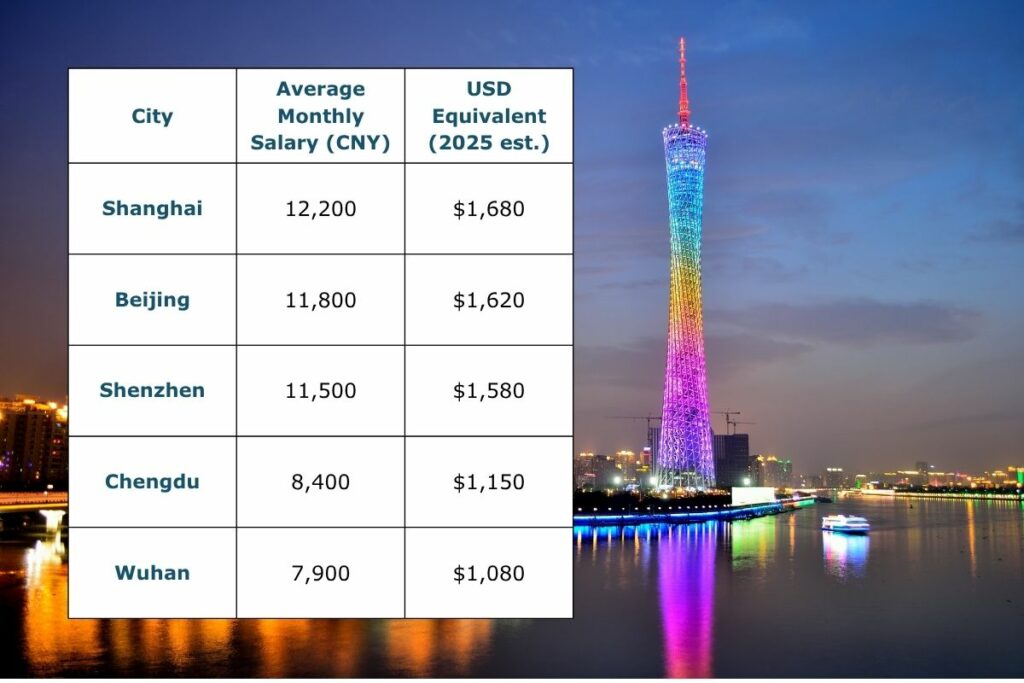
Average monthly salary by top-tier cities in China. (Source: TradingEconomics)

Average monthly salary by top-tier cities in China. (Source: TradingEconomics)

How Wages Are Set in China 

China’s wage structure is influenced by: 

  • Local regulations: Provinces and cities define their own minimum wage. 
  • Industry benchmarks: Tech and manufacturing sectors often pay above average. 
  • Experience and education: Multilingual professionals or engineers earn 30–50% more than the national average. 

Thus, EOR services help foreign employers navigate these differences by offering real-time benchmarking and transparent salary packages that meet both employee expectations and compliance rules. 

Tax and Social Contribution in China 

Payroll and taxation in China are heavily regulated, and compliance is non-negotiable. About salary tax in China, the country uses a progressive tax system on individual income. 

  • Tax-free allowance: CNY 60,000 per year (≈ USD 8,300). 
  • Tax rates range from 3% to 45%, depending on monthly income. 
  • Additional deductions cover housing, education, and parental care. 

Moreover, both employers and employees must contribute to five mandatory insurances plus the housing fund. Rates vary by city, but these contributions add roughly 35–40% to the total employment cost. EOR in China ensures these obligations are met on time, with clear payslips and tax reports, eliminating risk for foreign clients.

Both employers and employees must contribute to five mandatory insurances plus the housing fund.

Both employers and employees must contribute to five mandatory insurances plus the housing fund.

6. EOR Across China Mainland, Hong Kong, and Taiwan

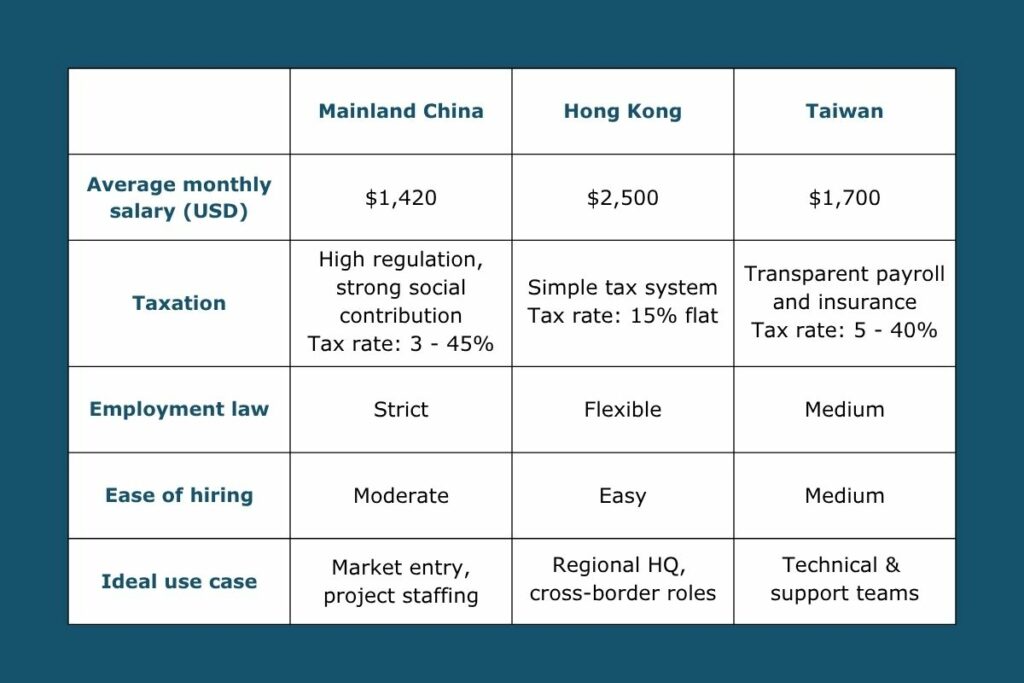
Employment laws, taxation, and HR systems differ sharply between mainland China, Hong Kong, and Taiwan. Understanding these differences is crucial before selecting where and how to deploy staff.

  • Mainland China has strict labor regulations and mandatory contributions, but it offers access to the world’s largest industrial and consumer market. Therefore, EOR is ideal for foreign companies seeking full legal compliance without creating an entity. It also simplifies management of social insurance, tax reporting, and regional wage variations, from Shanghai’s high salaries to emerging markets like Chengdu or Qingdao. 
  • EOR in Hong Kong provides maximum flexibility. Employment laws are straightforward; personal income tax is capped at 15%, and no mandatory social insurance applies beyond the Mandatory Provident Fund (MPF). Hong Kong is often chosen as a strategic base for regional coordination, especially for sales, marketing, or finance functions covering all of Asia. 
  • EOR in Taiwan combines transparency and affordability. Payroll and insurance are regulated under clear national laws, and local professionals often bring bilingual or technical expertise. The average monthly salary in Taiwan (2025) stands around TWD 55,000 (≈ USD 1,700), making it a cost-effective hub for support and R&D operations. 

With VVR RH, companies can manage EOR seamlessly across all three regions through one trusted partner, ensuring unified payroll, compliance, and HR oversight.
With VVR RH, companies can manage EOR seamlessly across all three regions through one trusted partner.

With VVR RH, companies can manage EOR seamlessly across all three regions through one trusted partner.

7. Why EOR Is the Fastest Way to Recruit in China 

Businesses operate in a fast-moving environment where speed and compliance define today’s competitive advantages and decide success. Through EOR, companies can hire staff in China within two to four weeksinstead of waiting months to register a legal entity. Here are 5 reasons why you should choose EOR in China for your recruitment: 

  1. Fast onboarding. With VVR’s established HR infrastructure, onboarding can be completed in 15-30 business days. All documentation, contracts, and payroll systems are already in place. Therefore, it enables new hires to start work almost immediately. 
  2. Full legal and tax compliance. China’s labor and tax environment can be complex. EOR ensures full compliance with local laws, from employment contracts to income tax declarations and mandatory insurances. VVR RH acts as the legal employer, taking care of documentation, audits, and social contributions, giving you complete peace of mind. Foreign employers do not need to worry about missing registrations or penalties. 
  3. Seamless administration. We – VVR RH experts, manage the full HR cycle under one system of EOR: 
    • Employment contract drafting. 
    • Social contribution setup. 
    • Payroll calculation and tax filing.
    • Expense reimbursements and reporting.
    • The client receives one consolidated monthly invoice, making international HR management as easy as running a local team. 
  4. Built-in mobility and scalability. When businesses expand from one city to another, EOR in China allows them to do so without delay. Employees can be reassigned, contracts adapted, or new hires added across cities. As a result, they are all within one compliant framework, giving companies the freedom to scale teams up or down easily. Thus, this flexibility is particularly useful for companies managing multi-site operations or testing regional demand. 
  5. Cost control. EOR services offer transparent pricing and eliminate unnecessary administrative costs. You receive a single monthly invoice covering salary, social contributions, and management fees. No hidden expenses, no local accounting burdens. Therefore, the model helps companies manage their budgets accurately while avoiding the long-term financial commitments of setting up a subsidiary. 

8. When to Choose EOR in China, Hong Kong, and Taiwan 

EOR is ideal if your company: 

  • Wants to test the Chinese and/or other markets before setting up a subsidiary. 
  • Needs to hire employees or consultants rapidly. 
  • Aims to manage risk while maintaining full compliance. 
  • Seeks local expertise for payroll, tax, and HR management. 

It’s a solution that bridges global ambition with local compliance, a smart alternative to entity creation or outsourcing. VVR International is a global consulting firm that helps companies expand across Asia through HR, market entry, and compliance services. With offices in Shanghai, Guangzhou, Shijiazhuang, Pékin, and Paris, VVR supports clients in EOR solutions, HR outsourcing, and recruitment across China, Hong Kong, Taiwan, and beyond. Our local HR specialists ensure your team operates smoothly, legally, and cost-effectively, whether you’re hiring an expert or building an entire branch.


Read more related articles:


9. Final Thoughts

Entering the Chinese market can be both exciting and challenging. Complex regulations, regional wage variations, and compliance requirements often slow down international expansion. EOR in China eliminates these barriers. It allows companies to hire talent, launch operations, and test markets without delay or legal risk. Whether you are a growing SME or a large enterprise, the EOR model gives you everything you need to succeed: speed, compliance, flexibility, and cost control. With the right local partner, you can focus on your business goals while your HR, payroll, and legal obligations are handled seamlessly. 

Contact VVR RH today to discuss your project or learn more about our EOR solutions across China and Greater Asia. 

Share your project with us via contact@vvrinternational.com.

CONTACT US

FAQ

  • What are the main HR challenges in China that outsourcing helps foreign companies solve?

The main HR challenges in China include compliance with labor contract law, managing payroll across different cities, handling social insurance and housing fund contributions, and navigating work permit requirements for foreign employees.

HR outsourcing for foreign companies in China addresses these issues by providing local expertise, payroll outsourcing services, contract management under mutual agreement rules, and support for work permits. This allows companies to operate smoothly while minimizing legal and operational risks.

  • How do HR outsourcing services in China support strategic HR management and long-term growth?

HR outsourcing services in China support strategic HR management, aligning with modern HR practices in China, including digital HR solutions, employee retention strategies, and ESG-focused HR policies. By outsourcing HR functions, companies gain access to market insights, salary benchmarks, and compliance monitoring, enabling them to build sustainable teams in China while adapting to workforce trends and long-term business objectives.

Related Posts

Read More
The potential of biomarkers for early diagnosis

The potential of biomarkers for early diagnosis

Imagine a world where debilitating diseases like cancer, Alzheimer’s, or heart ailments can be identified before they manifest symptoms, allowing for treatments that are not just less invasive but also significantly more effective. The technology that holds the promise to turn this vision into reality is already among us – it’s called biomarkers. By diving into this article, you’re taking the first step to understanding how biomarkers are revolutionizing the landscape of healthcare, especially in the realm of early diagnosis.

Unveiling the Power of Biomarkers

This section aims to unfold the transformative potential of biomarkers and their use in early diagnosis by explaining their unique diagnostic characteristics.

What are Biomarkers?

Biomarkers, or biological markers, are measurable indicators of some biological state or condition. They can be molecules, cells or cell fragments, genes, or characteristics observed through medical imaging. Biomarkers exist in various categories, primarily diagnostic, prognostic, and predictive. Diagnostic biomarkers identify whether a disease is present, prognostic biomarkers forecast the disease’s progression, and predictive biomarkers anticipate how a disease will respond to treatment.

The Revolutionary Potential for Early Diagnosis

Early diagnosis is an undisputed game-changer in healthcare. When diseases are identified in their initial stages, treatment outcomes are often significantly better, and healthcare costs can be reduced. Recent research has propelled biomarkers into the spotlight as a tool for early diagnosis. For instance, liquid biopsy, a non-invasive test, can now detect circulating tumor DNA in blood samples, providing a revolutionary way to identify early-stage cancer.

Studies have shown the increasing reliability of biomarkers in early diagnosis. For instances, in cardiovascular diseases, a high level of troponin – a type of protein – serves as an early warning sign of a heart attack; in cancer, the detection of circulating progastrin in the bloodstream has demonstrated its relevance in early diagnosis of various types of solid tumors. The utilization of such biomarkers has been instrumental in reducing mortality rates from heart attacks.

Methodologies and Challenges

In the quest to personalize medicine and revolutionize diagnostic procedures, biomarker discovery and successful clinical exploitation stands at the forefront, offering a glimpse into a future where treatment is tailored to the individual’s unique biological signature. The very advancements that promise a new era of medicine also beckon a host of ethical, financial, and technical conundrums.

Research Methodologies

Various methodologies are employed in biomarker discovery and validation. Some of the cutting-edge techniques include genomics, proteomics, and metabolomics.

Genomics: The entire genetic blueprint of an organism is the focus of this domain, with an exploration into how genes interact and function.

Proteomics: This area examines the structure and function of proteins, which are the products of gene expression.

Metabolomics: In this area, the emphasis is on the examination of small molecules, termed as metabolites, which originate from the actions of both genes and proteins.

High-throughput technologies like next-generation sequencing have revolutionized these fields, enabling the identification of new biomarkers at a faster rate. Multi-omics technologies encompass genomics, transcriptomics, proteomics, and metabolomics. These technologies act as efficient and effective tools for disease diagnosis, management, monitoring, treatment, and the discovery of novel biomarkers.

Challenges and Influential Factors

While the promise of biomarkers is immense, there are challenges that influence their widespread adoption. Ethical considerations, such as the privacy and security of genetic data, are a constant concern. Additionally, the cost factor cannot be ignored. Advanced tests can be expensive, which raises questions about accessibility, especially in developing countries.

The Global Landscape – From EU Regulations to Implications for Developing Countries

As we navigate the evolving landscape of global health diagnostics, biomarker regulation stands as a pillar of quality and safety. This section provides a comprehensive overview of the stringent regulatory frameworks of the European Union and their far-reaching implications for developing nations.

EU Regulations

The European Union has stringent regulations for the approval of biomarkers. All biomarkers must undergo rigorous clinical trials, most often conducted on the European soil, to establish their reliability and efficacy. The EU’s In Vitro Diagnostic Regulation (IVDR) serves as a comprehensive framework governing the approval and monitoring of in vitro diagnostic medical devices, including biomarkers.

Implications for Developing Countries

The stringent nature of EU regulations could serve as a benchmark for developing countries eager to adopt biomarker technology. However, challenges like inadequate healthcare infrastructure, low awareness, and limited financial resources make the situation complex. Despite these obstacles, the potential benefits of early diagnosis through biomarkers could be transformative for healthcare systems in these regions.

Conclusion: Toward a New Frontier in Early Diagnosis

Biomarkers have emerged as a potent tool in the world of healthcare, offering promising avenues for early diagnosis that can lead to more effective treatments and better patient outcomes. As we have seen, the European Union has set rigorous standards for the adoption of this technology, which could serve as a template for other nations, including those with developing economies. Yet, it is worth noting that countries like China are rapidly advancing in this sector (both technology-wise and cost-wise, with affordable full-genome sequencing devices adapted to single-patient diagnosis becoming a reality as we speak), with the potential to contribute to global healthcare by setting new benchmarks in the utilization of biomarkers for early diagnosis.

For European medical technology and diagnostic innovators looking to expand into the Chinese market, VVR Medical offers unparalleled expertise and assistance. Leveraging a deep understanding of both European and Chinese regulatory landscapes, VVR Medical provides services that range from strategic diagnosis to commercial development and supply chain management. By partnering with VVR Medical, businesses can navigate the complexities of the Chinese healthcare ecosystem, thereby securing and strengthening their foothold in one of the world’s most lucrative and fast-growing markets.

Read More
Portage vs setting up a business in China: The duel

Portage vs setting up a business in China: The duel

Once the Chinese market has been identified as a real opportunity, there are two main strategies for accelerating your business development in China: portage and setting up a local company. While China continues to be a popular destination for international expansion due to its vast and dynamic market, choosing the best approach to enter requires careful consideration. By simplifying the process, portage appears to be an attractive option for companies wishing to test the waters. On the other hand, setting up a local entity offers an unparalleled level of control and commitment. However, each option comes with its own set of advantages and disadvantages. This article will examine these two strategies in detail, weighing up the pros and cons, to help companies make an informed choice tailored to their needs and objectives in China.

Advantages of Portage services in China

Portage salarial is a solution that enables a company to hire an employee in China without having to set up a local legal entity. Here are the main advantages:

Administrative simplification

Avoid the complexities involved in setting up and managing a local entity. The freelance administration company handles all the administrative, tax and social security formalities for you, and can even physically house your employee in its premises in China.


Financial flexibility

With portage solution, no investment is required to set up your team in China. The only costs are the actual operating costs (salaries, travel expenses, etc.). Companies can therefore test the Chinese market with minimal investment and a limited commitment.

Absence of legal and regulatory risks

The portage company masters Chinese labour legislation and takes care of the employee’s legal obligations and administrative management, thereby reducing the risks for the foreign company.

Speed of implementation

Once the new employee has been selected, companies can start their activities in China almost immediately, without waiting for the long lead times involved in setting up a company.

Disadvantages of portage in China

While portage offers a simplified entry into the Chinese market, it also has its limitations:

Potential long-term costs

Although less expensive initially, portage can become costly over time, particularly if the company wants to increase the number of employees working in China. In this case, portage is a temporary solution until a local legal entity can be set up. VVR International supports companies from the recruitment of their first employee to the setting up of their own entity in China.

Dependence on a third party

Trust in a portage company imposes a dependence that can limit strategic autonomy. This is why it can be a transitional solution. This first stage can be part of a development project. If you are planning to set up a long-term presence in China, we recommend that you use a company offering a strategic diagnosis and a range of services to support your development and ensure the long-term future of your business.

Less control over operations

By delegating the administrative, tax and legal aspects, companies can feel a lack of direct control over their activities and their employees. This can be countered by implementing effective communication and monitoring tools that are accessible in both Europe and China.

Advantages of setting up a business in China

Opting to set up your own business in China is an ambitious move that offers a number of significant advantages:

Full control over operations and strategy

Having your own business gives you total control, enabling you to adjust strategy and operations in line with market needs and opportunities.

Potential for growth and expansion

With a solid structure, companies have the freedom to grow, invest and expand without limitations.

Recognition and credibility in the local market

A local presence, by opening stores or premises dedicated to its business or to the distribution of its products, strengthens the confidence of Chinese consumers and partners, facilitating business relationships.

Cultural and market adaptability

Proximity to the market allows us to understand consumers even better, and to adapt more finely to cultural and commercial specificities.

Disadvantages of setting up a business in China

Despite its advantages, setting up an entity in China is also fraught with pitfalls that should not be overlooked:

A long and complex process

setting up a business in China can be an obstacle course, with lengthy and sometimes opaque administrative, regulatory and legal procedures.

Legal and regulatory risks

China has a distinct legal and regulatory environment that can pose challenges for foreign companies. Failure to comply with regulations can result in severe penalties.

High initial costs

Unlike freelance administration, setting up a business requires a substantial initial investment, particularly in terms of capital, time and resources.

Cultural and linguistic barriers

Cultural differences can lead to misunderstandings and require constant adaptation.

Optimise your expansion in China with VVR International

The decision between portage and setting up a company in China is a crucial one, and largely depends on each company’s objectives, resources and long-term vision. While portage offers a quick and less risky entry into the Chinese market, a long-term vision with ambitions for solid expansion might lean towards setting up a company, despite its initial challenges.

However, this is not a choice to be made alone. With 23 years’ experience and more than 1,000 successful projects under its belt, VVR International is your trusted partner for securing and sustaining your business development in China.  VVR International carries out an initial diagnosis and works with you to devise a development strategy tailored to your business. VVR International then has the necessary licences and a dedicated HR team to recruit and support your employee in China or to help you set up an entity in China. Whatever your decision, VVR’s expertise will be a major asset in your conquest of the Chinese market.

Read More
Success in China: Managing your local teams brilliantly

Success in China: Managing your local teams brilliantly

China, with its dynamic economy and large population, offers countless opportunities for foreign companies looking to expand their global presence. Yet succeeding in China is about more than simply bringing products or services to market. At the heart of this success lies the ability to manage local teams effectively, a task that requires a deep understanding of Chinese culture and the country’s specific business environment. This article aims to enlighten companies on the nuances of management in China and to provide practical advice on how to build a strong and successful corporate culture.

Understanding Chinese culture at work

The Chinese business world is deeply rooted in its rich history and traditions. To effectively manage teams in China, it is essential to understand some key elements of the local business culture.

The predominant role of the hierarchy

In China, respect for hierarchy is sacrosanct. Employees often expect clear direction from their superiors and are used to a hierarchical structure. As a manager, it is crucial to recognise and respect this system, while creating an environment where employees feel confident to share feedback and ideas.

Guanxi (relationships) in business

Guanxi is a concept that refers to the importance of relationships in the Chinese business world. Building and maintaining solid relationships is fundamental to success. It’s much more than just a professional network; it’s a symbiosis based on mutual respect, trust and reciprocity. Incorporating this element into your management approach can greatly improve team collaboration and effectiveness.

Particularities of teamwork in China

Unlike some Western cultures where individualism can be valued, in China group harmony often takes precedence. Teams tend to value cohesion and avoid direct conflict. It is therefore essential to promote an environment where each member feels valued and where open communication is encouraged.

Best practices for effective management

Managing a team in China can be a challenge for those unfamiliar with the local culture. However, by adopting certain best practices, it is possible to successfully navigate this complex landscape.

Give priority to clear communication

Language and cultural barriers can often lead to misunderstandings. It is essential to ensure that expectations are clearly defined and understood. Using translation tools, organising regular training sessions and encouraging question-and-answer sessions can help ensure smooth communication.

Promoting training and skills development

The Chinese commercial landscape is changing rapidly. To stay competitive, it’s essential to invest in ongoing training for your teams. This can include technical training, language courses or cultural workshops.

Recognising successes and tackling challenges

Recognition is a powerful motivator. Celebrating successes, whether big or small, can boost team morale. Similarly, when it comes to challenges or problems, it’s best to approach them constructively, looking for collaborative solutions rather than pointing fingers.

Building a solid, appropriate corporate culture

Creating a corporate culture that resonates with local employees while retaining the company’s global identity is a delicate balance to strike. Here are a few key points to help you succeed.

The fusion of Chinese and Western values

It is not simply a matter of transposing a Western corporate culture to China. It is essential to understand and integrate Chinese values. This might involve taking account of local festivities, adopting preferred modes of communication or introducing managerial practices that resonate more with the local ethos.

Fostering a culture of innovation

The Chinese market is extremely competitive and constantly evolving. Encouraging innovation, initiative and flexibility within the team can help the company stay at the forefront and adapt quickly to new trends and opportunities.

Putting trust at the heart of relationships

Trust is the cornerstone of any successful business relationship. This is particularly true in China, where guanxi plays a central role. Establishing a culture of mutual trust, where employees feel valued and listened to, can greatly enhance commitment and job satisfaction.

Towards a prosperous future: conclusions and next steps

Navigating the Chinese business landscape, rich in opportunities but also in challenges, requires a tailored approach that respects local particularities. Success in China depends not only on a sound business strategy, but also on the ability to build and manage high-performance local teams.

The key elements discussed in this article, from understanding Chinese workplace culture, to adopting best managerial practices, to building a solid corporate culture, are all cornerstones for success in China.


As the Chinese market continues to evolve, it is essential for companies to remain flexible, invest in ongoing training and ensure that their management approach is adapted to local realities. By putting these principles in place, foreign companies can not only succeed in China, but also build lasting and mutually beneficial relationships with their local teams.

VVR International and its VVR HR team can help you set up a management style that is adapted to international companies and to the way Franco-Chinese teams operate.

Read More
Succeeding in China: Portage services to get started

Succeeding in China: Portage services to get started

The Chinese market offers enormous opportunities for foreign companies. However, setting up in China can be a major challenge, especially when it comes to the legal and administrative aspects. That’s where freelance administration comes in, as a flexible and effective solution to facilitate your entry or expansion into the Chinese market. In this article, we explore the keys to successful thanks to Portage services in China, to help you develop and sustain your local business with complete peace of mind. Business development – VVR International, strategic development, production, sourcing, distribution

Understanding Portage and PEO services in China

Definition of Portage

Employee portage is a service that enables a company that does not have a legal entity in China to delegate the administrative management of its employees to a portage company. This system is particularly useful for foreign companies that are not yet fully established and wish to initiate or accelerate their development in China. VVR International will take care of the administrative, legal and physical (if necessary) hosting of your Chinese or foreign employee as part of its “portage salarial” services. .Recruitment & Portage – VVR International, strategic development, production, sourcing, distribution…

The legal context in China

China has its own employment laws and regulations, which can be complex. It is therefore crucial to work with a “portage” company that understands the Chinese legal framework and has all the necessary licences to offer this service legally in China. VVR International is the only European company with licences recognised by the Chinese authorities to recruit and manage employees throughout China.

Advantages and disadvantages

The benefits include flexibility, reduced administrative costs and legal compliance. However, it is essential to choose the right partner to avoid disadvantages such as hidden costs or compliance issues.

Freelance administration in China: the start of a development strategy – VVR International, développement stratégique, production, sourcing, distribution…

How to choose a freelance administration company in China

Selection criteria

When it comes to choosing a portage company, a number of criteria need to be taken into account. Among them, experience in the Chinese market, cost transparency and reputation are essential.

Questions to ask

Before committing yourself, ask specific questions about the services offered, proximity, charges, legality and how to cancel the contract. This will help you avoid unpleasant surprises.

Avoiding common pitfalls

Be wary of companies that promise “turnkey” solutions without providing details. Also beware of hidden charges and make sure you read the terms of the contract carefully.

Key steps to successful freelance administration in China

Planning and budget

The first step to successful freelance administration in China is careful planning. Draw up a realistic budget that takes into account not only direct costs, but also administrative costs and other unforeseen expenses. Define your objectives and establish an appropriate development strategy.

Human resources management

Effective human resources management is crucial. Make sure that the freelance administration company you choose offers human resources management services, such as recruitment, incubation, human resources monitoring and performance monitoring. Identifying your needs, selecting the right profile and then training them are decisive factors in the long-term success of your development project in China.

Monitoring and assessment

Finally, it is essential to put in place monitoring and evaluation mechanisms to measure the effectiveness of freelance administration. This will enable you to adjust your strategy accordingly.

Conclusion: Put the odds in your favour with VVR International

As you can see, portage is a fast, legal and effective solution for securing your new market in China. VVR International offers you a full range of services to help you set up successfully by supporting you at every stage of your project. From rapidly setting up an operational team to managing complex administrative procedures, VVR International is your partner of choice. Home – VVR International, strategic development, production, sourcing, distribution

In addition to its portage and PEO services, VVR International can help you to recruit and manage your staff, while offering you suitable residential options thanks to its offices in four strategic areas in China. Their presence in France and China ensures that you receive quality support and assistance. Their presence in France and China guarantees you high-quality support and assistance.Areas of expertise – VVR International, strategic development, production, sourcing, distribution…

To find out more, we invite you to contact our experts for tailor-made support: Contact

Read More
Advancing Frontiers: The Rise of Minimally Invasive Surgical Techniques

Advancing Frontiers: The Rise of Minimally Invasive Surgical Techniques

In the realm of medical science, the evolution from open surgical procedures to minimally invasive surgical techniques marks a significant stride towards better patient care and enhanced operational efficiency. This shift not only epitomizes the advancement of medical technology but also mirrors the relentless pursuit of reducing surgical invasiveness and the associated risks. The focus of this article is to unravel the various minimally invasive surgical techniques currently in use, the ongoing research aimed at honing these methods, and the global implications of such medical innovations.

Unveiling Modern Techniques

The scope of minimally invasive surgical techniques is continuously expanding, thanks to relentless innovations in medical technology. Here’s a glance at some of these modern techniques.

Laparoscopy

Known as keyhole surgery, laparoscopy is widely used in gastrointestinal, gynecological, and urological surgeries. Recent advancements include the integration of artificial intelligence (AI) and robotic assistance, enhancing surgical precision, but also Single-Incision Laparoscopic Surgery (SILS), Natural Orifice Transluminal Endoscopic Surgery (NOTES), and telementoring, which have shown promise in bettering surgical outcomes and patient recovery times. The global market for laparoscopy devices is projected to grow at a CAGR of 6.5% from 2020 to 2030, reflecting the escalating adoption of this technique.

Endoscopy

Utilizing an endoscope, this technique allows visualization of internal body cavities. Surgical polarimetric endoscopy, a recent advancement, has been employed for the detection of laryngeal cancer. The year 2023 saw the launch of Olympus’s EVIS X1™ endoscopy system, marking a substantial stride in endoscopic technology​. The convergence of artificial intelligence and robotics with endoscopy is a trend to watch, as these technologies are driving further advancements in this domain.

Robotic Surgery

Robotic surgery, once a futuristic idea, has become a reality with its application spanning across various surgical domains, including cardiothoracic, colorectal, urological (in particular with EDAP TMS’s FocalOne® robotic HIFU solution), general, gynecology, and head-and-neck surgery, driven by ongoing technological advances. The surgical robotics market, now exceeding $3 billion, is poised for significant growth, with an increased demand for Robotic-Assisted Surgery (RAS) across the globe.

Laser Surgery

Laser surgery employs beams of light to cut, remove, or cauterize tissue, and is hailed for its precision and minimal damage to surrounding tissues. Recent advancements in refractive surgery, such as the rise of Small Incision Lenticule Extraction (SMILE) and the introduction of technically competitive laser systems, mark a paradigm shift in surgical precision, efficacy, and patient outcomes​. Improvements in aesthetic laser devices, including longer dye lives and increased wavelength capacities, contribute to the enhanced precision and accuracy of laser treatment​.

These techniques, each with its unique advancements, contribute to better patient care, faster recovery times, and reduced healthcare costs, showcasing significant strides in the surgical domain.

The Spectrum of Benefits

Minimally invasive surgical techniques hold a plethora of benefits that significantly enhance both patient care and operational efficiency. Here are the key advantages underscored by recent data:

Reduced Recovery Time

Smaller incisions expedite healing, enabling patients to resume normal activities sooner, substantiated by reduced postoperative complications and shorter hospital stays.

Lesser Pain and Scarring

Patients experience less post-operative pain and minimal scarring, contributing to better cosmetic results and an improved recovery experience​.

Lower Risk of Infection

The minimized exposure of internal body structures to potential contaminants lowers the risk of post-surgical infections, aligning with improved postoperative pain control and shortened postoperative hospitalization​.

Cost-Efficiency

Quicker recovery times, lower infection risks, and shorter hospital stays contribute to lower healthcare costs, aligning with the medico-economic benefits associated with MIS​.

Trailblazing Research and Emerging Techniques

The voyage of minimally invasive surgical techniques into new horizons is steered by groundbreaking research. Here’s a glimpse into the contemporary research and emerging techniques that are pushing the boundaries.

Robotic Assistance

The symbiosis of robotics with minimally invasive surgery is escalating surgical precision and control to unprecedented levels. The advent of sophisticated robotic systems is enabling surgeons to perform complex procedures with enhanced accuracy and minimal invasiveness. Recent innovations like the reconfigured robotic arm design, faster docking to reduce operative time, and fluorescence-detection to identify structures and lesions are notable advancements in this domain. Moreover, robotic-assisted surgery has become a popular trend offering prospective benefits to patients like shorter hospital stays, earlier recovery, and less pain, along with operational benefits to surgeons.

Artificial Intelligence (AI)

AI is the torchbearer of predictive analytics and real-time decision support during surgical procedures. It is fostering a paradigm of data-driven surgery, where AI algorithms aid in enhancing surgical precision and optimizing patient outcomes. While not aimed at replacing surgeons but rather at making most use of their experience and knowledge, AI has the potential to revolutionize surgery, particularly in technical skill assessment and integration into surgical robots, which paves the way for improved preoperative planning and intraoperative guidance.

3D Visualization and Augmented Reality (AR)

3D visualization and AR are revolutionizing the way surgeons interact with medical imaging data. Technologies like the XR90 augmented reality-based surgical visualization and navigation platform combine CT imaging with live ultrasound to perform minimally invasive procedures with enhanced precision. AR technology superimposes artificial targets onto a live view of patient anatomy, offering a more intuitive understanding of anatomical structures and enhancing surgical planning and execution.

Telemedicine and Remote Surgery

The combination of telemedicine with minimally invasive surgical techniques is greatly enhancing the application range for remote surgery and consultations. Telementoring, a form of remote teaching in surgery that includes more and more 3D/AR visualization modes, enriches the training options for surgical trainees, while telemedicine addresses some barriers to surgical care, especially in low- and middle-income countries, by providing remote healthcare services.

Advanced Imaging Technologies

Cutting-edge imaging technologies are the linchpin of successful minimally invasive procedures, offering clearer and more detailed visualizations crucial for surgical success. The evolution of medical imaging systems has been rapid, with the integration of artificial intelligence, cloud-based solutions, and mobile technology revolutionizing medical imaging.

Bridging Surgical Frontiers

The significance of minimally invasive surgical techniques extends beyond the operating rooms of developed nations to developing countries where healthcare resources are often limited. Moreover, the global reverberations of advancements in minimally invasive surgery are palpable, with countries like China embracing and investing in these techniques to foster a robust healthcare ecosystem.

VVR medical, a conduit for European innovators in medical technology and diagnostics, facilitates a smooth entry and establishment in the Chinese market, accelerating China market entry through strategic diagnosis, qualification, and efficient commercialization of products and services. This symbiosis of surgical advancements and market access strategies elucidates a promising trajectory towards a global surgical landscape that is not only efficient and effective but also inclusive and progressive, steering the global healthcare community towards a horizon where surgical care is more accessible, less invasive, and profoundly impactful.

Read More
Unveiling New Horizons: AI in Medical Diagnosis for Global Expansion

Unveiling New Horizons: AI in Medical Diagnosis for Global Expansion

In the dynamic realm of healthcare, Artificial Intelligence (AI) has emerged as a revolutionary force, particularly in the domain of medical diagnosis. By combining the power of sophisticated algorithms with clinical insights, AI facilitates quicker and more accurate diagnostic processes, to the benefit of the patient, the practitioner and the whole healthcare chain alike. For companies with a visionary outlook, this presents a ripe opportunity to expand their horizons beyond domestic borders and thrive in the international arena.


The essence of this article lies in elucidating the transformative potential of AI in medical diagnostics, and how it can be a catalyst for companies aspiring for global expansion. As healthcare demands continue to escalate worldwide, leveraging AI can empower businesses to meet these challenges head-on, while adhering to the diverse and stringent regulatory landscapes of different regions – some of them often unfamiliar with the subject. Thus, delving into AI’s diagnostic prowess is not merely an exploration of technological advancement, but a voyage towards unlocking new avenues of growth and making impactful strides on the global healthcare stage.

Navigating the Transformation: Harnessing AI for Diagnostic Excellence

The journey of AI in reshaping the medical diagnostic landscape is nothing short of remarkable. Here’s a glance at the current impacted domains and the advantages AI beholds for businesses eyeing international expansion in the medical diagnosis field:

  • Early Detection and Diagnosis:

  • Improved Accuracy and Efficiency:

    • By reducing the scope of human error and solving multiple repeatability & consistency issues, AI enhances the accuracy of diagnoses.
    • It also expedites the diagnostic process, smoothening patient flow and ensuring timely intervention and better patient outcomes, as evidenced by a case where AI could diagnose heart conditions in just 15 seconds compared to the human average of 30 minutes to an hour​.
  • Potential Advantages for International Business Expansion:

    • Meeting Global Healthcare Standards: With AI, companies can elevate their diagnostic services to meet or even surpass international healthcare standards, a critical aspect for gaining a foothold in foreign markets in need for cutting-edge innovation.
    • Overcoming Geographical and Resource Constraints: Provided solutions are designed and implemented in conformity with relevant data safety and patient privacy regulations and standards, AI can help transcend geographical barriers and resource limitations by enabling remote diagnostics and optimizing resource utilization, making international expansion more feasible and sustainable.

The integration of AI in medical diagnostics not only sets the stage for enhanced healthcare delivery but also opens up a world of opportunities for companies to extend their services globally. By aligning with the global healthcare ethos of early and accurate diagnosis, companies can carve a niche for themselves in the international market, thereby achieving a significant competitive edge.

Regulatory and Ethical Landscape: Preparing for International Markets

Navigating through the diverse regulatory and ethical landscapes is a prerequisite for a successful foray into international markets with AI-driven medical diagnostics. Here are key considerations:

  • Understanding Diverse Regulatory Frameworks:

    • Familiarization with the regulatory requisites in target markets such as the US FDA’s framework or the EU’s Artificial Intelligence Act is imperative to ensure compliance and smooth market entry​. This is particularly true for expansion towards second-tier countries and territories where US or EU clearance is often a prerequisite to successful local registration, as is the case g. in China.
    • Engage with local regulatory bodies and seek local regulatory expert guidance to align your AI diagnostic solutions with the prevailing legal frameworks, particularly in terms of data safety, patient privacy, and cross-border data transfer and exploitation.
  • Ethical Considerations in AI-Driven Diagnostics:

    • Beyond strict regulatory and legal compliance, addressing ethical dilemmas such as privacy, bias, and transparency is vital to building trust with local stakeholders and patients.
    • Establish clear, documented ethical guidelines and ensure they are communicated across all levels of the organization.
  • Building Trust and Credibility:

    • Establishing a reputation for ethical practices and regulatory adherence can foster trust among patients, healthcare providers, and local authorities.
    • Develop a robust system for addressing grievances and ensuring accountability in AI-driven diagnostic processes.

Strategic Alliances: Fostering Global Partnerships

Forming strategic alliances is a cornerstone for successfully navigating the global landscape of AI in medical diagnostics. These partnerships can provide invaluable local insights and foster a conducive environment for growth and innovation. Here are some crucial steps and considerations:

  • Partnering with Local Healthcare Providers and Authorities:

    • Forge partnerships with local healthcare providers and authorities to better understand the local healthcare ecosystems, regulatory landscapes, and patient needs. Targeted adaptations in order to meet these needs can significantly enhance the local acceptance and impact of your AI-driven diagnostic solutions.
  • Engaging in Collaborative Research and Development:

    • Engage in collaborative research and development with local institutions, through ad hoc, publishable clinical research that allows practitioners to familiarize with your solutions, will help you innovate and refine AI diagnostic solutions in alignment with local healthcare challenges and global standards.
  • Case Examples of Successful International Expansions:

Conclusion: Seizing the Global Opportunity: Your Next Steps

The panorama of AI in medical diagnostics offers a fertile ground for companies aspiring to extend their outreach globally. By harnessing the transformative potential of AI, understanding diverse regulatory frameworks, contributing to the education of local regulatory bodies on your solutions‘ breakthroughs and advantages, forming strategic alliances, and learning from successful case examples, companies can navigate the complexities of international markets.


VVR Medical stands as a bridge for European medical technology and diagnostic innovators eyeing the expansive Chinese market, which uniquely combines a massive need for new diagnosis paradigms in order to cope with its widely-stretched healthcare challenges, a strong appeal for cutting-edge innovation, and a flexible regulator that is willing to interact with you at all stages of your development.

VVR Medical support

With a deep understanding of regulatory and market dynamics, as well as multiple successful cases, VVR Medical assists in navigating through the entry and establishment phases, ensuring a smoother transition into this promising market. The journey may pose challenges, yet the rewards of China expansion in this burgeoning field are promising. Now is the opportune time to strategize and embark on a venture that not only elevates healthcare standards worldwide but also propels your business to new heights on the international stage.

Read More
New Tech Applied in China’s Healthcare Industry

On 24 August, Irénée Robin, director and co-founder of VVR Medical, took part in the “New Tech Applied In China’s Healthcare Industry” round table organised by La French Tech Shanghai.

This article looks back at Irénée’s speech, during which he shared advice for medical technology companies wishing to succeed in the Chinese market. Passionate about the latest advances in the field, Irénée also spoke about recent innovations that have caught his attention, arousing fascination and hope, such as the use of virtual reality software to replace drugs in the treatment of central nervous system pathologies (such as pain or certain phobias)!

Irénée Robin began by sharing his expertise on the regulatory registration process for highly innovative products. He explained how to interact with the Chinese regulator (NMPA) when it comes to submitting marketing authorisation applications for technologies that are still unknown to them. In such cases, the procedures are long and complex, and the application for authorisation is not always validated, which is why it is advisable to enlist the help of an expert to maximise the chances of success.

Irénée Robin then insisted on the need to carry out an evaluation of his technology before initiating the registration procedures with a view to setting up a distribution network on the Chinese market. According to our expert, it is essential to test your product or service against a series of questions to determine whether it meets the needs of the Chinese medical sector and whether it is suitable for integration into the local market. Indeed, before taking the plunge, it is crucial to ensure that your product or service offers an improvement in solving a specific problem:

  • For patients (improved standard of care, diagnosis, prophylaxis, etc.)
  • For practitioners (facilitating or accelerating diagnosis, outpatient vs. inpatient care, clinical decision support, etc.)
  • For hospitals (lower costs, easier patient flow, synergies between departments, better use of local dispensaries or “points of care”, etc.)
  • To solve a major public health problem for the Chinese government (increase in home care, medico-economic impact, etc.).

In some cases, technology can provide solutions or improvements at different levels. For example, an innovation that makes it possible to diagnose certain illnesses at an early stage is a step forward for patients, as it means they can be treated less severely. It can also reduce the cost and duration of treatment for hospitals. Lastly, it can reduce the prevalence of certain diseases in the population, ultimately enabling the medical system to make savings on a national scale.

According to Irénée Robin, it is essential to be able to qualify and even measure precisely the impact that the product or service will have in solving the problem, and to identify who will benefit from this improvement. What’s more, it’s not just a question of introducing technology into healthcare to be considered a medical innovation. In fact, it is by combining technology, clinical skills and an understanding of care pathways (which are often complex and impossible to change in depth) that products and services acquire added value and revolutionise the medical sector. Medical innovation must meet the real expectations of patients and practitioners. Irénée Robin concluded by pointing out that the greatest successes in health tech are achieved by relying on multidisciplinary teams at every stage of research and development.

To sum up, before entering the Chinese market, you need to :

  1. Identify and qualify the precise improvement that the product or service will bring to the Chinese healthcare sector;
  2. Take account of the entire care chain and rely on an interdisciplinary team right from the development phase;
  3. Supporting innovation with knowledge of how the medical world works and the issues specific to the sector in China.

In the second part of his speech, Irénée Robin took a closer look at Franco-Chinese collaboration in the health tech sector. In his view, the best strategy for success in the Chinese market would be to retain all the research and development of product innovation in France, and to draw on the strengths of a Chinese partner to scale up and market innovations developed outside China throughout China. “The best alliances are those that play to the strengths of the partners, not those that aim to correct their weaknesses”.

Read More
How do you pay for your purchases when travelling in China? The guide, by VVR International

China leads the way in the use of electronic payments in Asia and worldwide

In China, the preferred method of payment has shifted from cash to mobile payment, to the detriment of credit cards. Indeed, China is now the world leader in the use of payment via mobile phone applications. Alipay and WeChat Pay are the main payment methods used by almost the entire Chinese population, whether urban or rural, and can be used to pay for fruit from a street vendor or to buy a plane ticket to Europe.

Electronic payment: essential for accessing certain applications and services

Cash payments are still accepted in theory, with the exception of orders and services linked to applications such as DIDI, a very widespread car-for-hire service in China, equivalent to Uber, or home catering services. These applications can only be paid for by electronic payment. You will therefore not be able to order a DIDI driver without first setting up an electronic payment solution. Note that DIDI can be used directly via Alipay and has an English interface, which is not the case for all applications. In fact, some applications such as Meituan and Ele.me, which sell takeaway food, are still only available in Chinese.

The decline in cash payments in all sectors of the Chinese economy

It should be noted, however, that the majority of vendors (taxi drivers, grocers, etc.) and businesses (restaurants and others, etc.) strongly prefer to be paid by Alipay and WeChat Pay rather than in cash.

In theory, international bankcards are accepted in shops, restaurants and hotels in major cities such as Shanghai, Beijing, Shenzhen and Guangzhou, but as terminals accepting international cards have been used very little or not at all over the last 3 years, this is no longer possible.

Electronic payment is now available to foreigners.

Historically, these 2 methods of payment were only available to holders of a bank card issued by a Chinese bank, which made travelling in China increasingly complex for non-resident foreigners.

To make your journey easier and ensure that you can make payments in all circumstances, it’s advisable to opt for one of the electronic payment options: WeChat Pay and Alipay.

Since August 2023, these methods have finally been accessible to foreigners who do not have a Chinese bank account! It is now possible to register for Alipay or WeChat Pay with :

  • a non-Chinese telephone number
  • foreign passport details
  • an international bank card

… Finally, create an Alipay and/or WeChat Pay account. Once you’ve done that, you can use these 2 applications for your everyday purchases.

The exchange rate applied to your transactions is set by the bank issuing your bank card. However, some functions, such as money transfers or red envelopes (an option for sending gifts to contacts, echoing the tradition of red envelopes given to children for the Chinese New Year), may not be accessible with a foreign bank card.

Before signing up for WeChat Pay and Alipay

  • Before registering for one of these applications, make sure that you are able to receive the verification codes by SMS that will be sent to you when you create your account (if not, you will need to obtain a Chinese SIM card).
  • It is possible to register from abroad, but identity verification must be carried out in China, as the face scan function is not available in some countries.

Practical installation guide : ALIPAY

  1. Download the application and sign up for the international version
  2. Add your bank account by pressing “add now”, then let the application guide you through the registration process.
  3. Scan the retailers’ QR codes or present your personal QR code to pay.

Practical installation guide : WECHATPAY

  1. Install WeChat on your phone (or make sure you have the latest version, update if necessary) then register with your phone number or log in.
  2. Activate Weixin Pay: to do this, click on “Me” – “Service” then “Wallet” in the application. You can also activate Weixin Pay by clicking on Me – settings – general – tools – weixin pay at the bottom of the screen.
  3. Enter your details and add a card by going to the Wallet tab and then pressing “add a card” to add your card. You will need to accept the terms of use and follow the steps to complete the identity details (if you are using a passport for this step, you will receive a notification prompting you to upload a copy of your ID to the app). Finally, press “Next” and follow the instructions in the application to add your card.
Read More
China, dream or real market opportunity for French startups?

Last 4th April 2023, on the occasion of the SNITEM Start-up day, Irénée Robin, founder and partner of VVR Medical, expert of Chinese health market, was with the MEDICALLIANS experts from UK – Germany – France – USA – Middle East, to present the development opportunities in the main international health markets.

During a workshop focusing on China, Irénée Robin, founder and partner of VVR Medical shared his vision of the Chinese healthcare market, and the business strategies for French companies.

Irénée Robin, founder and partner of VVR Medical shared his analysis

Irénée Robin, founder and partner of VVR Medical shared his analysis

Here are the key takeaways from his speech:

China is (still) striving for the world’s best & cheapest healthcare

The pandemic delayed the process and highlighted structural issues…

  • Suboptimal use of all components of the healthcare chain
  • Deficits in early diagnosis and treatment

…but has triggered changes providing new opportunities

  • Generalization of smart hospital systems
  • Clear vision of Big Data in healthcare

The triptych to achieve this objective in MedTech: Innovation, Scaleability, Affordability

  • Accelerated regulatory proceedings
  • Volume-Based Procurement
  • Promotion of local manufacturing

Those changes raise new questions and challenges for MedTech innovators

  • Market access, distribution channels
  • Realistic bottom line, value chain
  • IP protection, local partners

VVR Medical experts can help you !
Click here to contact Irénée Robin, Co-Founder & Managing Partner at VVR Medical, member of MEDICALLIANS.

Read More