The main traditional and commercial celebrations in China: holidays in 2025

The main traditional and commercial celebrations in China: holidays in 2025

China, with its thousand-year-old history, is a country where tradition and modernity coexist. Traditional festivals play a central role, combining ancestral rituals with family gatherings. Alongside these cultural celebrations, commercial festivals, often inspired by global trends or local initiatives, complete the calendar of key events. In 2025, several of these celebrations will give rise to specific public holidays or holiday periods, marking crucial moments in the daily lives of the Chinese people. In this article, we take a look at the most important traditional and commercial festivals in China, with details of the public holidays and dates to remember this year.

Traditional festivals: cultural and family pillars

Chinese New Year: from 29 January to 4 February 2025 (public holidays)

Chinese New Year, also known as the Spring Festival (春节 – Chūnjié), is the most important festival in China. Based on the lunar calendar, it falls in 2025 on Wednesday 29 January, ushering in the Year of the Snake. This period is synonymous with family reunions, abundant feasting and traditional rituals such as cleaning houses to chase away evil spirits and the famous fireworks display. The official public holidays run from 29 January to 4 February, although the festivities often last a fortnight.

Cultural anecdote :

Every year, millions of Chinese make massive moves across the country to reunite with their families. This phenomenon, known as Chunyun (春运), is the largest annual human migration in the world.

Lantern Festival: 12 February 2025

Bringing the Chinese New Year festivities to a close, the Lantern Festival (元宵节 – Yuánxiāo jié) takes place on 12 February 2025. On this day, colourful lanterns light up the streets, lion dances and parades are held, and traditional foods such as tangyuan (glutinous rice balls) are eaten.

Qingming Festival: 4 April 2025 (public holiday)

Also known as the Festival of the Dead (清明节 – Qīngmíng jié), this day is dedicated to remembering ancestors. Families visit the cemeteries to clean the graves and make offerings. In 2025, Qingming falls on Friday 4 April, providing an opportunity for an extended weekend.

Dragon Boat Festival: 31 May 2025 (public holiday)

This festival, celebrated on 31 May 2025, commemorates the poet Qu Yuan, an emblematic figure of ancient China. The programme includes dragon boat races, spectacular river competitions and zongzi (pyramids of glutinous rice wrapped in bamboo leaves). This day will be a public holiday, so you can make the most of the festivities.

Mid-Autumn Festival: 6 October 2025 (public holiday)

The Mid-Autumn Festival (中秋节 – Zhōngqiū jié), also known as the Moon Festival, is celebrated as a public holiday on 6 October 2025. Considered the second most important festival after Chinese New Year, it is marked by family gatherings to admire the full moon while enjoying mooncakes.

National Holiday: from 1 to 7 October 2025 (Golden Week)

National Day (国庆节 – Guóqìng jié), celebrated on 1 October, marks the creation of the People’s Republic of China in 1949. It gives rise to a week-long holiday known as Golden Week. This is a key period for tourism, both inside and outside the country.

Shopping festivals: between innovation and consumption

Singles’ Day: 11 November 2025

Known as Guanggun Jie (光棍节), Singles’ Day has become a global shopping phenomenon thanks to Alibaba. In 2025, this event, which falls on Tuesday 11 November, will once again be marked by record sales on online shopping platforms, attracting millions of shoppers in search of bargains.

The Double Twelve: 12 December 2025

Inspired by the success of 11 November, Double Twelfth (双十二) is a day of promotions, although not as intense as Singles’ Day. This day allows retailers to sell their remaining stock at attractive prices.

Chinese Valentine’s Day: 29 August 2025

Chinese Valentine’s Day, or Qixi (七夕节), falls on 29 August 2025. Inspired by a romantic legend between two lovers separated by the Milky Way, this holiday is increasingly embraced by the younger urban generations, who celebrate love with gifts and romantic dinners.

The organisation of public holidays in 2025: between work and rest

In 2025, public holidays in China follow a particular logic. In order to maximise rest periods, the authorities often adjust the weekends that precede or follow public holidays. For example, for Chinese New Year or Golden Week, working days may be moved to allow longer periods of leave. Here is a summary of public holidays in 2025:

  • Lunar New Year: 29 January to 4 February
  • Qingming: 4 April
  • Labour Day: 1 May
  • Dragon Boat Festival: 31 May
  • Fête de la Mi-Automne and Fête Nationale combined: 1 to 7 October

Conclusion: a calendar rich in tradition and opportunity

Chinese festivals, whether traditional or commercial, punctuate daily life throughout the year. In 2025, they will offer not only moments of celebration and family gathering, but also opportunities for businesses and commerce to stand out from the crowd. Understanding these events is essential for anyone wishing to immerse themselves in Chinese culture or develop projects in this fascinating market.

Need advice on how to maximise your impact on the Chinese market? Contact VVR International! We’ll be delighted to help you with your projects in the Chinese market. contact@vvrinternational.com

Download our 2025 holiday calendar below:

Calendrier des fêtes en Chine 2025

Calendrier des fêtes en Chine 2025

Read More
The aeronautics sector in China in 2024: growth and business opportunities

The aeronautics sector in China in 2024: growth and business opportunities

Introduction

China’s aerospace sector in 2024 is showing strong growth, underpinned by massive investment in infrastructure and technological advances. As China surpasses pre-pandemic levels in several areas, the industry also offers promising prospects for foreign companies. This article explores the highlights of this recovery and highlights the opportunities for business development in China.

A powerful recovery: key figures for 2024

Passenger Transport and Air Traffic

In 2024, China will set new records with more than 700 million passenger journeys, including 640 million on domestic routes, marking a 14% increase on 2019. The first half of the year saw 350 million passengers carried, a year-on-year increase of 23.5%.

Air freight and performance

Air freight is also on the rise, with 4.17 million tonnes transported in the first half, 27.4% more than in 2023. Load factors reached 82.2%, reflecting optimised operational management.

 Opportunities for foreign companies

Partnership-friendly growth

As China aims for technological autonomy, local companies like COMAC are looking for international partners to develop strategic components. This need is opening doors for foreign companies specialising in components, engines and avionics systems.

A dynamic local market

With demand growing rapidly, foreign manufacturers such as Airbus and Embraer are stepping up their presence. Airbus, for example, plans to deliver its A330neo as early as 2025, once it has obtained Chinese certification.


Structuring projects: Jinzhouwan International airport in Dalian: an exceptional ambition

China is investing in ambitious projects to meet the growing demand for air transport. More than 100 new airport projects are planned over the next 10 years, and hubs such as Shanghai Pudong and Guangzhou Baiyun, already among the largest in the world, are seeing their capacity increased.

Among these investments, Jinzhouwan International Airport, currently under construction on an artificial island off the coast of Dalian, is one of the most ambitious projects in terms of airport infrastructure. Designed to become the largest offshore airport in the world, this project illustrates the ingenuity and scale of China’s ambitions in this field.

Features and capabilities

Covering an area of 20.9 km², the airport is designed with four runways and a terminal covering 900,000 m². When it opens, it will be able to handle 43 million passengers a year, with the capacity to expand to 80 million. In addition, it will handle around 1 million tonnes of freight a year, meeting the growing needs of regional and international trade.

Strategic objectives

The project aims to replace the current Dalian-Zhoushuizi airport, which is now saturated, and to become an engine of economic development for north-east China. With strengthened connections to the world’s major cities and business centres, this airport is set to play a key role in attracting investment and facilitating trade.

Technological and environmental advances

Chinese engineers are using advanced techniques to build on complex marine terrain, while incorporating rigorous environmental standards. This includes innovative energy management systems to reduce the carbon footprint.

Timetable and outlook

Work began in 2011 and will reach a crucial stage in 2024 with the completion of the foundation and backfill phases. Entry into service is scheduled for 2035, marking a new era for airport infrastructure in China.

This emblematic project demonstrates China’s determination to maintain its role as world leader in aviation and to support its economic development by diversifying its logistics and transport capacities.

Conclusion: time to act in the Chinese aerospace market

The Chinese aerospace sector in 2024 is fertile ground for visionary companies. With booming infrastructures, record growth and diversified technological needs, this is a key time to invest and get involved. However, to succeed in this market requires meticulous preparation, in-depth knowledge of local dynamics, and reliable partners to navigate a complex but promising environment.

Optimising your market entry strategy: an asset for High-Tech Companies

To penetrate the Chinese aerospace market, particularly in sectors linked to advanced technologies, it is essential to build a targeted partnership strategy and benefit from expert support. Companies specialising in advanced components, new-generation engines or connected avionics systems will find immense potential, provided they master the local complexities.

Full support from VVR International

Working with Chinese players or industry experts helps to overcome the challenges of strict regulations, technological standards and cultural differences. Partners like VVR International provide unique expertise by helping to identify strategic local partners, whether research centres, manufacturers or specialist institutions. Their support also extends to services such as assistance with negotiating contracts and defining action plans tailored to the objectives of innovative companies.

In China, a network approach is essential for effective integration into the technological and industrial ecosystem. This includes :

  • Establish technological partnerships to develop solutions tailored to the local market.
  • Negotiating strategic agreements with suppliers to integrate efficient local supply chains.
  • Set up in industrial and technological clusters, particularly active in regions such as Shanghai and Chengdu, to accelerate collaboration and innovation.

By combining a detailed knowledge of cultural dynamics and business practices with a solid network, high-tech companies can not only reduce risks but also maximise their impact on the Chinese aerospace market. Professional support such as that offered by VVR International becomes a key lever for success in this complex and highly competitive environment.

Read More
A major achievement in China: the world’s first recovery for type 1 diabetes

A major achievement in China: the world’s first cure for type 1 diabetes

A revolutionary medical advance

For the first time, a 25-year-old Chinese woman has been completely cured of type 1 diabetes thanks to a therapy developed by Chinese researchers. The approach, carried out at Tianjin Main Hospital in collaboration with Peking University, is based on cell regeneration. The researchers took cells from the patient’s pancreas, which they then chemically treated to return them to a stem cell state. Once modified, the cells were re-implanted into the patient’s pancreas via a micro-invasive route. Following this operation, the level of insulin secreted increased by 700%. The results of this operation were rapid and long-lasting: as early as 75 days after the operation, blood sugar levels were regulated without the need for external insulin injections, and the patient no longer had any symptoms of diabetes. This complete cure marks a major therapeutic revolution.[1]

A silent epidemic

Despite this progress, diabetes remains a real public health emergency. With more than 140 million people affected, China has one of the highest prevalence rates in the world, representing around 12% of its adult population[2] . By 2040, China could have 166 million diabetics, consolidating its position as one of the most affected countries.[3] Worryingly, type 2 diabetes also affects 1.77% of Chinese children aged between 3 and 18[4] .  Added to this is a lack of awareness: only 36.5% of Chinese diabetics are aware of their condition and, of those who are treated, less than half (49.2%) manage to control their blood sugar levels effectively[5] . The complications associated with diabetes are numerous and can be serious[6] :

  • Cardiovascular disease: the main cause of death among diabetics.
  • Kidney problems: kidney failure is common.
  • Neurological and ocular disorders: neuropathy, which can lead to blindness, is also common.

The underlying causes of this epidemic

Diabetes in China is not just a question of genetic predisposition. Several social, economic and environmental factors are converging to fuel this crisis.

Urbanisation

The rapid development of cities in China has transformed lifestyles. Urban populations, which make up a growing proportion of Chinese society, have a much higher prevalence of diabetes than rural areas (12.1% compared with 8.3%).

Dietary changes

Changes in eating habits have also played a crucial role. The increased consumption of sugars, processed foods and fast food among affluent populations puts them at greater risk of diabetes. This transition, once limited to large cities, is now spreading to rural areas as a result of increasing access to industrial food products.

A sedentary lifestyle and stress

With the rise of office jobs, physical activity has declined considerably. At the same time, the urban environment and growing socio-cultural challenges are generating chronic stress, known to disrupt hormonal and metabolic mechanisms.

An ageing population

Like many countries, China’s population is ageing rapidly. This phenomenon mechanically amplifies the prevalence of diabetes, a disease that affects the elderly to a greater extent.

Strategic solutions: prevention rather than cure

To curb the diabetes epidemic, China is investing in prevention and awareness-raising policies:

Education and screening

By raising awareness of diabetes, it is possible to increase the rate of early detection and appropriate management.

Encouraging a balanced diet

Promoting high-fibre, low-sugar diets helps to improve the health of at-risk populations.

Promoting physical activity

Incorporating exercise into the daily routine through incentives, promoting the benefits of sport and creating more accessible infrastructures in urban areas could help to reduce the prevalence of the disease.

Strengthening medical infrastructures and equipment

Rural areas still lack the resources to diagnose and treat diabetes effectively. Strengthening the capacity of local healthcare centres is essential to bridge this gap. Massive investment in diabetes management equipment such as glucometers, insulin pumps and other innovative medical devices is being made to meet this public health challenge.[7]

A land of opportunity for foreign companies

The fight against diabetes in China offers many opportunities for European and French companies, particularly in :

  • Innovative medical devices such as connected glucometers.
  • Digital solutions for monitoring and managing diabetes.
  • Advanced treatments (such as GLP-1 drugs like Ozempic), both for diabetes itself and for its complications.

The key to success lies in an in-depth understanding of the local market, the players involved and the regulations in force. VVR Medical, a division of VVR International and an expert in the Chinese pharmaceutical and medical markets, supports companies in their development strategy in China.

[1] World first: Chinese woman cured of type 1 diabetes

[2] https://www.federationdesdiabetiques.org/information/diabete/chiffres-monde

[3] https://fr.statista.com/statistiques/571668/pays-avec-le-plus-grand-nombre-previsionnel-de-personnes-diabetiques-en-2040/

[4] https://www.thelancet.com/journals/lanpub/article/PIIS2468-2667(24)

[5] https://www.dbl-diabete.fr/tout-sur-le-diabete/societe/classement-diabete-pays-monde

[6] https://www.thelancet.com/journals/lanpub/article/PIIS2468-2667(24)

[7] https://www.mordorintelligence.com/fr/industry-reports/china-diabetes-devices-market/market-size

Read More
The adoption of Ozempic in China: implications for public health and obesity control

The adoption of Ozempic in China: implications for public health and obesity control

In 2022, 38% of the population was overweight and 8% obese. China is experiencing a rapid rise in obesity. This phenomenon is worrying the health authorities and has prompted reaction from the public. Among the many fashionable weight-loss techniques and diets, there has been a boom in specialist drugs such as Ozempic (semaglutide).

GLP-1 and ozempic drugs

Ozempic, produced by Novo Nordisk under the name NovoCare in China, belongs to the GLP-1 class of drugs. Initially approved for type 2 diabetes, its field of action has recently been extended to the treatment of obesity. These drugs work by mimicking a hormone that regulates blood sugar levels and helps suppress appetite, making them useful for weight loss.

Regulatory and market advances

In 2024, the NMPA approved Ozempic for long-term weight management, a first for GLP-1 drugs in the country. This approval is seen as a response to rising obesity rates. At the same time, Eli Lilly’s tirzepatide has also been approved, signaling an opening of the market to these treatments. For the time being, the two companies together account for around 94% of total sales of GLP-1 drugs in China.

Questions and mixed opinions

Despite the popularity of Ozempic and other GLP-1 drugs, concerns remain about their side effects and high cost, which could limit their uptake. In addition, social networks reflect divided opinions, oscillating between enthusiasm for their efficacy and mistrust due to negative experiences.

Prospects for GLP-1 drugs on the Chinese market

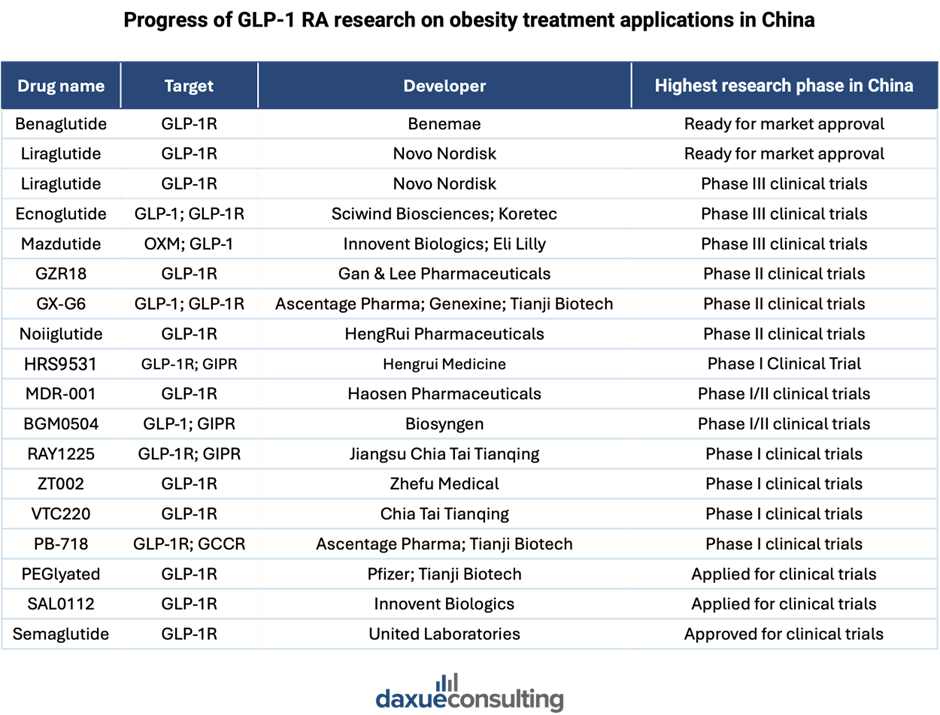
Strong demand and public health concerns continue to stimulate interest in GLP-1 drugs. Players in the Chinese pharmaceutical sector have initiated their own research and development into GLP-1 drugs. Currently, Shanghai Benemae’s beinaglutide, the first GLP-1 drug developed in China, is undergoing clinical trials for the treatment of weight loss, with potential approval expected soon.  The companiesHengrui Medicine

Gan & Lee Pharmaceuticals and Haosen Pharmaceuticals are also investing heavily in research and development to bring GLP-1-based treatments to market.

Source: 36Kr, Designed by daxue consulting, GLP-1 anti-obesity drugs being researched in China

With patents about to expire and the emergence of potentially cheaper local products, the market could become more competitive and accessible. Transparency about the long-term effects and results will be crucial to winning consumer confidence.

For the full article and more details, see the Daxue dossier: Behind the burgeoning popularity of weight loss drug Ozempic in China

VVR Medical and Daxue Consulting specialise in providing strategic and operational support to companies in the medical sector on the Chinese market. Do not hesitate to contact us at contact@vvrmedical.com to receive advice and support from our experts for your project.

Read More
Generative artificial intelligence in China: a rapidly expanding technological revolution

Generative artificial intelligence in China: a rapidly expanding technological revolution

Generative artificial intelligence (AI), a technology that enables the creation of textual, visual, audio and other content, is developing rapidly in China. With applications ranging from artistic creation to scientific research, not forgetting improved business services, this technology is becoming a strategic pillar of innovation. At the forefront of patent filings and research initiatives, China is positioning itself as a major player on the global generative AI scene, consolidating its ambition for technological leadership.


China leads the way in generative AI patent applications

China has been investing heavily in AI for several years, particularly in generative applications. According to the World Intellectual Property Organisation (WIPO), China has filed more patents than any other country in the field of AI over the past decade, accounting for around 60% of worldwide filings.


The patent landscape in China is dominated by large companies such as Baidu, Tencent and Alibaba. These companies are working closely with universities and research centres to develop new applications for generative AI. The synergy between the private sector, academic institutions and the government creates a favourable environment for rapid innovation.


The role of Chinese companies in generative AI

Tech giants such as Baidu, Huawei and Tencent play a central role in China’s generative AI ecosystem. Baidu, for example, has developed its own language model, Ernie, which aspires to rival Western models such as GPT. This model is used for a variety of applications, including automatic content generation, translation and the creation of intelligent chatbots.


Emerging uses and applications of generative AI

Advances in generative AI in China are finding applications in many sectors of the economy.  In marketing, for example, Chinese companies are exploiting generative AI to create tailor-made advertising campaigns tailored to consumer behaviour and preferences. These applications enable greater automation and optimisation of production costs. Huawei is integrating generative AI into its cloud infrastructures, offering solutions for automating processes such as generating reports or creating personalised content.


AI and the cultural and creative industries

AI is also being used in the cultural and creative industries. Tencent has invested in generative AI applications for entertainment, such as script creation and virtual art. In media and entertainment, platforms such as iQiyi and Bilibili use AI models to create content tailored to user preferences, such as animated series or podcasts. There are numerous projects and tests of specific applications, which are gradually being rolled out.


AI, education and scientific research

In the education sector, generative AI is being exploited to develop personalised learning tools, such as chatbots capable of proposing exercises tailored to the level of each student. Applications in the medical field are also promising: AI-based diagnostic systems assist doctors in interpreting medical images or generating complex clinical reports. Start-ups such as SenseTime are exploring applications in the health and finance sectors.


Conclusion: A promising future for generative AI in China

Generative AI represents a strategic opportunity for China, which is establishing itself as a world leader in this field. With massive investment in research, a dynamic technology development ecosystem and applications with high economic potential, China is shaping the future of generative AI. By continuing on this trajectory, China could redefine industry standards, play a central role in the evolution of artificial intelligence on a global scale and make it an asset of its economic and technological power.

Read More
Building a Franco-Chinese team: Tips for successful integration

Building a Franco-Chinese team: Tips for successful integration

Integrating foreign employees into Chinese teams is essential to the effective deployment of business in China, whether they are based locally or working remotely. This is not only crucial to the success of the business, but also an enriching opportunity for the company’s managers. By understanding and respecting local cultural specificities, companies can not only facilitate the building of strong Franco-Chinese teams, but also develop strong cohesion within the team, which will prove to be a decisive factor in productivity.

In this article, we’ll explore practical tips and tried-and-tested strategies to help your foreign employees integrate more easily into everyday life in China. From understanding fundamental cultural values to adapting communication and management styles, every aspect will be covered. The aim is simple: to turn the challenges of integration into opportunities for growth and successful collaboration.

Understanding Chinese working culture

Integrating into a Chinese team requires a thorough understanding of local cultural values and practices. In China, the working culture is shaped by traditions and norms that may seem very different from those in Western countries. Understanding these cultural differences and respecting them on a daily basis is key to successful integration. In this section, we will look at three key aspects of Chinese work culture: hierarchy and respect for elders, the values of collectivism and harmony, and indirect communication styles.

The importance of hierarchy and respect for elders

The Chinese work culture is deeply rooted in traditional values that emphasise hierarchy and respect for elders. Unlike Western cultures, where equality and horizontal collaboration are often valued, the Chinese context favours a clear hierarchical structure. Decisions are generally taken by superiors, and subordinates are expected to follow these directives.

Key values: teamwork, harmony and respect

Teamwork is another cornerstone of Chinese work culture. Unlike Western individualism, success is often seen as a collective effort. The well-being of the team and the company takes precedence over individual interests. This translates into a strong emphasis on collaboration and harmony within the team. Maintaining good relations with colleagues and avoiding direct confrontation are highly valued behaviours.

Differences in communication styles: indirect vs. direct

Communication in China is often more indirect than in Western cultures. Within the company, employees tend to avoid direct confrontation and prefer to use more subtle means to express their opinions or disagreements. For example, the translation of the word “yes” can lead to misunderstandings if it is misinterpreted. In China, it is sometimes used to mean “I understand” rather than “I agree”. This nuance in communication can create misunderstandings if it is not properly understood.

Strategies for successful integration

Here are some tried and tested strategies and innovative approaches that take into account cultural specificities to simplify the integration of foreign employees into a Chinese team and strengthen cohesion within the company.

Intercultural training and cultural awareness

Cross-cultural training is essential to help foreign employees understand and adapt to Chinese cultural norms. This training should cover aspects such as work habits, social protocols and communication expectations.

Innovative approach: Immersive workshops and virtual exchanges

Organise immersive workshops that simulate typical Chinese work situations and social interactions. In addition, anticipate your employee’s arrival by encouraging upstream exchanges with their Chinese colleagues. To do this, you can offer time for discussion during which the future employee can ask questions and where everyone can share their experiences and work practices.

Mentoring and incubation by Chinese employees

Mentoring is an effective way of helping foreign employees adapt more quickly. By assigning a Chinese mentor to each new arrival, you create a supportive relationship that makes it easier to learn cultural and professional nuances.

Reverse mentoring programme

As mentioned earlier, reverse mentoring can also be beneficial. In this model, young Chinese employees mentor foreign managers, bringing a fresh perspective and reversing traditional roles. This encourages a mutual exchange of knowledge and skills, promoting greater cultural understanding on both sides.

Incubation: supporting your employee step by step

In addition to freelance administration, some companies specialising in HR offer an incubation service. At VVR International, we can carry your employee: in this case, we take charge of his or her legal and administrative management. To help them get up and running quickly, our teams welcome them and support them as they set up in China. With the possibility of working on our premises, they will have local contacts, training and a workspace that will enable them to quickly take charge of their new role within your company.

Organising social activities to strengthen ties

Social activities are crucial to strengthening relationships between employees and creating a sense of camaraderie and trust. Regular events allow employees to get to know each other outside the workplace.

Innovative approach : Intercultural team-building events

To take this a step further, team-building events dedicated to intercultural issues in the workplace can help to highlight cultural differences and raise your employees’ awareness of their implications for their day-to-day work, while at the same time strengthening links between teams. For example, cooking workshops in which employees prepare traditional Chinese and Western dishes together, or cultural excursions to explore the local culture can be interesting team-building activities to strengthen the bonds between French and Chinese employees.

Overcoming common challenges

Even with well-planned integration strategies, companies can encounter difficulties when integrating foreign employees into Chinese teams. To avoid these pitfalls, a good knowledge of the points to watch out for can help to achieve a successful and lasting integration.

Managing language differences and misunderstandings

Language barriers can often lead to misunderstandings and frustration. Although many professionals in China speak English, it is essential to recognise the nuances and challenges of multilingual communication.

Technological tools and language training

Technological tools such as real-time translation applications and multilingual communication platforms are invaluable in making day-to-day exchanges more fluid. To take things a step further, language courses tailored to the needs of your foreign employees can be a worthwhile investment in improving the skills of your staff. These courses will focus on terms specific to your sector and expressions commonly used in the workplace. Today, there is a wide range of language learning software with virtual reality functions available, which can be an interesting alternative to traditional language courses. This makes learning more flexible and less expensive.

Adapting management styles to bring them into line with Chinese expectations

Western management styles can sometimes be perceived as too direct or individualistic in China. Adapting these styles so that they are more in tune with local cultural expectations is crucial to effective management.

Innovative approach : Intercultural leadership workshops

An inclusive work environment is essential for employee satisfaction and productivity. This means respecting cultural differences and promoting an atmosphere of respect and collaboration.

Organise cross-cultural leadership workshops where foreign managers can learn to adapt their management style to suit Chinese expectations. These workshops can include role-playing, case studies and group discussions on best management practices in a cross-cultural context. Integrate e-learning platforms to offer continuous training modules and resources that can be accessed at any time.

Conclusion: successful integration is a worthwhile investment

Integrating foreign employees into Chinese teams is essential for success in China. By understanding the working culture, adopting innovative integration strategies and overcoming common challenges, companies can create a harmonious and productive working environment. Successful integration has a direct impact on a company’s overall performance.

VVR International and its HR department can help you create or strengthen your teams in China. Thanks to our teams and our coaching and portage services, we can take charge of your employee and support him or her in settling in and integrating, both culturally and legally and administratively. With VVR International, you benefit from local expertise and personalised support to ensure the successful recruitment and integration of your employees in China.

Read More
Recruiting in China and Europe: Key Differences and Practical Insights

Recruiting in China and Europe: Key Differences and Practical Insights

1. Introduction

For global businesses, recruiting in China and Europe is more than just filling positions. It requires navigating labor laws, cultural norms, and fast-changing recruitment channels. The hiring process in China differs greatly from European recruitment practices. Companies that adapt can build efficient, compliant teams. Those that do not risk compliance issues, higher costs, and talent shortages.

This article compares recruitment and selection practices in China and Europe, providing practical insights for foreign companies. We – VVR RH, cover staffing systems, wage calculations, expat hiring, labor relations, digital platforms, and cultural factors. We also highlight how sustainability and workforce strategies will shape HR in 2026. 

2. Recruiting in China vs Europe: A Comparative View

HR strategies vary widely between China and Europe. Differences stem from regulation, culture, and economic structures. Understanding them is essential for foreign companies hiring employees in China, entering the Chinese market, or expanding into European markets.

  • Wage and benefits calculation systems

Payroll outsourcing in China is complex due to the mandatory contributions required. Employers must handle salaries, social insurance, and housing funds. Rules vary by city, making compliance difficult without local expertise. In Europe, wage structures vary, but contributions to healthcare, pensions, and unemployment insurance are universal. Compensation benefits are often influenced by collective agreements and vary by sector. 

China’s wage determination combines national legislation, local regulations, and individual negotiations.

China’s wage determination combines national legislation, local regulations, and individual negotiations.

  • Hiring foreign citizens and expats 

Hiring expats in China requires strict work permits. Employers must prove that no local candidate can fill the role. Permits are tied to qualifications and company quotas. The process is detailed and time-consuming. In Europe, mobility is simpler. The EU Blue Card allows skilled professionals to work across member states. Intra-EU mobility makes expat hiring easier, although each country still applies its own rules. 

  • Labor relations and contracts 

In China, contracts are non-negotiable. Employers must issue them within 30 days of hiring. Non-compliance triggers penalties. Labor disputes fall under Chinese labor law, which strongly protects employees. In Europe, contracts are also mandatory but vary by country. Many states allow flexibility through collective bargaining. 

Labor contract termination is sensitive in both China and Europe regions.

Labor contract termination is sensitive in both China and Europe.

However, termination is sensitive in both regions. In China, employers need lawful grounds such as redundancy or misconduct. Documentation and severance are required. Procedures are formal, and employee protections are strong. In Europe, termination depends on national law. The UK allows relatively more flexibility. Germany and France require strict justification and works council involvement. Therefore, plan exits early, document performance, and seek legal advice before acting. 

HR comparative table between China & Europe

Recruitment factors  China  Europe 
Hiring channels  WeChat, 51job, Zhaopin, referrals  LinkedIn, EURES, agencies 
Contracts  Mandatory written contracts, strict labor law  Country-level rules, collective agreements 
Expats  Strict permits, quotas, cultural barriers  EU Blue Card, intra-EU mobility 
Termination  Complex, highly regulated  Varies, generally more flexible 
IP & confidentiality  Must be enforced by employers  Strong EU-level protections 
Employee relations  Guanxi (relationships), hierarchy  Transparency, work-life balance.

3. Types of Labor and Employment Flexibility

China’s labor market is heavily shaped by state regulation. Full-time contracts remain the dominant form. Part-time or gig roles are limited in scope. This reflects the government’s priority on social stability and predictable employment. For foreign companies, this means less room to experiment with short-term hires or flexible project-based models.

Europe, in contrast, is built on a wider range of labor types: permanent, temporary, agency, freelance, and apprenticeship contracts. Countries like the Netherlands and Denmark apply the Flexicurity model, which balances employer flexibility with employee security. Workers may move between jobs more easily because unemployment protection and retraining programs are strong.

Practical takeaway: In China, expect a formal and regulated approach when hiring employees. In Europe, foreign firms can adapt contracts to business cycles but must respect country-specific labor laws.

4. Employee Development and Retention 

Retention is one of the top HR challenges worldwide, but strategies diverge between China and Europe. 

In China, employees often seek rapid career development and visible growth paths. The country’s fast-changing economy fuels strong competition for talent, especially in IT, engineering, and e-commerce. Many young workers value training, certifications, and international exposure. Companies that invest in training and clear promotion tracks tend to retain talent more effectively. In Europe, employees emphasize work-life balance and workplace stability. High expectations for benefits, flexible hours, and remote work are common. 

Both regions also embrace digital transformation in training. E-learning platforms, AI-driven career planning, and employer branding campaigns highlight opportunities for long-term growth. 

Practical takeaway: In China, focus on career growth, training, and rapid advancement. In Europe, you should invest in flexible policies, recognition programs, and meaningful work culture. Aligning strategies with these expectations ensures lower turnover and stronger engagement

5. Recruitment Channels & Digital Platforms: China vs Europe

Both the channels and the digital execution of recruitment are different in China and Europe.

Both the channels and the digital execution of recruitment are different in China and Europe.

In China, hiring is local and mobile-first. WeChat anchors outreach, screening, and follow-up. Job boards such as 51job and Zhaopin remain popular, while referrals based on guanxi (relationships) play an important role. Foreign firms often engage a recruitment company in China or use HR outsourcing services to stay compliant with Chinese labor law. 

In Europe, recruitment is more structured. LinkedIn dominates for skilled and managerial roles. EURES (European Employment Services), national portals, and specialist agencies connect employers with talent across borders. In addition, Applicant Tracking Systems (ATS) and AI-driven platforms streamline selection while ensuring GDPR compliance. Employer branding campaigns are critical in attracting talent in competitive markets. 

Practical tip: In China, add WeChat and local boards to your hiring mix. In Europe, pair LinkedIn with ATS and branding. If compliance and speed are priorities, consider outsourcing the hiring process to a local HR partner. 

⇒ Discover more information about how to build efficient recruitment and portage in China. 

6. Understanding Cultural & Social Differences between China and Europe 

Culture shapes the hiring process as much as labor law. For foreign companies, ignoring cultural differences can create misunderstandings and poor hiring outcomes. In China, guanxi (personal relationships and networks) is central. Recruitment often goes beyond résumés and job descriptions. Employers value loyalty, respect for hierarchy, and a strong sense of belonging to the group.  

Personal questions during interviews are common, as they help assess whether a candidate will fit into the company’s social fabric. Decisions may also be influenced by recommendations within networks. This reflects China’s collectivist orientation in Hofstede’s model, where cooperation, trust, and long-term relationships matter more than individual achievement. 

European recruitment is usually more structured and transparent. Employers rely on standardized job postings, competency frameworks, and formal interviews. Equality, compliance, and non-discrimination are central values. This reflects a more individualistic culture, where skills, personal merit, and career potential outweigh networks or personal connections. Candidates are judged by their qualifications and performance, not their relationships. 

Hofstede’s model further highlights other contrasts: 

  • Uncertainty avoidance. Many European countries have higher scores, leading to structured recruitment processes, detailed contracts, and formal compliance to reduce risk. China scores lower, showing more tolerance for ambiguity, which translates into flexible and adaptive hiring methods. 
  • Indulgence vs. restraint. Europe leans toward indulgence, supporting work-life balance and open expression during interviews. China is more restrained, where professionalism and modesty dominate recruitment interactions. Candidates are expected to show discipline and respect for authority rather than personal ambition. 

Practical takeaway: In China, build trust through relationships and demonstrate respect for hierarchy. In Europe, prepare for structured assessments and emphasize skills and transparency. Adapting to these cultural expectations not only improves recruitment success but also strengthens long-term employee engagement. 

7. Sustainable Workforce in China: Pros & Cons

Recruiting for a multinational enterprise in China presents challenges: 

  • Complex compliance under Chinese labor law. 
  • Intense competition for skilled talent in technology and engineering. 
  • Cultural gaps that require adaptation. 
  • Employee turnover in urban hubs is especially high among younger staff. 

Despite challenges, China offers vast potential: 

  • Large talent pool in STEM fields. 
  • Government incentives for high-tech, advanced manufacturing, and green industries. 
  • Expanding middle class driving demand for foreign employees. 
  • Specialized recruitment companies in China and HR outsourcing services to support compliance.

Read more related articles


8. Conclusion: Key Takeaways for Companies Recruiting in China

Foreign companies need balanced HR strategies. Compliance with Chinese labor law is non-negotiable. At the same time, cultural adaptation is essential for successful hiring in China. Partnering with recruitment companies in China or using HR outsourcing services in China ensures compliance and efficiency. Leveraging digital tools like WeChat for hiring employees in China gives access to a wide talent pool. 

Finally, when comparing recruiting in China vs Europe, remember: 

  • China requires more compliance and local expertise. 
  • Europe offers more flexibility, but it varies by country. 
  • Both regions reward companies that adapt culturally. 

To sum up, recruitment is never one-size-fits-all. Foreign firms must adjust their strategies for recruiting in China and Europe. From contracts to culture, each factor impacts success. For companies hiring employees in China, the key is to navigate labor law, use the right recruitment channels, and build strong relationships. For Europe, success comes from transparency, flexibility, and employer branding. 

👉 By partnering with trusted experts such as VVR International, foreign companies can simplify the hiring process, remain compliant, and secure the talent they need to grow.  📩Contact us today to discover how to recruit in China. Explore how our HR outsourcing services can help your business hire employees, manage payroll, and stay compliant. 

Share your project with us via contact@vvrinternational.com.

CONTACT US

FAQ

  • What are the main HR challenges in China that outsourcing helps foreign companies solve?

The main HR challenges in China include compliance with labor contract law, managing payroll across different cities, handling social insurance and housing fund contributions, and navigating work permit requirements for foreign employees.

HR outsourcing for foreign companies in China addresses these issues by providing local expertise, payroll outsourcing services, contract management under mutual agreement rules, and support for work permits. This allows companies to operate smoothly while minimizing legal and operational risks.

  • How do HR outsourcing services in China support strategic HR management and long-term growth?

HR outsourcing services in China support strategic HR management, aligning with modern HR practices in China, including digital HR solutions, employee retention strategies, and ESG-focused HR policies. By outsourcing HR functions, companies gain access to market insights, salary benchmarks, and compliance monitoring, enabling them to build sustainable teams in China while adapting to workforce trends and long-term business objectives.

Related Posts

Read More
China opens opportunities for foreign-owned hospital operations: What foreign healthcare companies should know

China opens opportunities for foreign-owned hospital operations: What foreign healthcare companies should know

Foreign-owned companies can now direct clinical operations and open 100% foreign owned hospitals in some Chinese cities. On September 7th 2024, China’s Ministry of Commerce, National Health Commission and the National Medical Products Administration announced the opening up the medical sector and, in particular, medical innovation to international players. As of this date, foreign-owned companies are now allowed to:

  • Direct clinical operation of gene and cell therapies, as well as genetic diagnostics, for regulatory registration purposes (NMPA), in the special economic zones of the three major coastal cities (Beijing, Shanghai, Guangzhou) and on the island of Hainan;
  • The opening of 100% foreign-owned international hospitals (excluding traditional Chinese medicine and the acquisition of a public hospital) in Beijing, Tianjin, Shanghai, Nanjing, Fuzhou, Suzhou, Guangzhou, Shenzhen and Hainan Island.

What do these policy changes mean for foreign healthcare companies in China?

In a way, this announcement resonates as a counterpoint to VBP (Volume Based Procurement), deployed in 2020, a policy aiming to achieve a lower price of medical care through high-volume procurement, whose intentions, while logical and laudable in macro-economic terms, demonstrated during the system’s implementation that is sometimes counter-productive on the innovation front. Indeed, in many cases, the economic equation for innovative products on the Chinese market can prove untenable for foreign innovators, with purchasers preferring so-called “museum” products in the VBP context.

This announcement therefore illustrates the Chinese government’s recognition of this situation, and its ongoing determination to attract innovation in health products and services, under economic conditions that are once again attractive to international healthcare innovators.

In concrete terms, after the major efforts made in the post-Covid period to digitalize the patient pathway (to an extent already ahead of many Western countries), the aim is to continue to drive the ongoing progress of the entire medical industry:

  • In terms of healthcare provision, the procedures for purchasing from public hospitals and validating the level of reimbursement by the Chinese social security system often delay the deployment of new therapeutic and diagnostic approaches by several months or even years.
  • In hospital management, to avoid the wasteful practices that still exist at various levels of hospital administration.
  • In terms of patient satisfaction, as the measured levels of satisfaction with public hospitals in China still leave much to be desired.

Moreover, as is customary with the Chinese government, the decision is multifactorial. Thus, the positive consequences of this announcement for the country, its population, and the general environment of the healthcare industry are numerous.

How the opening of China’s medical industry benefits patients

  1. Mobilize savings from the middle and upper classes towards the real economy, at around 45% in 2021, China’s savings rate significantly surpasses the global average savings rate of 26.5%. China bets here that wealthy Chinese will allocate an ever-increasing share of their family budget to healthcare, as can already be seen in existing international hospitals, where Chinese patients are by far in the majority compared to foreign patients – which was not the case just ten years ago.
  2. Accelerate the growth of the private medical insurance sector, in terms of both volume and actuarial skills, in order to continue to control public health spending and develop a whole area of financial services that is currently immature compared to the major Western countries. Notably, the situation in this field has already been improving for several years, thanks in part to innovative public-private partnerships.

China’s healthcare professionals benefit from the entry of foreign-owned healthcare

  1. Providing new career opportunities for the strictly “medical” staff of the public hospital, private hospitals in China are known and recognized for paying better salaries and offering better working conditions.
  2. Continue the process of specializing public hospitals in translational and clinical research (many large public hospitals are affiliated to a university with a medical curriculum), by increasing funding for physician-researchers and multiplying the number of world-class clinical trial centers – a trend already underway since 2018.
  3. The aim is to create an incentive for young Chinese to enter the medical and medical-scientific professions, by restoring the attractiveness they have lost in recent years due to the imbalance between pay and workload and the “glass ceiling” that has been reached too quickly.

How China’s healthcare opening boosts innovation

  1. Promote medical innovation, by facilitating the rapid market entry of innovative drugs and medical/diagnostic devices via private hospitals: these are not subject to the strict rules of public tenders (VBP or others), and therefore purchase their healthcare products at more or less “international” prices. With the combined population of the above-mentioned cities and their immediate surroundings exceeding 150 million, there is little doubt that such a market will prove profitable;
  2. Encourage the emergence of specialized medical distributors in the private hospital channel: as this type of distributor is still relatively rare, it is highly likely that new, high-caliber players will emerge in the next few years. This will enable innovative healthcare products to penetrate the Chinese market via multiple channels, with accelerated profits from the “private” channel supporting gradual entry into the “public” channel.

What is the next step for foreign health and medical tech companies to enter China?

In the ever-changing context of China’s human health and medical technology industry, it is essential for innovative health companies to obtain information and data from sources that are in direct contact with the country’s real developments and therefore understand the nuances of the market. We equip human health and med tech companies with clear, substantiated recommendations, backed up by a realistic, costed action plan.

VVR Medical/Daxue Consulting, leaders in strategic and operational support for companies in the medical sector on the Chinese market. Don’t hesitate to reach out to sustain your healthcare company’s presence in China. We look forward to hearing from you!

Read More
Press release: Daxue Consulting joins VVR International

Press release: Daxue Consulting joins VVR International

Press release

Consulting and business services – China / Asia
Daxue Consulting joins VVR International

Paris / Shanghai, July 25, 2024 – Daxue Consulting, a market research and strategy consulting firm that has supported over 400 clients in China and Asia since 2012, and VVR International, a consulting and organization services provider having facilitated the industrial and commercial development of over 1,000 companies in China since 1999, today announce their strategic merger to form a leading group on China-related issues.

The skills and expertise of Daxue Consulting, specialized in identifying and mobilizing the growth levers of its customers in China and Asia, remarkably complement the operational capabilities of VVR International, whose mission is to define and implement innovative organizational models that will enable the Group’s clients, whatever their sector of activity, to develop in these markets ambitiously, securely, and sustainably.

With more than 70 consultants combined (excluding PEO employees), including over 60 in China, spread across 8 offices managed by an Executive Committee of 9 French and Chinese partners, the Group aims to become the leader in strategic and organizational consulting for companies in China. VVR International and Daxue Consulting provide their global clients – multinationals, ETIs, SMEs and start-ups alike – not only with a clear, quantified vision of their growth opportunities, but also with the ability to implement this vision, via a set of particularly innovative and solid operational, regulatory and HR services.

Capitalizing on their strong brand awareness, both entities will continue to operate under their own brand names. The Daxue Consulting and VVR International teams in Shanghai are joining forces immediately, to accelerate synergies and foster the rapid development of an integrated consulting and services offering. In particular, the Group will increasingly draw on the unrivalled expertise of its consultants in the fields of business development, digital, medical technologies and capital partnerships in China.

Matthieu David, CEO and founder of Daxue Consulting:

“The alliance between Daxue Consulting and VVR will enable companies worldwide which are invested in China to benefit from business development solutions at both strategic and operational levels. For Daxue and its team, VVR’s operational offering is the ideal complement to Daxue’s mission to serve our clients in both the strategy and execution of their ambitions in China. It should be added that this merger will enable Daxue to draw on VVR’s expertise in the medical field, negotiation, and distribution issues“.

Camille Verchery, CEO and founder of VVR International:

“The integration of Daxue Consulting’s expertise will enable us to offer our clients high-quality strategic market research and relevant marketing skills, particularly in the healthcare and BtoC sectors. The new group will achieve sales of 10 million euros. What’s more, the group’s growth will justify greater investment in new technologies. Last but not least, the culture, the DNA of our teams and our values are incredibly similar, which is ultimately the most important thing for the development of our employees, and therefore performance for our clients“.

About Daxue Consulting

Founded in 2012, Daxue Consulting is a strategic market research and consulting firm specializing in the Chinese market, with offices in Beijing, Shanghai and Hong Kong.
Through strategic market research tailored to the needs of its clients (large international companies and SMEs), Daxue Consulting’s team defines unique and fine-tuned growth strategies in the Chinese market.
Thanks to a combination of digital data collection tools and traditional investigation methods, Daxue Consulting has supported over 400 clients through 600 projects, in sectors as varied as F&B, beauty, food, cosmetics & luxury, healthcare, video games, e-commerce and numerous industrial sectors.

About VVR International

Founded in 1999, VVR International is a consulting and services company that assists companies from all over the world in their industrial and commercial development in China.
VVR International’s core business is to secure and perpetuate its clients’ development in China by setting up sustainable and innovative organizations.
Over the past 25 years, VVR International has managed more than 1,000 projects in China, including over 350 distribution projects (strategic diagnosis, development of sales networks, recruitment, PEO and setting up of sales structures), 250 capital partnership projects (technology transfer, setting up of own operations, joint ventures, fund-raising, mergers, acquisitions), and over 400 purchasing/quality projects (sourcing, auditing, product development, quality control) in 20+ business sectors.
VVR International is a founding member of Globallians and Medicallians.

Download the press release:

Read More
Cosmetics regulations in China: What foreign brands need to know

Cosmetics regulations in China: What foreign brands need to know

The Chinese cosmetics market has become a major global player, attracting many foreign brands. However, setting up a successful business in China requires a thorough understanding of the strict regulations that govern the sector. This article examines the key regulations concerning cosmetics ingredients in China, their importation, marketing and commercialisation, with a particular focus on the implications for foreign brands.

The new CSAR regulations

On 1 January 2021, China introduced a new global regulatory framework for cosmetics: the Cosmetic Supervision and Administration Regulation (CSAR). This regulation replaces the old rules dating back to 1989 and aims to improve the safety, quality and efficacy of cosmetic products on the Chinese market. The CSAR introduces an obligation to assess the safety of each product and strengthens control throughout the product life cycle. The regulation also introduces new requirements for efficacy claims and new definitions and classifications for cosmetic products and their ingredients.

Although the CSAR has officially been in force since 2021, its full implementation is being phased in gradually until 2024, with the introduction of additional implementing regulations. The list of prohibited ingredients drawn up by the National Medical Products Administration (NMPA), for example, has been regularly amended and extended since 21 March 2024 to include 5 new ingredients. At the same time, the testing protocols have been modified and will come into force in December 2024. This change introduces 11 new test methods and revises 3 already in use.

From 1 May 2024, all cosmetic products marketed in China will have to undergo a full safety assessment, replacing the simplified version currently accepted.

The inventory of cosmetic ingredients (IECIC 2021) has been updated. It lists the 8783 authorised ingredients. Safety data for all new ingredients must be submitted to the authorities. The aim of this regulatory update is to better control the quality and safety of cosmetics imported or produced in China, in a fast-growing market.

Importation of Cosmetic Products

Product registration :

Before importing cosmetic products into China, foreign brands must register their products with the National Medical Products Administration (NMPA). This process can be complex and time-consuming, requiring the submission of detailed technical files, safety tests and compliance with local standards. For example, so-called ‘special cosmetics’ (such as sun protection products, hair dyes and hair loss products) must be registered and tested, a process that can take several months.

Animal Testing Requirements :

Historically, China required animal testing for all imported cosmetics, which posed an ethical problem for many international brands. Since May 2021, so-called “ordinary” cosmetics (such as skin care products, hygiene products and make-up) can be exempted from this requirement if certain conditions are met, such as Good Manufacturing Practice (GMP) certification by the country of origin.

Marketing and Sales

Advertising regulations :

All products, whether sold on the domestic market (offline or online) or on cross-border e-commerce (CBEC), must comply with Chinese advertising laws. Claims requiring administrative approval from the Chinese government are not permitted without the corresponding certificate. For example, cosmetics advertised as being for sensitive skin or simply improving skin elasticity must undergo efficacy tests on humans or consumer tests to assess the efficacy claim.

Product Supervision Solution
Cosmetics with general claims: moisturising, anti-oxidant, etc. Less strict Regulatory restrictions can be avoided by using alternative arguments
Cosmetics with specific claims: sensitive skin, etc. Very strict supervision Sanctions will be applied if these claims are not accompanied by efficacy tests on humans or consumer tests.

 Sales channels :

  • Cross Border E-Commerce: Supervised by the General Administration of Customs of China (GACC), trademarks will be reported to the local authorities by anti-counterfeiting professionals against the illegal use of arguments.
  • Domestic market: Overseen by the State Administration for Market Regulation, advertising and designations are strictly supervised.

Ingredients and Formulation

List of Prohibited and Restricted Ingredients :

The NMPA maintains a list of prohibited and restricted ingredients in cosmetic products. Brands must ensure that their formulations comply with this list. For example, certain preservatives and colourings commonly used in other markets may be banned in China.

Certification of Ingredients :

Brands must also provide detailed information on the ingredients used in their products, including certificates of analysis and evidence of safety. New substances used in cosmetic products must be approved by the NMPA before being placed on the market.

Labelling and Packaging

Labelling requirements :

Cosmetic products sold in China must comply with strict labelling requirements. This includes the translation into Chinese of all relevant information, such as the name of the product, the list of ingredients, instructions for use and precautions. In addition, the label must include the name and address of the Chinese importer, and of the responsible body in the event of an incident.

Mandatory information :

The label must also indicate the date of manufacture and the product’s shelf life. Cosmetics intended for children or people with sensitive skin must include specific warnings. Failure to comply with labelling requirements may result in products being withdrawn from the market.

Cosmetics advertising

Cosmetics advertising in China is subject to strict rules to protect consumers from misleading information and unsubstantiated claims.

Prohibitions on advertising :

  • Falsify or exaggerate the name, manufacturing method, ingredients, effectiveness or performance of cosmetic products.
  • Using another person’s name to guarantee or mislead others as to effectiveness.
  • Communicate medical effects or use medical terminology (e.g. cosmeceuticals, prescriptions, antibacterials, sterilisation, etc.).
  • Denigrate the similar products or services of other producers or operators.
  • Using or concealing the name or image of a State body or its staff.
  • Indicate or imply that the efficacy, quality or safety of cosmetic products have been recognised by the State authorities through registration, filing, certification and other activities of State bodies.

Authorised claims :

  • Advertisements must be consistent with the content of the product registration or filing documents. For example, a product registered in China as having a whitening function cannot use the argument of sun protection.
  • The following effects are authorised in China: hair dyeing, perming, freckle whitening, sunscreen, hair loss prevention, acne elimination, moisturising, anti-wrinkle, soothing, etc. Cosmetics claiming to have additional effects or to be suitable for specific groups must provide a special registration certificate.
  • The data and quotations used in advertising must be true and accurate, and the source must be indicated.

Restrictions on Terms and Claims :

  • It is forbidden to use terms such as “national level”, “superlative”, “best”, “first”, “premium”, “top”, “latest innovation”, “pure natural products”, “organic products”, “without side effects”, “food quality”, etc.
  • The arguments “gentle and non-irritating”, “sensitive skin”, “does not sting the eyes” require an assessment of efficacy, including human efficacy tests, consumer tests or laboratory tests.

Conclusion

The cosmetics market in China represents a considerable opportunity for foreign brands, but it is governed by strict regulations that can be complex. Understanding import, marketing, formulation and labelling requirements is essential for a successful and sustainable business. Despite the challenges, brands that are able to comply with regulations and adapt their marketing strategies to local preferences can thrive in this dynamic and growing market. With growing demand for beauty products and an increasingly sophisticated consumer population, China offers exciting prospects for the global cosmetics industry.

If you are interested in the cosmetics market in China and would like to find out more about consumer habits, Chinese regulations governing the import and sale of skincare products and cosmetics, or the role and importance of the responsible body, contact VVR International. Our experts in the field will be happy to answer your questions.

Read More