Category: Expertise

Learning expedition in China: an immersion to understand the innovation and culture of a changing market

Learning expedition in China: an immersion to understand the innovation and culture of a changing market

Why is immersion becoming an essential step before launching a business in China?

Understanding the Chinese market from within China

The Chinese market attracts companies from around the world due to its size, capacity for innovation, sustained growth, and vast opportunities in cutting-edge sectors. But China is also a complex market with its own dynamics, unique business culture, and rapid changes. For foreign companies, it is not always enough to consult reports or follow trends from a distance. Field experience can therefore be an asset in preparing for expansion in China, enabling informed decisions to be made and strategies to be adjusted.

This is why learning expeditions are a valuable tool for better understanding the Chinese market. At VVR International, our teams in France and China design and organize these immersive trips tailored to each project, in order to offer groups of companies a precise and strategic vision of the Chinese market.

What is a learning expedition in China?

The concept of a “learning expedition” is a short trip (usually between 4 and 8 days) during which a group of decision-makers, executives, or business managers meet with key players in an ecosystem: companies, institutions, incubators, start-ups, R&D centers, etc.

A learning expedition is not just a business trip punctuated by a series of visits; it is designed to be an immersive experience, with strategic objectives defined in advance with the help of our teams of Chinese market experts:

  • Explore a sector or market,
  • Identify opportunities,
  • Understand local practices,
  • Draw inspiration from models of innovation,
  • Establish initial contacts.

This format is particularly relevant in China. The country is vast, diverse, evolving at a rapid pace, and often operates according to principles that are very different from those of Western markets. Immersion, direct observation, and contextualization provide a better understanding of China and its potential for development in this market.

It should be noted that for nationals of many countries, including France, visas are no longer required to enter China for stays of 30 days or less (for more information, read our article “Making a success of your first business trip to China”).

Immersion in the heart of the Chinese industrial ecosystem: what are the objectives for foreign companies?

The learning expedition enables companies to reduce uncertainty about the Chinese market by providing a concrete understanding of it. Each mission is built around several key objectives that enable participants to improve their understanding of China:

1. Decoding the specificities of the Chinese market

Chinese consumers do not have the same expectations, purchasing practices, and preferences as consumers in European countries. Regulations and the competitive landscape are also very different from those in European countries. By meeting with local companies, experts, and institutions, participants gain a direct understanding of the realities on the ground:

  • How do consumers make their decisions?
  • What are the rules for accessing the market in a given sector?
  • How are local partnerships built?

2. Draw inspiration from Chinese innovations

China is now a global driver of innovation in sectors such as green tech, automotive, smart cities, energy, healthcare, and logistics. Seeing these innovations at work, both in industry and manufacturing and in marketing and distribution, allows participants to challenge their own models and identify opportunities for collaboration or adaptation.

3. Make useful contacts

A learning expedition opens doors. Whether through B2B meetings, site visits, or informal exchanges, companies can forge initial links with potential partners, suppliers, customers, or local influencers.

4. Become familiar with Chinese business culture

In China, understanding cultural customs, negotiation mechanisms, and social codes is important for success. Immersion allows you to grasp these subtleties, which are often invisible from a distance but crucial for building a relationship of trust.

5. Refine your development strategy in China

Upon returning from China, participants have tangible elements to adjust their strategy: which regions to target? Which entry model to adopt (distribution, partnership, JV, subsidiary, license)? Which products or services to adapt? The learning expedition thus becomes a decision-making tool. The VVR International teams then assist participants in analyzing and adjusting their development strategy in China.

China: a laboratory for innovation and a market of the future

China is a leading technological player. It invests heavily in R&D, actively supports the emergence of cutting-edge companies in many strategic fields, and develops innovation hubs across all its regions.

Some particularly innovative sectors:

  • Tech and digital: ultra-integrated e-commerce, mobile payment, AI, connected objects.
  • Mobility and energy: electric cars, batteries, shared mobility solutions.
  • Industry 4.0: automation, robotics.
  • Smart cities: urban flow management, big data, connected infrastructure.
  • Agri-food: traceability, food safety, food tech.
  • Medicine

Observing these trends from the inside allows foreign companies to better understand market expectations and potential levers for differentiation.

How does VVR International support companies in their learning expeditions?

A tailor-made and locally-based approach

Organizing an effective learning expedition in China cannot be improvised. VVR International offers federations, professional organizations, business associations, and clusters tailor-made support. Our experts have in-depth knowledge of China and its industry, mobilize the right contacts, and provide high-quality cultural support.

With more than 25 years of experience in China, VVR International designs learning expeditions that are tailored to the objectives, sector, level of international maturity, and schedule of each group of participants.

Our services include:

  • Upstream strategic framing: understanding objectives, selecting priority geographical areas and sectors.
  • Complete program organization: identifying companies to visit, experts to meet, and building an optimized itinerary.
  • On-site support: professional interpreters, intercultural consultants, turnkey logistics (transportation, accommodation, catering).
  • Daily debriefings and final summary: putting things into perspective, key lessons learned, strategic recommendations.
  • Post-mission follow-up: connecting with partners, analyzing identified opportunities, support for the next phase.

What participants take away from a learning expedition

Learning expeditions are often “trigger” moments, allowing you to move from intention to action, or, conversely, to readjust a strategy and avoid costly mistakes. The strength of a learning expedition lies in the combination of concrete observations, informal exchanges, cultural discoveries, and collective reflection.

Understanding China to effectively prepare for development

Expanding into the Chinese market requires serious and meticulous preparation. Learning expeditions are a strategic step in the process of reflection and acculturation. These well-prepared trips, accompanied by experts in the Chinese market, are a valuable tool for field analysis that can be decisive when considering or initiating a development project in China.

For more than 25 years, we have been helping foreign companies succeed in their industrial or commercial development in China, supporting them at every stage of their project: market analysis, identification of opportunities, search for partners, institutional networking, legal and operational structuring, intercultural management, etc.

Contact our experts to build a strategy tailored to your sector and the realities on the ground in order to secure each stage of your project in China and thus sustain your activities in the Chinese market.

Read More
China’s railway network: rapid development to support domestic mobility

China’s railway network: rapid development to support domestic mobility

China’s rail network: beyond compare

China now has the largest rail network in the world, with over 162,000 kilometers of track, including 48,000 km dedicated to high-speed rail.

The network is designed to efficiently serve the entire country, connecting major cities such as Beijing, Shanghai, Guangzhou, Shenzhen, and Chengdu, as well as secondary cities that were previously underserved.

The iconic Beijing–Shanghai line, inaugurated in 2011, illustrates this ambition: 1,318 km long, it connects the country’s two largest cities in less than 4.5 hours, with commercial speeds reaching 350 km/h. The longest high-speed line, Beijing-Guangzhou (2,298 km), takes 8 to 10 hours.

An ambitious rail development plan for 2035

China’s rail development shows no signs of slowing down. The Chinese government has set targets in its 2021–2035 rail master plan, a major strategic policy supported by significant public investment aimed at developing a national rail network:

  • 200,000 km of railways planned by 2035,
  • including 70,000 km of high-speed lines, making high-speed trains accessible to cities with more than 500,000 inhabitants, with a very dense network covering all key economic regions.
  • Systematic rail connection of cities with more than 200,000 inhabitants,
  • Increasing the maximum speed of high-speed trains to 400 km/h, while improving comfort, reducing energy consumption, and lowering long-term operating costs.
  • Reduction in travel times: the ongoing development of ultra-high-speed trains (up to 400 km/h from 2027) should further accelerate travel times on major lines.

The aim is to enable widespread access to high-speed trains, with increasingly fast and optimized interurban journeys. This project is part of a drive to strengthen territorial cohesion and support regional economic development, particularly in the interior and western parts of the country, by promoting low-carbon mobility for people and freight transport.

Cutting-edge rail technologies to strengthen the Chinese network

China is also investing in innovation to enhance the efficiency and safety of its network:

  • The Shanghai Maglev train, which entered service in 2004, remains one of the fastest trains in commercial operation in the world, reaching 431 km/h on a 30 km line between Pudong Airport and the city.
  • Planned investments in 2025: 590 billion yuan (approximately $80.8 billion) to develop and modernize infrastructure.[1]
  • China is working on the commercial operation of ultra-high speed (400 km/h) trains and is also investing in Hyperloop and smart rail technologies.[2]
  • In 2021, the manufacturer China Railway Rolling Stock Corporation CRRC presented a prototype of a 600 km/h Maglev train, which is currently in the testing phase before entering service in the coming years.
  • Many Chinese stations are being modernized and integrated into metro networks, with automated services to streamline passenger flows.

The metro has also undergone extremely rapid development over the past 20 years, growing from just four cities with metro systems before 2000 to around 50 in 2025, with numerous projects and extensions currently underway.

A lever for development in inland regions

The expansion of the rail network also benefits regions in the interior of the country, which have historically been less developed. Provinces such as Guizhou, Gansu, and Yunnan have seen the arrival of high-speed lines connecting them to major economic centers.

This is particularly true of the Chengdu–Guiyang line, which crosses a mountainous region and opens up several rural areas. The journey time has been reduced from 11 hours to just 3 hours, encouraging tourist and business travel.

These infrastructures help to reduce the gap between coastal and inland regions by stimulating mobility, employment, and investment.

A booming mode of transport for both people and goods

Rail transport in China is now one of the most widely used in the world:

In 2023, more than 3.6 billion trips were made by rail in the country, according to the Ministry of Transport, a sharp increase after the end of Covid-19 restrictions.

Trains are now preferred to planes for many domestic routes, thanks to their punctuality, affordable prices, and smooth user experience.

Trains are also used extensively for freight:

  • From January to September 2025, 3.03 billion tons of goods were transported, an increase of 3.4% year-on-year.[3]
  • High priority for essential freight: in 2025, 1.553 billion tons of coal were transported, including more than 1 billion for electricity production. The flow of metallurgical materials (+9.4%) and cereals (+10.8%) increased significantly. [4]

Railways: a showcase for China and a lever for economic development

The development of the railways illustrates China’s ability to carry out large-scale infrastructure projects that are fundamental to its territory and economy.

It also demonstrates a desire to connect all regions and facilitate human, commercial, and logistical exchanges on a national scale. With increasingly ambitious projects, China is confirming its position as a world leader in rail transport, both in terms of infrastructure and transport volumes.

VVR International supports you in your development in China

At VVR International, we are closely monitoring these major transformations that are impacting territorial networks, logistics flows, and urban dynamics in China.

Our expertise in the Chinese market, acquired over more than 25 years, enables us to support you in your development, establishment, or local partnership projects by providing you with precise knowledge of infrastructure, regions, and economic players.

Would you like to better understand the Chinese environment and adapt your strategy to the local context? Contact our teams.

Sources:

[1] China: railway investment up 5.5% in the first half of the year – Xinhua – french.news.cn

[2] China prepares for the era of 400 km/h rail travel | Le Rail

[3] http://french.china.org.cn/business/txt/2025-10/23/content_118138155.htm

[4] China: rail freight volume up 3.4% between January and September

Read More
The cosmetics market in China in 2025: consumers and trends

The cosmetics market in China in 2025: consumers and trends

The cosmetics and skincare market in China reached a value of €69.7 billion in 2024. In 2025, the market is proving resilient despite an economic climate marked by low consumer confidence due to concerns about employment and the property market.

Are e-commerce and social e-commerce supporting the cosmetics market in China?

E-commerce platforms, particularly Douyin, have remained the driving force behind the growth of the Chinese beauty market. In July 2025, the gross merchandise volume (GMV) of Douyin’s beauty category reached nearly 20 billion yuan, an increase of 31.7% over the previous year.

Data from China’s National Bureau of Statistics showed that retail sales of cosmetics rose 4.5% year-on-year in July to 26.5 billion yuan.[1] In addition, online sales for the first seven months of the year recorded a strong increase of 9.2%.[2] Thus, consumers are cautious, but they continue to spend, albeit selectively. The “challenges” for cosmetics lie in the organisation and strategic use of traditional offline channels, while the overall market is supported by the strong performance of online commerce, particularly social e-commerce. The most successful brands are no longer just companies offering quality products: they are companies that analyse trends and master the algorithms and sales logic specific to platforms such as Douyin. Success now depends on deep operational integration with these dominant sales platforms, which requires specific teams and strategies for each platform.

It should be noted that the gross merchandise volume of the platform’s top 20 brands grew even faster, at 56.1% year-on-year, indicating a consolidation of power among the major players who have mastered the platform’s complex ecosystem.[3] Domestic brands are enjoying significant success and have a particularly good grasp of effective marketing and distribution strategies, as well as a better understanding of the domestic market . Hanshu, a brand owned by Chicmax Cosmetic Company Limited, has topped Douyin’s list of beauty brands for the seventh consecutive month.

Nevertheless, the key strategy for top-performing brands such as Hanshu, ELL and Proya is to rely heavily on physical stores. These shops allow them to directly control prices, brand messaging and first-hand customer data, reducing their dependence on third-party distributors or KOLs. This strategy of combining effective online sales with branded stores enables these companies to reach Chinese consumers and become leading players in the domestic market.

Growth in niche cosmetics segments

Certain cosmetics sectors are particularly promising in China, including:

  • Anti-ageing skincare (serums, targeted treatments)
  • Men’s products,
  • Makeup that incorporates the concept of skincare (“makeup care”),
  • Innovation in hair and body care.

Demand from Chinese consumers for targeted and innovative solutions is fuelling the growth of new niche categories. A report by Future Market Insights predicts that the global market for waterless cosmetic powders[4] will grow at a compound annual growth rate of 23.3% in China, far outpacing the overall market.[5] This growth is fuelled by the convergence of sustainability (water conservation) and innovation narratives. These innovative products come in more compact, convenient formats. They also often have a higher concentration of active ingredients. E-commerce is the dominant channel for this segment, accounting for approximately 51.5% of sales in 2025, which shows how much these new categories are being discovered and adopted online.

Understanding Chinese consumer demand in the cosmetics sector in China

A report published in 2025 by Kantar Worldpanel provides a useful framework for understanding this complex consumer behaviour.[6] Among the trends identified are:

  • Fragmentation of demand: brand loyalty is declining, with consumers mixing and matching products from various niche and major brands to meet specific needs, rather than relying on a single brand.
  • Demand linked to specific needs: purchases are increasingly driven by specific scenarios, whether it be morning or evening skincare routines or specialised care products for the rapidly expanding aesthetic medicine market.
  • Convergence of functions: consumers now expect a single product to offer multiple benefits, such as a formula that moisturises and controls sebum, or a whitening product with anti-ageing properties.

Indeed, demand for premium, science-backed products that are considered effective is growing significantly in China. Consumers are willing to pay more for products that deliver tangible results that meet their specific needs. The high-end beauty products sector is expected to capture 53% of the market share in China by 2025, driven by this search for effective, high-quality solutions. [7]

The Chinese cosmetics market in 2025 is both promising and demanding

The growth of social e-commerce, the rise of niche segments and increased demand for high-end products offer real opportunities. But this momentum is accompanied by growing complexity: fragmented consumer expectations, mastery of platforms such as Douyin, a subtle combination of online and offline distribution, and rapid adaptation to new regulations.

In this context, success depends not only on product quality, but also on brands’ ability to integrate all these dimensions into a coherent strategy tailored to the local market.

At VVR International, we have been supporting cosmetics and skincare companies in their development in China for over 26 years. From defining market strategy to operational implementation, regulatory analysis and distribution monitoring, our expertise enables you to launch and sustain your business in China.

[1] July retail sales total up 3.7% year-on-year, growth rate up year-on-year, month-on-month decline stronger than the market (maintained), accessed 16 September 2025, http://pdf.dfcfw.com/pdf/H3_AP202508191730479501_1.pdf?1755622635000.pdf

[2] China’s e-commerce sector posts steady growth in first 7 months …, accessed 16 September 2025, https://english.news.cn/20250823/3b95dd6a31714941945f077739171eb0/c.html

美护及潮玩驱动新消费行业景气度上行, accessed 16 September 2025, https://pdf.dfcfw.com/pdf/H3_AP202508101724900044_1.pdf?1754840698000.pdf

[4] This refers to cosmetic products formulated without water or with a very low proportion of water.

[5] Waterless Cosmetics Powders Market – Future Market Insights, accessed 16 September 2025, https://www.futuremarketinsights.com/reports/waterless-cosmetics-powders-market

[6] Five key FOCUS areas for China’s beauty market in 2025 – Kantar, accessed 16 September 2025, https://www.kantar.com/inspiration/fmcg/five-key-focus-areas-for-chinas-beauty-market-in-2025

[7] China’s Cosmetics and Personal Care Market: Key Trends and Business Outlook, accessed 16 September 2025, https://www.china-briefing.com/doing-business-guide/china/sector-insights/china-s-cosmetics-and-personal-care-market-key-trends-and-business-outlook

Read More
Agri-food in China: a market between dependence and diversification

Agri-food in China: a market between dependence and diversification

A strategic market at the heart of global food tensions

In 2024, China imported 188 billion euros worth of agricultural and agri-food products. This impressive figure reflects a structural reality: despite its desire to move towards self-sufficiency, China must rely on imports to feed its population of 1.4 billion. Rapid urbanization, rising living standards, diversification of dietary habits and pressure on domestic production reinforce this underlying trend.

China’s trade balance is largely in deficit, as the country turns massively to its partners to secure its supplies. 25% of its imports come from Brazil, the main supplier of soy and meat, 12% from the United States, and 8% from the European Union. Also noteworthy: the rise of Asian partners such as Thailand (6%), a sign of the regionalization of trade.

Agri-food in China: a growing sector, targeted needs

Among the agri-food products imported into China, 57% are raw agricultural products, notably :

  • Oilseeds (30% alone),
  • Meats (11%)
  • Aquatic products (9%)
  • Cereals (7%)
  • Fats and oils (6%)

Processed products, including ready-made meals, preserves, sauces and cold meats, account for 45% of Chinese food imports. Finally, alcoholic beverages still account for a small share (2%), but they concentrate a high value and premium demand, particularly in the European wine segment.

This segmentation illustrates strong demand for plant and animal proteins, raw materials and processed products, in response to new consumer habits.

Rising food expenditure reflecting increased purchasing power

In 2024, the average annual food expenditure of Chinese households will reach 32,994 yuan, or around 4,300 euros. This already significant sum climbs sharply in the major metropolises: up to 7,300 euros in Shanghai and 6,786 euros in Beijing. This trend, linked to urbanization, the development of the middle classes and growing purchasing power, is stimulating demand for varied, safe, premium and practical products.

Chinese food imports on the rise

The Chinese market for imported food products is growing at an annual rate of 15%, well above the world average of 4%. Among imported products, the meat and charcuterie sector is experiencing strong growth, with 6.6 million tonnes in 2023, over +2.25% on the previous year[1] . Consumption of ready-to-eat products and snacks is booming, in line with the lifestyles of young urbanites, who prefer quick, healthy and even innovative solutions.[2]

This dynamism offers particularly interesting opportunities for companies capable of combining quality, innovation and understanding of the local market.

Europe as a leading partner for Chinese supplies

In 2024, China imported €14.5 billion worth of European agricultural and food products. This figure is rising, with France leading the way at 4.3 billion euros, followed by Spain, the Netherlands and Germany. What distinguishes Europe in this market is the complementarity of its national offerings: each country exports different products, which limits intra-European competition. Germany exports food preparations, Spain meat and pork products, France wines, cereals and dairy products, the Netherlands dairy products and cereal preparations.


France: European leader with rising exports

China imported 4.3 billion euros worth of French agricultural products in 2024, making France the leading European supplier to the Chinese market by value (30% of European imports are French). Between 2018 and 2023, its agri-food exports grew by 65%, a significant figure that underlines the potential of this commercial partnership.

China is now France’s 8th largest customer by value for agri-food products. France will be China’s 12th largest supplier in 2024.

French exports to China in 2024 are dominated by :

  • Alcoholic beverages (37%), notably wines and spirits;
  • Cereals (27%): France is the leading supplier of barley;
  • Dairy products (9%), in constant growth.

These performances illustrate France’s ability to adapt to the expectations of Chinese consumers, particularly in terms of quality, safety and traceability.

Opportunities for international exporters in the agriculture and agrifood sector

The Chinese market offers numerous opportunities for foreign companies capable of offering :

  • Traceable, safe products that comply with Chinese standards,
  • Formats adapted to the local market and lifestyle,
  • A premium or innovative image,
  • Practical food solutions for the urban lifestyle.

Growth segments for all international players include :

  • Upscale snacking,
  • High added-value dairy products,
  • Fruit, vegetables and processed products,
  • Traditional cereals and breads adapted to local tastes.

Organic produce is also enjoying strong growth in China. By 2022, Chinese consumption of organic food products will be worth 12.4 billion euros, making China Asia’s leading market for organic products, and the 3rd largest in the world.

China’s growing export power in the agri-food sector

Alongside its imports, China is developing its own agri-food exports, which reached $95 billion in 2024. It is particularly active in :

  • Seafood products (fish, shrimps),
  • Processed fruit and vegetables,
  • Cereals and cereal derivatives,
  • Processed products such as sauces and preserves.

China is no longer content to import: it is becoming a global agri-food player, capable of competing in certain segments.

The Chinese agri-food market in full transformation

The Chinese agrifood market is undergoing rapid change, driven by sustained domestic growth, galloping urbanization and demanding consumers. For international players, it’s a promising but demanding market, requiring agility, consistency and a genuine local strategy. Importers must adapt by focusing on :

  • Product innovation,
  • Understanding local habits,
  • Mastery of Chinese regulations,
  • Building solid partnerships with local distributors and platforms.

For over 26 years, VVR International has been assisting food companies with their development projects in China. From strategic positioning, to developing brand awareness, to import and distribution procedures, VVR International’s experts support foreign companies every step of the way.


Sources:

Business France

https://agreste.agriculture.gouv.fr/agreste-web/download/publication/publie/IraCex2425/2024_25inforapcommerceext.pdf

https://www.tresor.economie.gouv.fr/Articles/2024/02/01/la-veille-agri-agro-du-ser-de-pekin-semaine-du-01-fevrier-2024

https://www.tresor.economie.gouv.fr/Articles/2024/11/01/la-veille-agri-agro-du-ser-de-pekin-premiere-quinzaine-d-octobre-2024

[1]  https://www.teamfrance-export.fr/fiche-marche/produits-alimentaires/viandes-et-charcuterie/CN

[2] https://www.lemoci.com/actualites/actualites/agroalimentaire-la-chine-continue-doffrir-des-opportunites-export-malgre-tout/


Read More
Dog or cat? Preferences change in China and the market adapts

Dog or cat? Preferences change in China and the market adapts

In China, pets are particularly popular with young urbanites in search of affection, home comforts and new landmarks. This craze for dogs and cats is driving sustained growth in the pet food and care market of over 13%, reaching an impressive 300 billion yuan (over 40 billion euros) by 2024.

This strong growth is accompanied by deeper transformations in the structure of the pet supplies market in China: changing consumer habits, changing purchasing preferences and distribution channels, the rise of Chinese brands… We take a closer look.

A recent shift in preferences in favor of cats in China

Until recently, dogs were preferred to cats in China. But since 2021, a turning point has been reached: cats now outnumber dogs in Chinese households. By 2024, there were 71 million cats in China, compared with 52 million dogs.

This shift in preferences when choosing a pet may reflect cultural and lifestyle changes. In ever denser cities and smaller apartments, young urbanites prefer cats, which are more independent and better adapted to city life.

This change has a direct impact on market structure. Although the market for dog food, care and accessories remains slightly ahead in value terms, amounting to 155.7 billion yuan in 2024 versus 144.5 billion yuan for cats, forecasts predict a reversal by 2026. Indeed, with annual growth of 10% for cats versus 4% for dogs, the cat market is set to overtake the dog market.

A substantial budget for pet owners in China

China’s pet budget is on the rise. Chinese owners are investing more and more in the well-being and quality of life of their pets. In 2024, the average annual expenditure was 2960 yuan for a dog, or around €410, and 2020 yuan for a cat, or almost €300, a steady rise from around 1800 yuan just a few years ago.

Over 52% of this pet-related spending in China is devoted to food, a lucrative segment that has become strategic for brands and retailers.

Rise of Chinese brands in the pet food sector

One of the major changes in the Chinese pet food market between 2017 and 2024 is the spectacular rise of local brands. Whereas in 2017, foreign brands dominated with 60% of the market, they now hold just 35%, while Chinese brands climb to 65%. In terms of foreign brand market share, American brands dominate.

The success of local brands can be attributed to a number of factors:

  • A significant improvement in the quality of local products.
  • Communication better adapted to the culture and expectations of Chinese consumers.
  • A high-performance omnichannel distribution strategy.

As regards consumer preferences, in 2024, 28% to 34% of consumers said they preferred Chinese brands, while 44% had no clear preference – a figure down on 2023 (47%). Foreign brands, meanwhile, are preferred by 12% to 19% of consumers.

This phenomenon is emblematic of a national reconquest affecting many sectors in China, where consumers no longer systematically consider an imported product to be synonymous with superior quality.

E-commerce and social networks: the preferred purchasing channels for the pet food sector

The Chinese pet food market is largely digitalized.

  • 35% of sales are made via e-commerce, with platforms such as Tmall and JD.com leading the way.
  • 27% use Chinese social networks to promote their products, using KOLs (Key Opinion Leaders) for example, and to sell them.
  • In contrast, retail sales through veterinarians account for only 15% of sales.

The Chinese consumer prefers speed, personalization and direct interaction with the brand. The most successful brands are those that have understood how to transform their communication into an experience: original packaging, educational or humorous video content, community engagement via WeChat or Xiaohongshu…

What opportunities are there for foreign pet food brands in China?

Faced with this changing market, foreign brands need to adapt their strategy. Importing quality products is not enough to establish a long-term presence on the Chinese market:

  • Localize your offer to suit the specific needs of pets and their owners in China
  • Forge partnerships with Chinese distributors and influencers to gain visibility.
  • Invest in localized content: videos, WeChat mini-programs, educational live events on animal nutrition, etc.


China: the world’s leading pet food market?

China is fast becoming the world’s largest pet food market, driven by a growing love of cats, a demanding and connected urban population, and increasingly successful local brands.

For foreign companies, the challenge lies in fully understanding the market and the expectations of Chinese consumers. They also need to choose the right distribution channels and marketing strategy. VVR International’s experts help foreign companies seize the opportunities offered by China’s demanding and competitive pet market.

Read More
Employees Benefits in China: Salary, Compensation, Insurance | A Full Guide 2026

Employees Benefits in China: Salary, Compensation, Insurance | A Full Guide 2026

1. Introduction

For foreign companies, understanding salaries and employee benefits in China is essential. The Chinese labor market is large, diverse, and regulated by strict labor laws. Knowing the details of wages, taxes, social insurance, and workplace expectations helps employers avoid risks and attract talent. In 2025, China continues to balance rising wages with a competitive workforce. According to the National Bureau of Statistics (NBS), the average annual salary in urban China reached 124,100 Yuan (≈USD 17,200) in 2024. Moreover, this marks a 6.2% increase year-on-year. At the same time, new labor regulations and social insurance obligations require careful planning. This guide explains a clear overview of employee benefits in China, including the salary structure, mandatory benefits, working conditions, and HR practices in China. It also explores challenges and strategies for foreign employers, including HR outsourcing and using an Employer of Record (EOR). 

2. Salary Landscape in China: Salary Structure

International firms face higher competition for skilled workers. To succeed, companies must understand wages in China, salary structures, and benefit expectations. According to the National Bureau of Statistics of China, the average annual wage was 124,110 Yuan (~USD 17,200) in the urban non-private sector, and 69,476 Yuan (~USD 9,600) in the urban private sector. Based on a 40-hour workweek, the estimated average hourly wage is ~60 Yuan (~USD 8.5), or about 124,800 Yuan annually 

Salaries are highest in Tier 1 cities (Beijing, Shanghai, Shenzhen, Guangzhou) where average yearly pay exceeds 200,000 Yuan (~USD 28,000). However, the cost of living in these cities is also significantly higher.   In Tier 2 and Tier 3 cities (Chengdu, Suzhou, Wuhan, etc.), salaries average closer to 80,000 – 100,000 Yuan per year (~USD 11,000 to 14,000). In addition, these cities now offer growing talent pools for employers.  Additionally, inland provinces have much lower wages but rising competitiveness in manufacturing. Wages vary widely by region and industry. Sectors such as finance, IT, and biotechnology command premium salaries, while agriculture and textiles remain lower. 

Practical insight: Employers entering the Chinese market should benchmark salaries by region and sector. Compensation that works in Shenzhen may not attract talent in Chengdu or vice versa. 

Mnimum Wage and Labor Types 

China does not have a national minimum wage. Instead, each of the 31 provinces and municipalities sets its own rates, adjusted every 1–2 years.  For instance, in 2025:

  • Shanghai has the highest minimum wage at 2,690 Yuan per month. 
  • Smaller provinces set minimums closer to 1,500–1,800 Yuan per month. Anhui has the lowest minimum wage at 1,350/month Yuan. 

Labor contracts in China are divided into three categories: 

  • Fixed-term contracts. It is common for new hires, must last at least one year. 
  • Open-term contracts. After two fixed-term renewals, workers can request one. 
  • Project-based contracts for temporary or seasonal work. It tied to a specific project timeline. 

This system is designed to balance flexibility with worker protection, in line with the Chinese Labor Law. Employers must sign a written labor contract within 30 days of hiring. Otherwise, they face fines. 

Salary Tax in China 

China applies a progressive personal income tax (PIT) system for salary tax (State Taxation Administration of China). Standard deduction is 60,000 Yuan per year. From 3% to 45% depending on income, as below: 

  • Income up to 36,000 Yuan  taxed at 3%. 
  • 36,001 – 144,000 Yuan  10%. 
  • 144,001 – 300,000 Yuan  20%. 
  • 300,001 – 420,000 Yuan  25%. 
  • 420,001 – 660,000 Yuan  30%. 
  • 660,001 – 960,000 Yuan  35%. 
  • Above 960,000 Yuan  45%. 

Employers must withhold taxes monthly and report them to the authorities. Foreign employees are taxed on their China-sourced income. Since 2024, some expatriate allowances (like housing and children’s education) remain tax-exempt. As a result, relocation has become more attractive for foreign workers. In addition, many foreign SMEs use payroll outsourcing in China to handle tax, benefits, and compliance. As a result, this ensures accurate filings and reduces the risk of errors. 

3. Social Insurance and Mandatory Benefits (The 5+1 Model)

Employee benefits in China include additional compensation such as overtime pay, medical insurance, vacation, profit sharing, and retirement benefits.

Employee benefits in China include additional compensation such as overtime pay, medical insurance, vacation, profit sharing, and retirement benefits.

China’s “five insurances and one housing fund” are mandatory:  

  • Pension insurance ensures financial security for employees in retirement. 
  • Medical insurance covers a portion of medical expenses for employees. 
  • Unemployment insurance provides financial assistance in case of job loss. 
  • Work injury insurance covers medical expenses and compensation for work-related injuries. 
  • Maternity insurance supports employees during pregnancy and childbirth. 
  • Housing provident fund (+1) aims at helping employees save for housing-related expenses. 

Contribution rates vary by city. For example, in Beijing: 

  • Employers pay around 27–30% of an employee’s gross salary. 
  • Employees contribute around 10–12% of gross salary. 

In Shanghai, employers contribute ~27%, employees ~11%. These costs must be budgeted into total employment packages. Otherwise, companies face penalties, back payments, and even legal liability. Furthermore, Chinese citizens and foreigners are subject to different social security contribution regulations. Shanghai temporarily exempts foreign workers from paying China’s foreigner social insurance.  Foreigners are required to pay full Chinese social insurance in other Chinese cities.  

According to PwC China HR Updated 2025, foreign employees must also contribute unless exempt under a bilateral agreement. However, workers from Germany or South Korea benefit from such exemptions.  

Supplemental Employee Benefits in China: 101 Overview 

Employee benefits in China include additional compensation such as overtime pay, medical insurance, vacation, profit sharing, and retirement benefits. These benefits are essential for showing concern for employee well-being. It also attract and retain top talent while differentiating a company from its competitors. Thus, it is imperative for employers to understand the relevant regulations in China to ensure fair wages and appropriate benefits when hiring or establishing a subsidiary. Beyond statutory benefits, companies must offer additional perks to attract top talent and retain staff. Common supplemental benefits include: 

  • Performance-based bonuses. 
  • Additional paid leave. 
  • 13th month or “double pay” bonus, especially in MNCs. 
  • Commercial health insurance, covering gaps in public healthcare. 
  • Meal, housing, and transport allowances, especially in manufacturing hubs. 
  • Training budgets to support upskilling. 
  • Flexible benefits such as mental health support, gym memberships, or flexible working hours. 

Overall, these employee benefits improve retention and help foreign firms compete with local champions in China.

Paid annual leave in China is mandated, from 5 to 15 days depending on seniority.

Paid annual leave in China is mandated, from 5 to 15 days depending on seniority.

4. Working Conditions in China

Strict labor laws and cultural norms shape working conditions in China. 

  • Standard working week: 40 hours, typically Monday – Friday. 
  • Overtime is regulated, with premiums ranging from 150% to 300% of base pay, depending on whether it falls on weekends/holidays. 
  • Paid annual leave is mandated: 5 – 15 days depending on seniority. Specifically, 5 days of paid vacation per year (1 – 10 years), 10 days (10 – 20 years), 15 days (20+ years). 
  • Maternity leave: 98 days minimum, with extensions in some provinces.  

It is common for foreign employers to offer more vacation time to mid-level or senior managers.  These offers frequently include up to four weeks of annual vacation time.

Overtime is regulated, with premiums at 150% - 300% of base pay.

Overtime is regulated, with premiums at 150% – 300% of base pay.

5. Key Differences Between China and Global Benefits

Worldwide companies typically offer a range of benefits to their employees, including health insurance, paid time off, and retirement plans, with additional options such as training, wellness programs, and childcare support. These benefits align with the company’s size, location, and industry standards, playing a crucial role in employee satisfaction and retention. 

In Western countries, such as the US and UK, employee benefits vary based on employer policy and local legislation. Health insurance is common but not universally mandated. Retirement savings plans, such as 401(k) in the US, are prevalent, and benefits often include paid vacation, parental leave, and flexible working hours. Some regions provide more favorable leave policies and health services. 

In certain Asian countries, including Japan, Singapore, and South Korea, employee benefits are robust as well, covering health insurance, paid leave, and work injury protection. Loyalty among employees is often rewarded with enhanced benefits, with China’s employee benefits reflecting substantial governmental oversight. Each Asian nation customizes its benefits according to cultural and economic factors. 

For China, the government plays a strong role in controlling employee benefits, leading to a more structured but less flexible system compared to other countries where private companies set benefit plans. Chinese law mandates consistent social and housing benefits across companies, with global firms providing additional perks to attract talent. While vacation days in China are fewer than in many Western nations, maternity leave is generally longer, alongside specific leave allowances for personal events like marriage and funerals, contrasting with the often more customizable leave policies found elsewhere. 

⇒ Do you want to explore more about recruitment practices across regions? Read our guide on Recruiting in China and Europe: Key Differences and Tips for Adapting to understand how hiring processes differ and how to adapt your HR strategy. 

6. Challenges for MNCs in China’s Labor Market  

China offers a wide range of opportunities for global employers. Rising wages, a strong middle class, and a skilled workforce make it an attractive market. However, challenges remain: 

  • Rising wages increase costs. 
  • Regional disparities in salary and benefits. 
  • Complex payroll systems. 
  • Compliance with Chinese labor law requires expertise. 

Foreign companies in China need to navigate complex labor benefit laws to avoid fines and legal issues. Therefore, collaboration with local experts becomes essential. The cost of providing mandatory benefits such as social insurance and housing fund payments can be significant, especially for smaller firms.  

Additionally, employers must understand the expectations of Chinese employees. Many prioritize social stability and housing support. This is critical for retaining staff and ensuring satisfaction. Thus, for SMEs, using HR outsourcing in China or an Employer of Record (EOR) can reduce risks, simplify hiring, payroll, and compliance for expat staff. 


Read more related articles


7. Conclusion 

China’s labor market continues to evolve. NBS reported urban surveyed unemployment at 5.1% in April 2025. Employment opportunities are strongest in technology, renewable energy, logistics, and advanced manufacturing (World Bank China Economic Update, April 2025). In conclusion, understanding employee benefits in China, the average salary in China, and payroll compliance is essential. In fact, these are critical success factors for any business entering the market.  

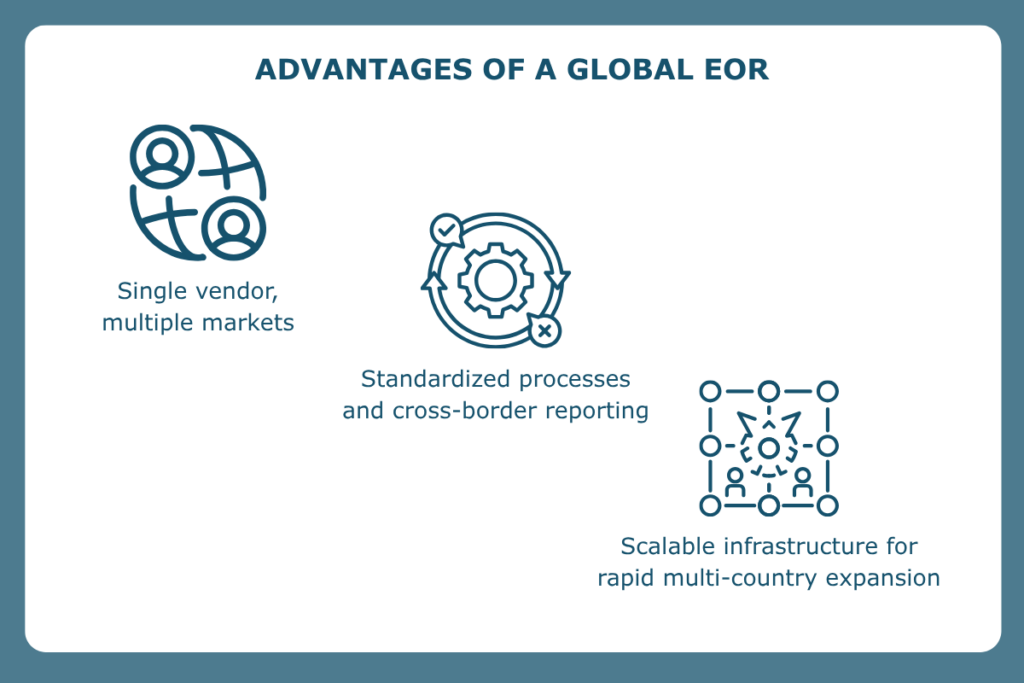
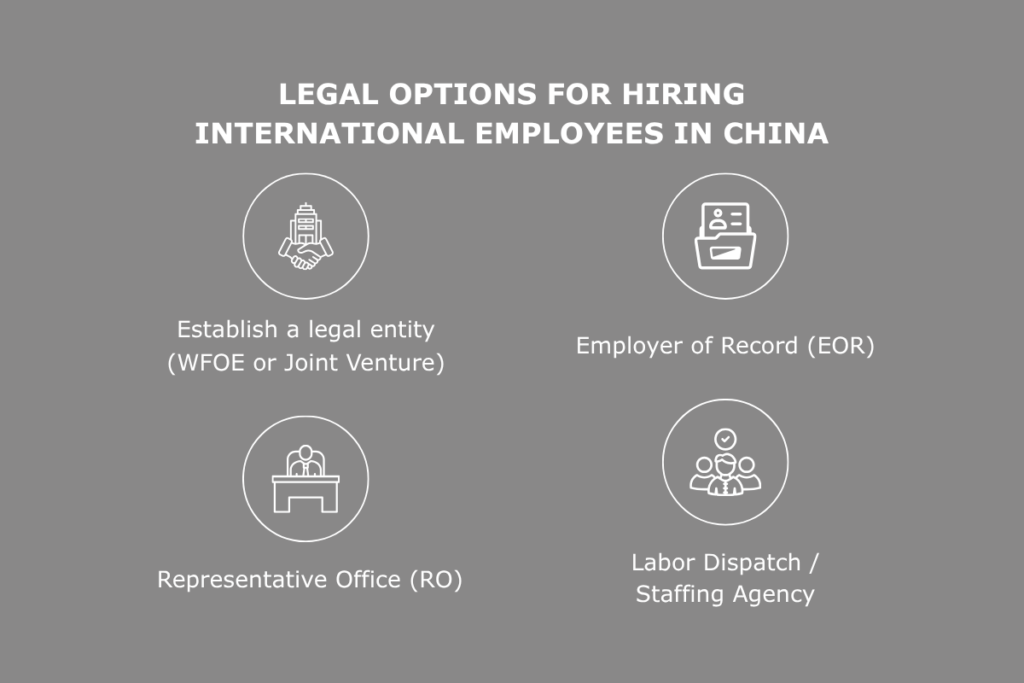
For foreign firms without a legal entity, Employer of Record (EOR) services are a popular solution because setting up a local entity in China can take months. We – VVR RH can help you with our professional services: 

  • The EOR hires employees on behalf of the foreign company. 
  • Handles contracts, payroll, taxes, and benefits. 
  • Allows market entry without registering a subsidiary. 

If you want to test the Chinese market without high upfront costs, Ean OR service is a suitable solution. 

⇒ Contact us today to discover how our HR outsourcing services in China 2026 can help your business hire employees, manage payroll, and stay compliant. 

Share your project with us via contact@vvrinternational.com.

CONTACT US

FAQ

  • What are the main HR challenges in China that outsourcing helps foreign companies solve?

The main HR challenges in China include compliance with labor contract law, managing payroll across different cities, handling social insurance and housing fund contributions, and navigating work permit requirements for foreign employees.

HR outsourcing for foreign companies in China addresses these issues by providing local expertise, payroll outsourcing services, contract management under mutual agreement rules, and support for work permits. This allows companies to operate smoothly while minimizing legal and operational risks.

  • How do HR outsourcing services in China support strategic HR management and long-term growth?

HR outsourcing services in China support strategic HR management, aligning with modern HR practices in China, including digital HR solutions, employee retention strategies, and ESG-focused HR policies. By outsourcing HR functions, companies gain access to market insights, salary benchmarks, and compliance monitoring, enabling them to build sustainable teams in China while adapting to workforce trends and long-term business objectives.

Related Posts

Read More
The aeronautics sector in China in 2024: growth and business opportunities

The aeronautics sector in China in 2024: growth and business opportunities

Introduction

China’s aerospace sector in 2024 is showing strong growth, underpinned by massive investment in infrastructure and technological advances. As China surpasses pre-pandemic levels in several areas, the industry also offers promising prospects for foreign companies. This article explores the highlights of this recovery and highlights the opportunities for business development in China.

A powerful recovery: key figures for 2024

Passenger Transport and Air Traffic

In 2024, China will set new records with more than 700 million passenger journeys, including 640 million on domestic routes, marking a 14% increase on 2019. The first half of the year saw 350 million passengers carried, a year-on-year increase of 23.5%.

Air freight and performance

Air freight is also on the rise, with 4.17 million tonnes transported in the first half, 27.4% more than in 2023. Load factors reached 82.2%, reflecting optimised operational management.

 Opportunities for foreign companies

Partnership-friendly growth

As China aims for technological autonomy, local companies like COMAC are looking for international partners to develop strategic components. This need is opening doors for foreign companies specialising in components, engines and avionics systems.

A dynamic local market

With demand growing rapidly, foreign manufacturers such as Airbus and Embraer are stepping up their presence. Airbus, for example, plans to deliver its A330neo as early as 2025, once it has obtained Chinese certification.


Structuring projects: Jinzhouwan International airport in Dalian: an exceptional ambition

China is investing in ambitious projects to meet the growing demand for air transport. More than 100 new airport projects are planned over the next 10 years, and hubs such as Shanghai Pudong and Guangzhou Baiyun, already among the largest in the world, are seeing their capacity increased.

Among these investments, Jinzhouwan International Airport, currently under construction on an artificial island off the coast of Dalian, is one of the most ambitious projects in terms of airport infrastructure. Designed to become the largest offshore airport in the world, this project illustrates the ingenuity and scale of China’s ambitions in this field.

Features and capabilities

Covering an area of 20.9 km², the airport is designed with four runways and a terminal covering 900,000 m². When it opens, it will be able to handle 43 million passengers a year, with the capacity to expand to 80 million. In addition, it will handle around 1 million tonnes of freight a year, meeting the growing needs of regional and international trade.

Strategic objectives

The project aims to replace the current Dalian-Zhoushuizi airport, which is now saturated, and to become an engine of economic development for north-east China. With strengthened connections to the world’s major cities and business centres, this airport is set to play a key role in attracting investment and facilitating trade.

Technological and environmental advances

Chinese engineers are using advanced techniques to build on complex marine terrain, while incorporating rigorous environmental standards. This includes innovative energy management systems to reduce the carbon footprint.

Timetable and outlook

Work began in 2011 and will reach a crucial stage in 2024 with the completion of the foundation and backfill phases. Entry into service is scheduled for 2035, marking a new era for airport infrastructure in China.

This emblematic project demonstrates China’s determination to maintain its role as world leader in aviation and to support its economic development by diversifying its logistics and transport capacities.

Conclusion: time to act in the Chinese aerospace market

The Chinese aerospace sector in 2024 is fertile ground for visionary companies. With booming infrastructures, record growth and diversified technological needs, this is a key time to invest and get involved. However, to succeed in this market requires meticulous preparation, in-depth knowledge of local dynamics, and reliable partners to navigate a complex but promising environment.

Optimising your market entry strategy: an asset for High-Tech Companies

To penetrate the Chinese aerospace market, particularly in sectors linked to advanced technologies, it is essential to build a targeted partnership strategy and benefit from expert support. Companies specialising in advanced components, new-generation engines or connected avionics systems will find immense potential, provided they master the local complexities.

Full support from VVR International

Working with Chinese players or industry experts helps to overcome the challenges of strict regulations, technological standards and cultural differences. Partners like VVR International provide unique expertise by helping to identify strategic local partners, whether research centres, manufacturers or specialist institutions. Their support also extends to services such as assistance with negotiating contracts and defining action plans tailored to the objectives of innovative companies.

In China, a network approach is essential for effective integration into the technological and industrial ecosystem. This includes :

  • Establish technological partnerships to develop solutions tailored to the local market.
  • Negotiating strategic agreements with suppliers to integrate efficient local supply chains.
  • Set up in industrial and technological clusters, particularly active in regions such as Shanghai and Chengdu, to accelerate collaboration and innovation.

By combining a detailed knowledge of cultural dynamics and business practices with a solid network, high-tech companies can not only reduce risks but also maximise their impact on the Chinese aerospace market. Professional support such as that offered by VVR International becomes a key lever for success in this complex and highly competitive environment.

Read More
Building a Franco-Chinese team: Tips for successful integration

Building a Franco-Chinese team: Tips for successful integration

Integrating foreign employees into Chinese teams is essential to the effective deployment of business in China, whether they are based locally or working remotely. This is not only crucial to the success of the business, but also an enriching opportunity for the company’s managers. By understanding and respecting local cultural specificities, companies can not only facilitate the building of strong Franco-Chinese teams, but also develop strong cohesion within the team, which will prove to be a decisive factor in productivity.

In this article, we’ll explore practical tips and tried-and-tested strategies to help your foreign employees integrate more easily into everyday life in China. From understanding fundamental cultural values to adapting communication and management styles, every aspect will be covered. The aim is simple: to turn the challenges of integration into opportunities for growth and successful collaboration.

Understanding Chinese working culture

Integrating into a Chinese team requires a thorough understanding of local cultural values and practices. In China, the working culture is shaped by traditions and norms that may seem very different from those in Western countries. Understanding these cultural differences and respecting them on a daily basis is key to successful integration. In this section, we will look at three key aspects of Chinese work culture: hierarchy and respect for elders, the values of collectivism and harmony, and indirect communication styles.

The importance of hierarchy and respect for elders

The Chinese work culture is deeply rooted in traditional values that emphasise hierarchy and respect for elders. Unlike Western cultures, where equality and horizontal collaboration are often valued, the Chinese context favours a clear hierarchical structure. Decisions are generally taken by superiors, and subordinates are expected to follow these directives.

Key values: teamwork, harmony and respect

Teamwork is another cornerstone of Chinese work culture. Unlike Western individualism, success is often seen as a collective effort. The well-being of the team and the company takes precedence over individual interests. This translates into a strong emphasis on collaboration and harmony within the team. Maintaining good relations with colleagues and avoiding direct confrontation are highly valued behaviours.

Differences in communication styles: indirect vs. direct

Communication in China is often more indirect than in Western cultures. Within the company, employees tend to avoid direct confrontation and prefer to use more subtle means to express their opinions or disagreements. For example, the translation of the word “yes” can lead to misunderstandings if it is misinterpreted. In China, it is sometimes used to mean “I understand” rather than “I agree”. This nuance in communication can create misunderstandings if it is not properly understood.

Strategies for successful integration

Here are some tried and tested strategies and innovative approaches that take into account cultural specificities to simplify the integration of foreign employees into a Chinese team and strengthen cohesion within the company.

Intercultural training and cultural awareness

Cross-cultural training is essential to help foreign employees understand and adapt to Chinese cultural norms. This training should cover aspects such as work habits, social protocols and communication expectations.

Innovative approach: Immersive workshops and virtual exchanges

Organise immersive workshops that simulate typical Chinese work situations and social interactions. In addition, anticipate your employee’s arrival by encouraging upstream exchanges with their Chinese colleagues. To do this, you can offer time for discussion during which the future employee can ask questions and where everyone can share their experiences and work practices.

Mentoring and incubation by Chinese employees

Mentoring is an effective way of helping foreign employees adapt more quickly. By assigning a Chinese mentor to each new arrival, you create a supportive relationship that makes it easier to learn cultural and professional nuances.

Reverse mentoring programme

As mentioned earlier, reverse mentoring can also be beneficial. In this model, young Chinese employees mentor foreign managers, bringing a fresh perspective and reversing traditional roles. This encourages a mutual exchange of knowledge and skills, promoting greater cultural understanding on both sides.

Incubation: supporting your employee step by step

In addition to freelance administration, some companies specialising in HR offer an incubation service. At VVR International, we can carry your employee: in this case, we take charge of his or her legal and administrative management. To help them get up and running quickly, our teams welcome them and support them as they set up in China. With the possibility of working on our premises, they will have local contacts, training and a workspace that will enable them to quickly take charge of their new role within your company.

Organising social activities to strengthen ties

Social activities are crucial to strengthening relationships between employees and creating a sense of camaraderie and trust. Regular events allow employees to get to know each other outside the workplace.

Innovative approach : Intercultural team-building events

To take this a step further, team-building events dedicated to intercultural issues in the workplace can help to highlight cultural differences and raise your employees’ awareness of their implications for their day-to-day work, while at the same time strengthening links between teams. For example, cooking workshops in which employees prepare traditional Chinese and Western dishes together, or cultural excursions to explore the local culture can be interesting team-building activities to strengthen the bonds between French and Chinese employees.

Overcoming common challenges

Even with well-planned integration strategies, companies can encounter difficulties when integrating foreign employees into Chinese teams. To avoid these pitfalls, a good knowledge of the points to watch out for can help to achieve a successful and lasting integration.

Managing language differences and misunderstandings

Language barriers can often lead to misunderstandings and frustration. Although many professionals in China speak English, it is essential to recognise the nuances and challenges of multilingual communication.

Technological tools and language training

Technological tools such as real-time translation applications and multilingual communication platforms are invaluable in making day-to-day exchanges more fluid. To take things a step further, language courses tailored to the needs of your foreign employees can be a worthwhile investment in improving the skills of your staff. These courses will focus on terms specific to your sector and expressions commonly used in the workplace. Today, there is a wide range of language learning software with virtual reality functions available, which can be an interesting alternative to traditional language courses. This makes learning more flexible and less expensive.

Adapting management styles to bring them into line with Chinese expectations

Western management styles can sometimes be perceived as too direct or individualistic in China. Adapting these styles so that they are more in tune with local cultural expectations is crucial to effective management.

Innovative approach : Intercultural leadership workshops

An inclusive work environment is essential for employee satisfaction and productivity. This means respecting cultural differences and promoting an atmosphere of respect and collaboration.

Organise cross-cultural leadership workshops where foreign managers can learn to adapt their management style to suit Chinese expectations. These workshops can include role-playing, case studies and group discussions on best management practices in a cross-cultural context. Integrate e-learning platforms to offer continuous training modules and resources that can be accessed at any time.

Conclusion: successful integration is a worthwhile investment

Integrating foreign employees into Chinese teams is essential for success in China. By understanding the working culture, adopting innovative integration strategies and overcoming common challenges, companies can create a harmonious and productive working environment. Successful integration has a direct impact on a company’s overall performance.

VVR International and its HR department can help you create or strengthen your teams in China. Thanks to our teams and our coaching and portage services, we can take charge of your employee and support him or her in settling in and integrating, both culturally and legally and administratively. With VVR International, you benefit from local expertise and personalised support to ensure the successful recruitment and integration of your employees in China.

Read More
Recruiting in China and Europe: Key Differences and Practical Insights

Recruiting in China and Europe: Key Differences and Practical Insights

1. Introduction

For global businesses, recruiting in China and Europe is more than just filling positions. It requires navigating labor laws, cultural norms, and fast-changing recruitment channels. The hiring process in China differs greatly from European recruitment practices. Companies that adapt can build efficient, compliant teams. Those that do not risk compliance issues, higher costs, and talent shortages.

This article compares recruitment and selection practices in China and Europe, providing practical insights for foreign companies. We – VVR RH, cover staffing systems, wage calculations, expat hiring, labor relations, digital platforms, and cultural factors. We also highlight how sustainability and workforce strategies will shape HR in 2026. 

2. Recruiting in China vs Europe: A Comparative View

HR strategies vary widely between China and Europe. Differences stem from regulation, culture, and economic structures. Understanding them is essential for foreign companies hiring employees in China, entering the Chinese market, or expanding into European markets.

  • Wage and benefits calculation systems

Payroll outsourcing in China is complex due to the mandatory contributions required. Employers must handle salaries, social insurance, and housing funds. Rules vary by city, making compliance difficult without local expertise. In Europe, wage structures vary, but contributions to healthcare, pensions, and unemployment insurance are universal. Compensation benefits are often influenced by collective agreements and vary by sector. 

China’s wage determination combines national legislation, local regulations, and individual negotiations.

China’s wage determination combines national legislation, local regulations, and individual negotiations.

  • Hiring foreign citizens and expats 

Hiring expats in China requires strict work permits. Employers must prove that no local candidate can fill the role. Permits are tied to qualifications and company quotas. The process is detailed and time-consuming. In Europe, mobility is simpler. The EU Blue Card allows skilled professionals to work across member states. Intra-EU mobility makes expat hiring easier, although each country still applies its own rules. 

  • Labor relations and contracts 

In Chinacontracts are non-negotiable. Employers must issue them within 30 days of hiring. Non-compliance triggers penalties. Labor disputes fall under Chinese labor law, which strongly protects employees. In Europecontracts are also mandatory but vary by country. Many states allow flexibility through collective bargaining. 

Labor contract termination is sensitive in both China and Europe regions.

Labor contract termination is sensitive in both China and Europe.

However, termination is sensitive in both regions. In China, employers need lawful grounds such as redundancy or misconduct. Documentation and severance are required. Procedures are formal, and employee protections are strong. In Europe, termination depends on national law. The UK allows relatively more flexibility. Germany and France require strict justification and works council involvement. Therefore, plan exits early, document performance, and seek legal advice before acting. 

HR comparative table between China & Europe

Recruitment factors  China  Europe 
Hiring channels  WeChat, 51job, Zhaopin, referrals  LinkedIn, EURES, agencies 
Contracts  Mandatory written contracts, strict labor law  Country-level rules, collective agreements 
Expats  Strict permits, quotas, cultural barriers  EU Blue Card, intra-EU mobility 
Termination  Complex, highly regulated  Varies, generally more flexible 
IP & confidentiality  Must be enforced by employers  Strong EU-level protections 
Employee relations  Guanxi (relationships), hierarchy  Transparency, work-life balance.

3. Types of Labor and Employment Flexibility

China’s labor market is heavily shaped by state regulation. Full-time contracts remain the dominant form. Part-time or gig roles are limited in scope. This reflects the government’s priority on social stability and predictable employment. For foreign companies, this means less room to experiment with short-term hires or flexible project-based models.

Europe, in contrast, is built on a wider range of labor types: permanent, temporary, agency, freelance, and apprenticeship contracts. Countries like the Netherlands and Denmark apply the Flexicurity model, which balances employer flexibility with employee security. Workers may move between jobs more easily because unemployment protection and retraining programs are strong.

Practical takeaway: In China, expect a formal and regulated approach when hiring employees. In Europe, foreign firms can adapt contracts to business cycles but must respect country-specific labor laws.

4. Employee Development and Retention 

Retention is one of the top HR challenges worldwide, but strategies diverge between China and Europe. 

In China, employees often seek rapid career development and visible growth paths. The country’s fast-changing economy fuels strong competition for talent, especially in IT, engineering, and e-commerce. Many young workers value training, certifications, and international exposure. Companies that invest in training and clear promotion tracks tend to retain talent more effectively. In Europe, employees emphasize work-life balance and workplace stability. High expectations for benefits, flexible hours, and remote work are common. 

Both regions also embrace digital transformation in training. E-learning platforms, AI-driven career planning, and employer branding campaigns highlight opportunities for long-term growth. 

Practical takeaway: In China, focus on career growth, training, and rapid advancement. In Europe, you should invest in flexible policies, recognition programs, and meaningful work culture. Aligning strategies with these expectations ensures lower turnover and stronger engagement

5. Recruitment Channels & Digital Platforms: China vs Europe

Both the channels and the digital execution of recruitment are different in China and Europe.

Both the channels and the digital execution of recruitment are different in China and Europe.

In Chinahiring is local and mobile-first. WeChat anchors outreach, screening, and follow-up. Job boards such as 51job and Zhaopin remain popular, while referrals based on guanxi (relationships) play an important role. Foreign firms often engage a recruitment company in China or use HR outsourcing services to stay compliant with Chinese labor law. 

In Europe, recruitment is more structured. LinkedIn dominates for skilled and managerial roles. EURES (European Employment Services), national portals, and specialist agencies connect employers with talent across borders. In addition, Applicant Tracking Systems (ATS) and AI-driven platforms streamline selection while ensuring GDPR compliance. Employer branding campaigns are critical in attracting talent in competitive markets. 

Practical tip: In China, add WeChat and local boards to your hiring mix. In Europe, pair LinkedIn with ATS and branding. If compliance and speed are priorities, consider outsourcing the hiring process to a local HR partner. 

⇒ Discover more information about how to build efficient recruitment and portage in China. 

6. Understanding Cultural & Social Differences between China and Europe 

Culture shapes the hiring process as much as labor law. For foreign companies, ignoring cultural differences can create misunderstandings and poor hiring outcomes. In Chinaguanxi (personal relationships and networks) is central. Recruitment often goes beyond résumés and job descriptions. Employers value loyalty, respect for hierarchy, and a strong sense of belonging to the group.  

Personal questions during interviews are common, as they help assess whether a candidate will fit into the company’s social fabric. Decisions may also be influenced by recommendations within networks. This reflects China’s collectivist orientation in Hofstede’s model, where cooperation, trust, and long-term relationships matter more than individual achievement. 

European recruitment is usually more structured and transparent. Employers rely on standardized job postings, competency frameworks, and formal interviews. Equality, compliance, and non-discrimination are central values. This reflects a more individualistic culture, where skills, personal merit, and career potential outweigh networks or personal connections. Candidates are judged by their qualifications and performance, not their relationships. 

Hofstede’s model further highlights other contrasts: 

  • Uncertainty avoidance. Many European countries have higher scores, leading to structured recruitment processes, detailed contracts, and formal compliance to reduce risk. China scores lower, showing more tolerance for ambiguity, which translates into flexible and adaptive hiring methods. 
  • Indulgence vs. restraint. Europe leans toward indulgence, supporting work-life balance and open expression during interviews. China is more restrained, where professionalism and modesty dominate recruitment interactions. Candidates are expected to show discipline and respect for authority rather than personal ambition. 

Practical takeaway: In China, build trust through relationships and demonstrate respect for hierarchy. In Europe, prepare for structured assessments and emphasize skills and transparency. Adapting to these cultural expectations not only improves recruitment success but also strengthens long-term employee engagement. 

7. Sustainable Workforce in China: Pros & Cons

Recruiting for a multinational enterprise in China presents challenges: 

  • Complex compliance under Chinese labor law. 
  • Intense competition for skilled talent in technology and engineering. 
  • Cultural gaps that require adaptation. 
  • Employee turnover in urban hubs is especially high among younger staff. 

Despite challenges, China offers vast potential: 

  • Large talent pool in STEM fields. 
  • Government incentives for high-tech, advanced manufacturing, and green industries. 
  • Expanding middle class driving demand for foreign employees. 
  • Specialized recruitment companies in China and HR outsourcing services to support compliance.

Read more related articles


8. Conclusion: Key Takeaways for Companies Recruiting in China

Foreign companies need balanced HR strategies. Compliance with Chinese labor law is non-negotiable. At the same time, cultural adaptation is essential for successful hiring in China. Partnering with recruitment companies in China or using HR outsourcing services in China ensures compliance and efficiency. Leveraging digital tools like WeChat for hiring employees in China gives access to a wide talent pool. 

Finally, when comparing recruiting in China vs Europe, remember: 

  • China requires more compliance and local expertise. 
  • Europe offers more flexibility, but it varies by country. 
  • Both regions reward companies that adapt culturally. 

To sum up, recruitment is never one-size-fits-all. Foreign firms must adjust their strategies for recruiting in China and Europe. From contracts to culture, each factor impacts success. For companies hiring employees in China, the key is to navigate labor law, use the right recruitment channels, and build strong relationships. For Europe, success comes from transparency, flexibility, and employer branding. 

👉 By partnering with trusted experts such as VVR International, foreign companies can simplify the hiring process, remain compliant, and secure the talent they need to grow.  📩Contact us today to discover how to recruit in China. Explore how our HR outsourcing services can help your business hire employees, manage payroll, and stay compliant. 

Share your project with us via contact@vvrinternational.com.

CONTACT US

FAQ

  • What are the main HR challenges in China that outsourcing helps foreign companies solve?

The main HR challenges in China include compliance with labor contract law, managing payroll across different cities, handling social insurance and housing fund contributions, and navigating work permit requirements for foreign employees.

HR outsourcing for foreign companies in China addresses these issues by providing local expertise, payroll outsourcing services, contract management under mutual agreement rules, and support for work permits. This allows companies to operate smoothly while minimizing legal and operational risks.

  • How do HR outsourcing services in China support strategic HR management and long-term growth?

HR outsourcing services in China support strategic HR management, aligning with modern HR practices in China, including digital HR solutions, employee retention strategies, and ESG-focused HR policies. By outsourcing HR functions, companies gain access to market insights, salary benchmarks, and compliance monitoring, enabling them to build sustainable teams in China while adapting to workforce trends and long-term business objectives.

Related Posts

Read More
China opens opportunities for foreign-owned hospital operations: What foreign healthcare companies should know

China opens opportunities for foreign-owned hospital operations: What foreign healthcare companies should know

Foreign-owned companies can now direct clinical operations and open 100% foreign owned hospitals in some Chinese cities. On September 7th 2024, China’s Ministry of Commerce, National Health Commission and the National Medical Products Administration announced the opening up the medical sector and, in particular, medical innovation to international players. As of this date, foreign-owned companies are now allowed to:

  • Direct clinical operation of gene and cell therapies, as well as genetic diagnostics, for regulatory registration purposes (NMPA), in the special economic zones of the three major coastal cities (Beijing, Shanghai, Guangzhou) and on the island of Hainan;
  • The opening of 100% foreign-owned international hospitals (excluding traditional Chinese medicine and the acquisition of a public hospital) in Beijing, Tianjin, Shanghai, Nanjing, Fuzhou, Suzhou, Guangzhou, Shenzhen and Hainan Island.

What do these policy changes mean for foreign healthcare companies in China?

In a way, this announcement resonates as a counterpoint to VBP (Volume Based Procurement), deployed in 2020, a policy aiming to achieve a lower price of medical care through high-volume procurement, whose intentions, while logical and laudable in macro-economic terms, demonstrated during the system’s implementation that is sometimes counter-productive on the innovation front. Indeed, in many cases, the economic equation for innovative products on the Chinese market can prove untenable for foreign innovators, with purchasers preferring so-called “museum” products in the VBP context.

This announcement therefore illustrates the Chinese government’s recognition of this situation, and its ongoing determination to attract innovation in health products and services, under economic conditions that are once again attractive to international healthcare innovators.

In concrete terms, after the major efforts made in the post-Covid period to digitalize the patient pathway (to an extent already ahead of many Western countries), the aim is to continue to drive the ongoing progress of the entire medical industry:

  • In terms of healthcare provision, the procedures for purchasing from public hospitals and validating the level of reimbursement by the Chinese social security system often delay the deployment of new therapeutic and diagnostic approaches by several months or even years.
  • In hospital management, to avoid the wasteful practices that still exist at various levels of hospital administration.
  • In terms of patient satisfaction, as the measured levels of satisfaction with public hospitals in China still leave much to be desired.

Moreover, as is customary with the Chinese government, the decision is multifactorial. Thus, the positive consequences of this announcement for the country, its population, and the general environment of the healthcare industry are numerous.

How the opening of China’s medical industry benefits patients

  1. Mobilize savings from the middle and upper classes towards the real economy, at around 45% in 2021, China’s savings rate significantly surpasses the global average savings rate of 26.5%. China bets here that wealthy Chinese will allocate an ever-increasing share of their family budget to healthcare, as can already be seen in existing international hospitals, where Chinese patients are by far in the majority compared to foreign patients – which was not the case just ten years ago.
  2. Accelerate the growth of the private medical insurance sector, in terms of both volume and actuarial skills, in order to continue to control public health spending and develop a whole area of financial services that is currently immature compared to the major Western countries. Notably, the situation in this field has already been improving for several years, thanks in part to innovative public-private partnerships.

China’s healthcare professionals benefit from the entry of foreign-owned healthcare

  1. Providing new career opportunities for the strictly “medical” staff of the public hospital, private hospitals in China are known and recognized for paying better salaries and offering better working conditions.
  2. Continue the process of specializing public hospitals in translational and clinical research (many large public hospitals are affiliated to a university with a medical curriculum), by increasing funding for physician-researchers and multiplying the number of world-class clinical trial centers – a trend already underway since 2018.
  3. The aim is to create an incentive for young Chinese to enter the medical and medical-scientific professions, by restoring the attractiveness they have lost in recent years due to the imbalance between pay and workload and the “glass ceiling” that has been reached too quickly.

How China’s healthcare opening boosts innovation

  1. Promote medical innovation, by facilitating the rapid market entry of innovative drugs and medical/diagnostic devices via private hospitals: these are not subject to the strict rules of public tenders (VBP or others), and therefore purchase their healthcare products at more or less “international” prices. With the combined population of the above-mentioned cities and their immediate surroundings exceeding 150 million, there is little doubt that such a market will prove profitable;
  2. Encourage the emergence of specialized medical distributors in the private hospital channel: as this type of distributor is still relatively rare, it is highly likely that new, high-caliber players will emerge in the next few years. This will enable innovative healthcare products to penetrate the Chinese market via multiple channels, with accelerated profits from the “private” channel supporting gradual entry into the “public” channel.

What is the next step for foreign health and medical tech companies to enter China?

In the ever-changing context of China’s human health and medical technology industry, it is essential for innovative health companies to obtain information and data from sources that are in direct contact with the country’s real developments and therefore understand the nuances of the market. We equip human health and med tech companies with clear, substantiated recommendations, backed up by a realistic, costed action plan.

VVR Medical/Daxue Consulting, leaders in strategic and operational support for companies in the medical sector on the Chinese market. Don’t hesitate to reach out to sustain your healthcare company’s presence in China. We look forward to hearing from you!

Read More