HR Outsourcing in China: Everything You Need to Know (2025 – 2026)
1. Introduction
Expanding into China remains a key strategy for international companies seeking growth and cost efficiency. The country combines world-class manufacturing capacity, skilled labor, and advanced infrastructure. However, entering China’s market can be complex due to regulations, labor laws, and setup costs. That’s why HR outsourcing in China has become one of the most effective solutions. It allows foreign businesses to delegate specific functions, from manufacturing and IT to HR and logistics, to local experts without establishing a full legal entity.
In this article, VVR International’s experts will explore:
- What outsourcing in China is and how it works.
- The benefits and risks of this model.
- HR, and compliance aspects about labor contract law.
- A comparison between outsourcing and outstaffing models.
- Why companies increasingly rely on outsourcing for faster, more efficient market entry.
By the end, you’ll understand whether outsourcing is the right strategy to support your expansion in China.
2. Outsourcing in China: 101 Overview
For global businesses, outsourcing provides a quick and compliant way to access China’s talent, production, and service capabilities. Let’s dive into what it means and how it differs from other models like outstaffing.

Outsourcing offers a fast and compliant way to access the local talent pool.
What is Outsourcing in China?
Outsourcing is a business model where a company delegates certain functions, projects, or processes to an external service provider in China. The provider handles managing tasks, people, and outcomes.
Unlike outstaffing, where employees are legally hired by a third party but work under your daily supervision, outsourcing means the provider takes full responsibility for delivery, quality, and operations.
Common types of outsourcing in China include:
- Manufacturing outsourcing: Partnering with Chinese factories to produce goods cost-effectively.
- IT outsourcing: Delegating software development, technical support, or maintenance.
- Business Process Outsourcing (BPO): Outsourcing functions such as customer service, accounting, or procurement.
- HR outsourcing: Using a local partner to handle contracts and compliance.
Key Benefits of Outsourcing to China
Outsourcing continues to attract global companies for its strategic and operational advantages:
- Cost efficiency. China offers competitive labor and production costs without compromising quality.
- Access to expertise. Local providers bring deep knowledge of supply chains, logistics, and compliance.
- Faster market entry. Avoid months of administrative setup by working through established partners.
- Scalability. Easily expand or reduce operations based on demand.
- Focus on core business. Delegating non-core functions allows management to focus on growth.
- Compliance support. Providers ensure adherence to labor, and environmental regulations.
👉 The Verdict: Outsourcing in China delivers flexibility, cost savings, and operational reliability. Thus, it is ideal for companies aiming to grow in Asia while minimizing administrative complexity.
Risks and Challenges of Outsourcing in China
Like any business approach, outsourcing brings both advantages and risks. Companies must also consider its challenges:
- Loss of direct control. The provider manages daily operations and decisions.
- Quality consistency. Product or service quality must be monitored closely.
- Intellectual property (IP) risks. Always use clear legal contracts and NDAs.
- Cultural and communication gaps. Time zones, language, and expectations may differ.
- Vendor dependence. Your performance may rely heavily on your partner’s reliability.
⇒ Tip for you: You should choose outsourcing companies with proven track records, transparency, and strong local networks to mitigate risks.
3. Outsourcing vs Outstaffing in China
Both models help companies operate in China without building a full entity, but they serve different purposes.
- Outsourcing in China shifts responsibility for a function or project to a third party. You focus on results while the provider manages the process.
- Outstaffing in China gives you dedicated employees who legally belong to the outstaffing company but work under your direction. Think of it as renting talent with compliance included.
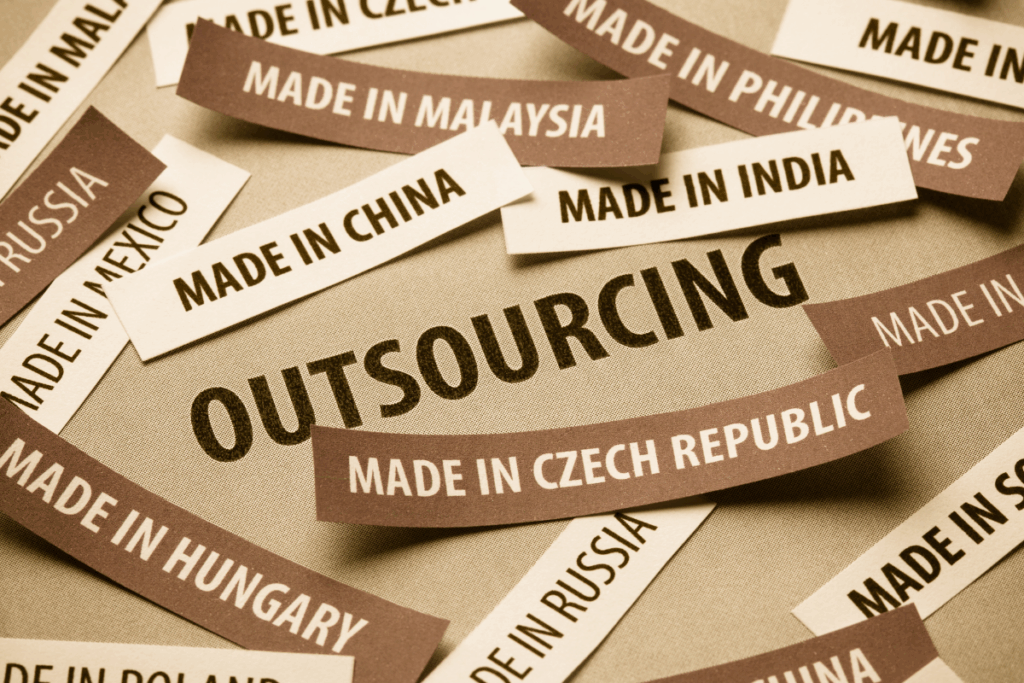
Outsourcing in China shifts responsibility for a function or project to a third party.
The table below shows some key points of the two models’ differences.
| Aspect | Outsourcing in China | Outstaffing in China |
| Control | Limited control, focus on outcomes. | Full control over tasks and workflows. |
| Cost structure | Fixed price for project/function. | Salaries plus service fees. |
| Workforce | Staff serve multiple clients. | Dedicated staff to your company. |
| Flexibility | Less flexible once contracted. | Easy to scale up or down. |
| Compliance | Provider ensures project delivery. | Provider ensures labor law, payroll, and social insurance. |
👉 The Verdict: Choose outsourcing when you prefer a hands-off, results-driven model. So, it is perfect for production, logistics, IT, or back-office operations. Opt for outstaffing when you want to manage people directly while keeping legal employment with a third party.
Here are some practical scenarios for your references:
- A software company needs developers: outstaffing model.
- A fashion brand wants garments produced: outsourcing to China.
- A trading company needs logistics support: could use either, depending on goals.
So, the decision depends on your business goals.
Choose outstaffing services in China if:
- You want to manage employees directly.
- You need flexibility to scale quickly.
- You value compliance and secure HR handling.
- You plan to test the Chinese market before setting up a company.
Choose outsourcing to China if:
- You want a third party to take over manufacturing or support functions.
- You don’t need daily management of employees.
- You want predictable project-based costs.
4. Why Foreign Companies Use HR Outsourcing in China
Here’s why outsourcing remains one of the top entry strategies for international businesses:
- Access to a skilled workforce. China has a large talent pool in IT, engineering, sales, and manufacturing support.
- End-to-end service. From design to delivery, providers handle complete workflows.
- Compliance and legal safety. Local partners ensure adherence to China’s labor contract law.
- Supply chain optimization. Outsourcing manufacturing or logistics reduces overhead and speeds of delivery.
- HR outsourcing. Providers support recruitment, contract administration, and local HR compliance.
For foreign businesses, this model allows companies to start operations quickly, without forming a Wholly Foreign-Owned Enterprise (WFOE).

Outsourcing services in China help foreign companies save time and reduce risks.
5. How Outsourcing Works in China: The Typical Process
A successful outsourcing setup generally follows these steps:
- Define needs. Determine which functions or projects to delegate.
- Select a provider. Choose based on experience, references, and local expertise.
- Set KPIs and scope. Agree on timelines, performance metrics, and quality standards.
- Contract signing. Include clauses on IP, confidentiality, and dispute resolution.
- Project execution. The provider manages tasks while reporting progress.
- Quality control and feedback. Regular reviews ensure compliance and standards.
For example, instead of registering a WFOE (known as Wholly Foreign-Owned Enterprise), a European consumer-goods brand may outsource packaging production to a certified Chinese supplier while maintaining quality control through audits and shared digital tools.
6. How to Choose Right HR Outsourcing Partner in China
Your success depends heavily on the provider. So how do you choose HR outsourcing for foreign companies in China to meet the needs? Here are key tips to help you make better decisions:
- Compliance expertise. Do they understand Chinese labor laws?
- Industry knowledge. Do they have experience in your sector?
- Quality control systems: Are processes certified (e.g., ISO, BSCI)?
- HR systems. Can your provider effectively support recruitment workflows, employee documentation, and compliant contract handling?
- Transparency. Clear fees and no hidden costs.
- Network. Strong local connections for recruitment and support.
When you have a list of potential providers, remember to always ask for references and case studies before signing an agreement.
You may also like:
📩 Looking to expand your HR operations in China? Talk to our experts today.
7. HR Considerations in Outsourcing
China has strict labor and HR regulations. Many foreign companies often struggle with employment laws and expectations. Therefore, HR outsourcing providers bridge this gap, especially in recruitment, onboarding, and employee support.
Chinese Labor Contract Law requires formal, compliant agreements that define the employee’s terms of work. A reliable HR provider can help draft and manage these contracts.
In addition, HR partners like VVR International assist with talent acquisition, onboarding, and day-to-day HR guidance. When operating under an Employer of Record (EOR) service, the HR provider becomes the legal employer in China, and is responsible for contracts, onboarding, and social insurance obligations.
In short: A trustworthy outsourcing partner like VVR you stay compliant with Chinese labor law, especially when recruiting, onboarding, and supporting employees, so you can focus on core growth.
8. Look Ahead
Outsourcing in China is a flexible and cost-effective way for foreign companies to hire staffs, enter the market quickly, and reduce compliance risks. Compared to outstaffing, it offers a more hands-off model focused on results and end-to-end delivery.
If you are considering outsourcing services in China, VVR International can support you. With deep experience in Chinese labor law, HR management, our team guides foreign companies through every step of their China strategy.
⇒ Contact us today to discover how outsourcing can accelerate your business in China.
FAQ
- How does EOR model work for foreign companies without a local entity in China?
EOR in China allows foreign companies to hire and manage staff without setting up a Wholly Foreign-Owned Enterprise (WFOE). A local EOR/PEO provider acts as the legal employer, handling labor contracts, social insurance, and compliance with Chinese labor contract law. This model enables faster market entry, reduces administrative burden, and ensures compliance, while foreign companies retain strategic oversight of operations. It is particularly suitable for companies testing the Chinese market or scaling teams quickly in 2026.
- What are the main compliance risks when outsourcing to China and how can they be managed?
When outsourcing to China, foreign companies may face compliance risks related to labor law, intellectual property protection, and quality control. These risks can be managed by selecting experienced outsourcing providers with proven compliance expertise, clear contractual frameworks, and strong IP protection clauses. Reputable HR outsourcing partners also ensure employment contracts align with Chinese labor contract law, reducing legal exposure and operational risk for foreign companies expanding in China.
Related Posts


Shanghai, Chine
7888 Humin Road, Minhang District
+86 21 3422 7164 103
contact@vvrchina.com

Guangzhou, China
Merchants City Home
495 Hanxi East Road,
Panyu District
+86 20 8332 1024
contact@vvrchina.com

Shijiazhuang, China
368 XinShi Bei Road,
Zhenxin Industry District
+86 3118 381 0103
contact@vvrchina.com

Beijing, China
Yard 48 Liangmaqiao Road,
Chaoyang District
contact@vvrinternational.com