Tag: EOR

EOR/PEO Services in China: Detailed Explanation and Legal Insights for Foreign Companies

PEO Services in China: Detailed Explanation and Legal Insights for Foreign Companies

1. Introduction

China continues to attract foreign companies, but hiring employees directly is never simple. The country’s strict labor laws, complex payroll system, and regional social insurance rules make compliance a serious challenge. For businesses that want to expand quickly, PEO services in China provide a practical solution. In this article, we – VVR RH, explain what EOR/PEO services are, how they work, and what legal updates in 2025 – 2026 mean for foreign businesses. We also compare EOR/PEO with alternatives like WFOEs, helping you decide which approach best supports your China expansion.

2. What Are EOR/PEO in China?

Before diving into regulations, it is important to define what PEO means in China. A Professional Employer Organization (PEO) is a local HR service provider that becomes the legal employer of record for your staff. PEO allows companies to hire employees in China without creating a local entity. While the PEO handles payroll, contracts, and benefits, the foreign company still manages the employees’ day-to-day work.

This model reduces time, costs, and legal risks while ensuring compliance with Chinese regulations. In fact, PEO services are now one of the most popular choices for SMEs and multinational firms testing the market. This arrangement is also referred to as EOR in China, since in practice, the PEO functions as the employer of record. In China, the difference between the two is more technical than practical.
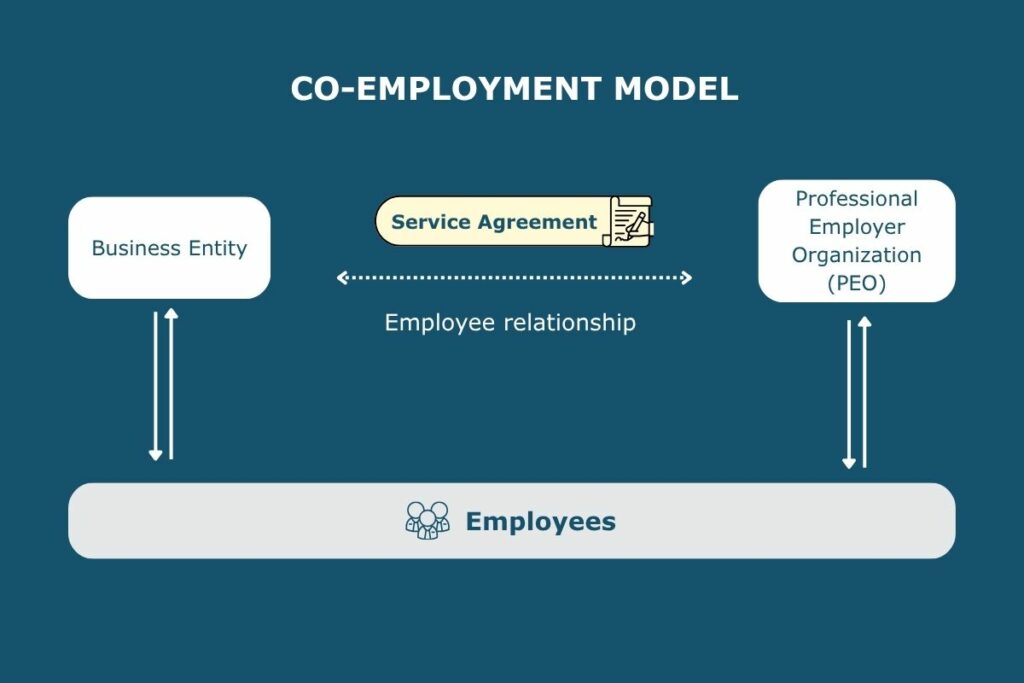
Co-employment involves a business and a professional employer organization (PEO) jointly sharing specific employment responsibilities through a contractual relationship.

Co-employment involves a business and a professional employer organization (PEO) jointly sharing specific employment responsibilities through a contractual relationship.

PEO and EOR in China: Definitions

Although the terms are used interchangeably, understanding the PEO and EOR helps decision-makers.

  • PEO (co-employment). Both the PEO and the client share employer roles. The PEO handles HR and payroll, while the client directs the employee’s work.
  • EOR (full legal employer). It refers to when the PEO is the sole legal employer. The client company manages the employee’s duties but does not appear as the employer on contracts.

In China, most providers market PEO/EOR services together, so the difference is largely branding. The choice depends on whether the company already has a legal entity in China. If yes, PEO services complement the entity. If not, EOR solutions in China provide a full legal employer framework.

Benefits of Using This Service in China

For many foreign companies, the benefits go beyond compliance.

  • Market entry speed: Start operations quickly.
  • Legal security: Reduce exposure to fines or lawsuits.
  • Employee satisfaction: Timely salary, insurance, and benefits build trust.
  • Strategic flexibility: Scale staff up or down as business needs evolve.
  • Access to HR expertise: PEOs understand local practices, from contracts to dispute resolution.

Ultimately, PEO/EOR services in China free up foreign firms to focus on sales, sourcing, and growth — while experts handle HR and compliance.

Risks and Challenges

Of course, no model is without drawbacks. Companies should understand the risks before committing.

  • Legal gray areas. In some regions, PEO services may overlap with restricted “labor dispatch.” Choosing a licensed provider reduces this risk.
  • Higher long-term costs. Service fees may exceed the cost of setting up a WFOE if hiring dozens of staff.
  • Employee perception. Some Chinese employees may prefer direct contracts with foreign entities.
  • Dependence on provider. The client relies on the PEO’s systems and expertise.
  • Mitigation strategy. Conduct due diligence and choose a provider with proven compliance, transparent pricing, and local licensing.

3. Why Foreign Companies Choose PEO/EOR in China

Expanding in China is complex, but PEO services simplify the process. For foreign companies, the benefits are immediate and significant.

  • Speed. A PEO can onboard employees in days, while setting up a Wholly Foreign-Owned Enterprise (WFOE) may take 3–6 months. So, it is critical for companies testing the market or starting pilot projects when applying PEO service in China.
  • Compliance. China has strict rules for labor contracts, payroll, and mandatory benefits. PEOs ensure full compliance with the Chinese Labor Contract Law and local bureau requirements.
  • Flexibility. Companies can start with one or two employees before scaling up. If the business shifts, they can also exit without facing heavy closure costs.
  • Risk reduction. PEOs reduce the risk of fines, penalties, or employee lawsuits related to misclassification.
  • Cost efficiency. SMEs can avoid the high registered capital and administrative costs linked to entity setup.

In short, PEO services in China provide a low-risk bridge for foreign companies that want to operate in the country without committing large investments upfront.

Furthermore, the demand for PEO services in China is set to rise, driven by several key trends. Many companies are adopting a China+1 strategy, combining their China presence with expansion into ASEAN markets such as Vietnam and Thailand, and PEO solutions make this dual approach easier to manage.

At the same time, the rise of digital PEO platforms, powered by AI and automation, is streamlining payroll, enhancing compliance monitoring, and reducing costly errors. Moreover, high-growth sectors such as green energy, semiconductors, and AI are attracting increasing foreign investment, creating strong demand for compliant hiring models.

Together, these factors indicate that PEO services will remain a critical tool for businesses entering China, offering agility and compliance in an unpredictable global market.
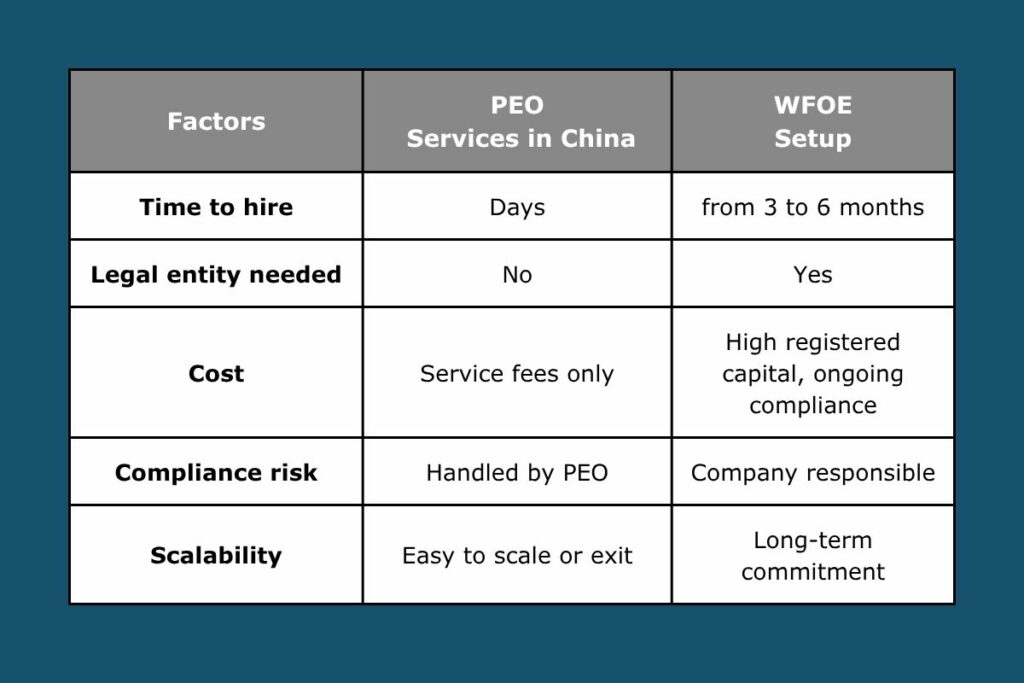
Comparison between PEO (Professional Employer Organization) and WFOE (Wholly Foreign-Owned Enterprise) in China.

Comparison between PEO/EOR and WFOE (Wholly Foreign-Owned Enterprise) in China.

4. Legal Environment for PEO Services in China (2026 Update)

China’s labor market is heavily regulated, and foreign companies must follow the same laws as local employers. PEOs step in as the legal buffer to ensure compliance.

  • Employment contracts. Every employee in China must have a written labor contract in Mandarin. Contracts must specify job roles, working hours, wages, benefits, and termination clauses. PEOs prepare these contracts according to Chinese law, protecting foreign companies from non-compliance fines.
  • Social insurance and housing fund (5+1 model). Employers must contribute to the “five insurances and one housing fund” which are pension, medical, unemployment, work injury, maternity, and housing fund. Contribution rates vary by city. For instance, in Shanghai, employers pay around 27% of salary, while employees contribute ~11%. PEOs manage these payments accurately, avoiding penalties and ensuring employees receive their benefits.
  • Probation and termination rules. Probation periods are capped based on contract length, ranging from one to six months. Termination without proper cause requires severance pay. Mishandling termination is one of the most common risks for foreign firms, and PEOs reduce this risk by following the correct procedures.
  • Expat employment rules. Hiring foreigners in China requires work permits, Z visas, and residence permits. PEOs can handle these processes, ensuring documents meet requirements and reducing visa rejection risks.
  • Legal updates. Crackdowns in Beijing and Shanghai on the misuse of labor dispatch agencies. Stricter enforcement of social insurance for foreign workers, unless exempted by bilateral agreements. More digitalized labor administration systems, requiring timely online filings.

To sum up, these updates make it more difficult for foreign companies to hire directly without expertise, further reinforcing the value of EOR/PEO services in China.

5. EOR/PEO vs. Setting Up a WFOE in China

Foreign firms often compare PEO with setting up a Wholly Foreign-Owned Enterprise (WFOE). Both allow hiring, but the processes differ greatly.

Factors EOR/PEO in China WFOE Setup
Time to hire Days 3 – 6 months
Legal entity needed No Yes
Cost Service fees only High registered capital, ongoing compliance
Compliance risk Handled by PEO/EOR Company responsible
Scalability Easy to scale or exit Long-term commitment


Therefore, for companies testing the market, PEO/EOR is a flexible first step. WFOEs are better for firms planning long-term, large-scale operations.

6. Payroll and HR Compliance Under China EOR Services

Payroll in China is more complex than in many Western countries. PEO/EOR payroll services ensure compliance with:

  • Personal income tax (PIT). Progressive rates up to 45%, with monthly withholding.
  • Social insurance and housing fund contributions.
  • Reporting deadlines. Company must file with the local tax bureaus each month.
  • Payroll cycle. Usually monthly, with strict deadlines.

Failure to comply can lead to fines or blocked work permits. Using a PEO payroll service reduces administrative burdens while guaranteeing employees are paid accurately and on time.
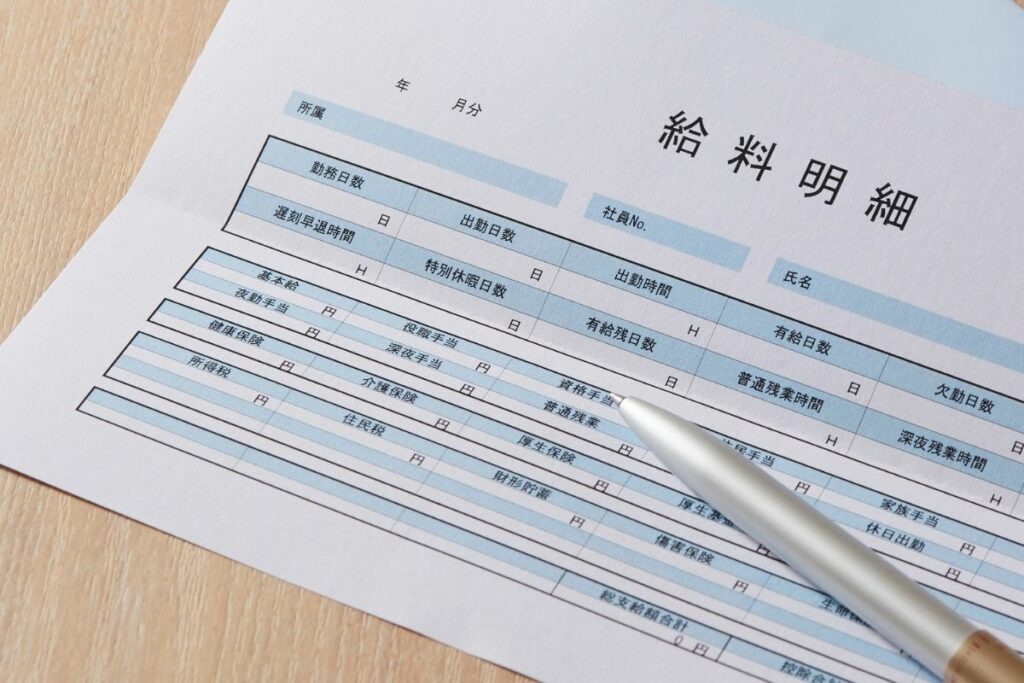
Payroll in China is more complex than in many Western countries.

Payroll in China is more complex than in many Western countries.

7. How to Choose the Best PEO Services in China

Selecting the right PEO partner is essential, as your compliance, payroll accuracy, and even employee trust will depend on it. The wrong choice can lead to fines, disputes, or talent loss. Below are key factors for your evaluation:

  • Licensing and compliance track record.

Not every PEO in China is licensed to operate legally. You always verify that the provider holds valid licenses for HR outsourcing, payroll services, and labor dispatch, where applicable. Also, you should ask for proof of compliance and check whether the provider has faced any disputes with local authorities. A strong track record ensures you won’t risk penalties.

  • Experience with foreign SMEs and multinationals.

A PEO that has worked with both small businesses and large corporations understands different hiring needs. SMEs often require flexibility and cost efficiency, while MNCs demand scalability and strict compliance. Look for case studies or testimonials from companies similar to yours, especially in your industry.

  • Transparent fees without hidden charges.

Some providers charge low upfront fees but add hidden costs for visa applications, tax filings, or sudden contract terminations. You should request a full pricing sheet that covers payroll, benefits, onboarding, and offboarding. Clear pricing builds trust and helps you budget accurately.

  • Knowledge of local labor laws.

Chinese labor law is detailed and enforced differently across provinces. A good PEO should not only know the national laws but also local variations in minimum wage, social insurance rates, and housing fund contributions. Providers should also update you about regulatory changes that may affect your employees.

  • Ability to handle expat visas and cross-border payroll.

If you plan to hire foreign experts in China, the PEO must manage work permits, residence permits, and renewals smoothly. Delays can interrupt operations and frustrate employees. For regional companies, the PEO should also provide cross-border payroll support, ensuring compliance when staff split time between China and ASEAN hubs under a China+1 expansion model.

  • Cultural and HR expertise

Beyond compliance, a strong PEO understands workplace culture in China. This includes handling sensitive resignations, providing guidance on bonuses, and supporting employee retention strategies. Providers with bilingual HR staff can bridge communication gaps between foreign managers and local employees.


Read more related articles


8. Conclusion

Hiring employees in China is complex, but PEO/EOR services in China simplify the process. They provide a legal employer framework, manage payroll and benefits, and ensure compliance with labor laws. Compared to setting up a WFOE, PEO services are faster, cheaper, and less risky, making them ideal for SMEs and firms testing the Chinese market. However, choosing the right partner is critical. A reliable PEO not only manages compliance but also builds trust with employees, supporting long-term success.

📩 If you want to hire employees in China without setting up a local entity, VVR RH offers expert PEO and/or EOR solutions for foreign companies in China. Contact us today to explore how we can help you expand with confidence.

Share your project with us via contact@vvrinternational.com.

CONTACT US

FAQ

  • What are the main HR challenges in China that outsourcing helps foreign companies solve?

The main HR challenges in China include compliance with labor contract law, managing payroll across different cities, handling social insurance and housing fund contributions, and navigating work permit requirements for foreign employees.

HR outsourcing for foreign companies in China addresses these issues by providing local expertise, payroll outsourcing services, contract management under mutual agreement rules, and support for work permits. This allows companies to operate smoothly while minimizing legal and operational risks.

  • How do HR outsourcing services in China support strategic HR management and long-term growth?

HR outsourcing services in China support strategic HR management, aligning with modern HR practices in China, including digital HR solutions, employee retention strategies, and ESG-focused HR policies. By outsourcing HR functions, companies gain access to market insights, salary benchmarks, and compliance monitoring, enabling them to build sustainable teams in China while adapting to workforce trends and long-term business objectives.

Related Posts

Read More
EOR in China: Meaning, Salary Standards, and How It Simplifies Recruitment

EOR in China: Meaning, Salary Standards, and How It Simplifies Recruitment

1. Introduction

Expanding into China is an exciting opportunity, but it can also be complex. For foreign companies without a legal entity in the country, hiring talent, managing payroll, and ensuring tax compliance present real challenges. That’s where EOR in China comes in. This model, also known as wage/salary portage, allows companies to recruit quickly and legally without setting up a local subsidiary. It combines flexibility for the employer with full protection for the employee. In this guide, we’ll explain the meaning of EOR in China, how it works, and why it has become one of the most efficient recruitment solutions for international companies in 2026. 

2. What Is EOR?

EOR (Employer of Record) is a legal employment solution that allows foreign companies to hire staff in China without setting up a local entity. In this model, a licensed third-party provider, EOR company as VVR International, becomes the employee’s official legal employer in the country of operation. The EOR signs a compliant local employment contract with the employee and manages administrative obligations such as onboarding, contract implementation, and local labor compliance. Meanwhile, the foreign company retains full control over the employees’ day-to-day responsibilities and performance.

3. How EOR Works in China

The EOR in China model follows a simple, three-party structure: 

  • The client company abroad (the actual employer directing the work). 
  • The EOR company (the legal employer handling payroll and compliance). 
  • The employee (working in China for the client under a local labor contract. All administrative, legal, and payroll management is handled by the portage provider. 

It allows companies to deploy staff in China within weeks, without establishing a local subsidiary or WFOE. It also guarantees that the employee receives regular salary payments, social contributions, and tax declarations under Chinese law. Take VRR RH’s example, here’s how the process works in practice: 

  • Needs assessment. The foreign company identifies a candidate in China or requests recruitment support. VVR RH experts verify the job scope, salary range, and location-specific compliance requirements. 
  • Employment contract setup. The employee signs a local labor contract with VVR RH (the EOR company), while VVR signs a service agreement with the client company abroad. This dual framework clearly defines each party’s responsibilities. 
  • Payroll and social insurance management. VVR handles all salary payments, tax deductions, and social insurance contributions, including the five mandatory insurances and the housing fund. The client receives a monthly invoice covering gross salary, contributions, and management fees. 
  • Daily management and performance. The employee works directly for the foreign company, following its operational goals and reporting structure. VVR remains the legal employer, ensuring compliance and employee welfare at every stage. 
  • Continuous support. Throughout the collaboration, VVR assists with visa processes, onboarding, HR counseling, and local regulations. It ensures a smooth and sustainable employment experience for both the employer and the employee. 

In short, EOR lets you deploy talent in China within weeks – fully compliant, transparent, and scalable. 

4. Key Advantages for Employers Using EOR in China

For foreign companies entering or expanding in China, EOR is not just a temporary fix. It’s a strategic HR solution that brings measurable business advantages. 

  • Rapid deployment. Setting up a Wholly Foreign-Owned Enterprise (WFOE) can take 3–6 months and involve multiple registrations. With EOR, hiring in China can start in as little as 2–4 weeks, enabling your team to start operations immediately. 
  • No legal entity needed. EOR removes the need for complex corporate structures. You can hire staff, test markets, or launch projects without creating a company or representative office. It is especially beneficial for SMEs or startups exploring China for the first time. 
  • Legal compliance. China’s labor law is strict and highly localized. VVR RH ensures compliance with local wage standards, social insurance, and tax obligations. By acting as the legal employer, the portage firm assumes responsibility for HR compliance, reducing legal exposure for your company. 
  • Flexibility. EOR allows employers to scale up or down quickly. If your market test proves successful, VVR can help you transition to a full entity or direct employment structure. This adaptability aligns perfectly with global companies seeking agility in uncertain economic environments. 
  • Cost efficiency. EOR in China offers predictable costs through transparent invoicing. You avoid hidden expenses such as company registration fees, accounting, or local audits. Additionally, you only pay for active contracts, ideal for short-term projects or flexible expansions. 

In essence, EOR benefits both sides: employers enjoy flexibility and compliance, while employees gain security and recognition. 

5. Wage Setting and Salary Management in China

Understanding wage setting in China is essential to define fair and compliant compensation packages. 

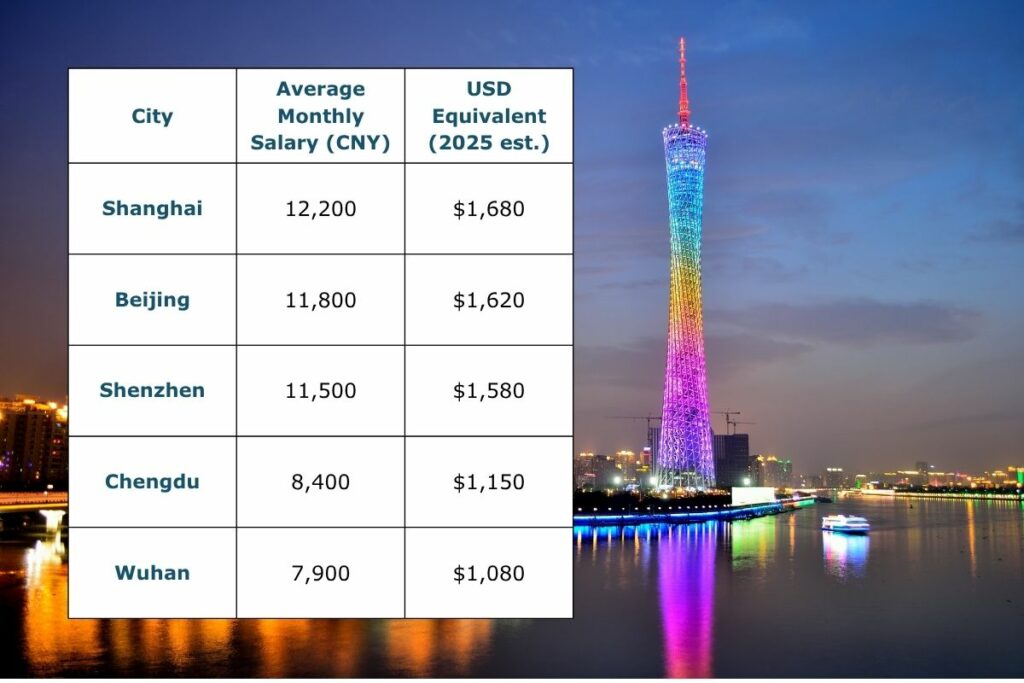
Average Wage and Salary Data in China (2025 Update) 

According to the National Bureau of Statistics of China (NBS): 

  • The average annual salary in urban areas in 2024 reached CNY 124,100 (≈ USD 17,200). 
  • The average monthly wage in China is around CNY 10,300 (≈ USD 1,420). 
  • The median salary in China is approximately CNY 8,200 (≈ USD 1,130) per month. 
  • The average wage in China per hour is about CNY 59 (≈ USD 8.15). 

In fact, salaries vary significantly by city and industry. The China minimum wage (2025) ranges from CNY 1,680 to 2,690 per month, in USD, is 230–370, depending on the region. These differences highlight why a reliable EOR company is critical, ensuring competitive, compliant, and locally benchmarked salaries.

Average monthly salary by top-tier cities in China. (Source: TradingEconomics)

Average monthly salary by top-tier cities in China. (Source: TradingEconomics)

How Wages Are Set in China 

China’s wage structure is influenced by: 

  • Local regulations: Provinces and cities define their own minimum wage. 
  • Industry benchmarks: Tech and manufacturing sectors often pay above average. 
  • Experience and education: Multilingual professionals or engineers earn 30–50% more than the national average. 

Thus, EOR services help foreign employers navigate these differences by offering real-time benchmarking and transparent salary packages that meet both employee expectations and compliance rules. 

Tax and Social Contribution in China 

Payroll and taxation in China are heavily regulated, and compliance is non-negotiable. About salary tax in China, the country uses a progressive tax system on individual income. 

  • Tax-free allowance: CNY 60,000 per year (≈ USD 8,300). 
  • Tax rates range from 3% to 45%, depending on monthly income. 
  • Additional deductions cover housing, education, and parental care. 

Moreover, both employers and employees must contribute to five mandatory insurances plus the housing fund. Rates vary by city, but these contributions add roughly 35–40% to the total employment cost. EOR in China ensures these obligations are met on time, with clear payslips and tax reports, eliminating risk for foreign clients.

Both employers and employees must contribute to five mandatory insurances plus the housing fund.

Both employers and employees must contribute to five mandatory insurances plus the housing fund.

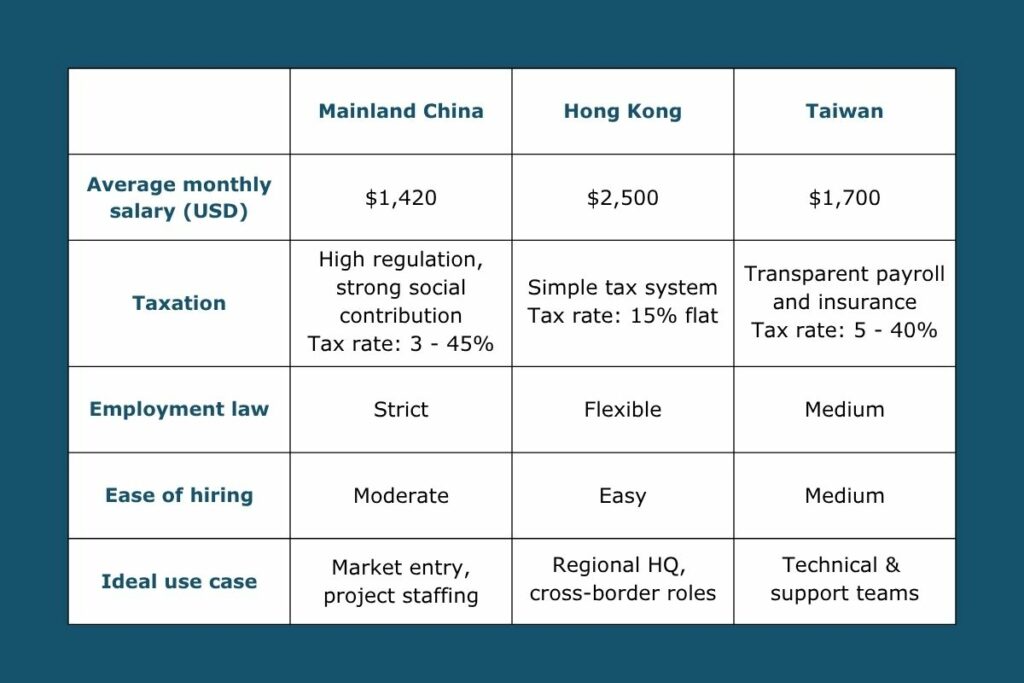
6. EOR Across China Mainland, Hong Kong, and Taiwan

Employment laws, taxation, and HR systems differ sharply between mainland China, Hong Kong, and Taiwan. Understanding these differences is crucial before selecting where and how to deploy staff.

  • Mainland China has strict labor regulations and mandatory contributions, but it offers access to the world’s largest industrial and consumer market. Therefore, EOR is ideal for foreign companies seeking full legal compliance without creating an entity. It also simplifies management of social insurance, tax reporting, and regional wage variations, from Shanghai’s high salaries to emerging markets like Chengdu or Qingdao. 
  • EOR in Hong Kong provides maximum flexibility. Employment laws are straightforward; personal income tax is capped at 15%, and no mandatory social insurance applies beyond the Mandatory Provident Fund (MPF). Hong Kong is often chosen as a strategic base for regional coordination, especially for sales, marketing, or finance functions covering all of Asia. 
  • EOR in Taiwan combines transparency and affordability. Payroll and insurance are regulated under clear national laws, and local professionals often bring bilingual or technical expertise. The average monthly salary in Taiwan (2025) stands around TWD 55,000 (≈ USD 1,700), making it a cost-effective hub for support and R&D operations. 

With VVR RH, companies can manage EOR seamlessly across all three regions through one trusted partner, ensuring unified payroll, compliance, and HR oversight.

With VVR RH, companies can manage EOR seamlessly across all three regions through one trusted partner.

With VVR RH, companies can manage EOR seamlessly across all three regions through one trusted partner.

7. Why EOR Is the Fastest Way to Recruit in China 

Businesses operate in a fast-moving environment where speed and compliance define today’s competitive advantages and decide success. Through EOR, companies can hire staff in China within two to four weeksinstead of waiting months to register a legal entity. Here are 5 reasons why you should choose EOR in China for your recruitment: 

  1. Fast onboarding. With VVR’s established HR infrastructure, onboarding can be completed in 15-30 business days. All documentation, contracts, and payroll systems are already in place. Therefore, it enables new hires to start work almost immediately. 
  2. Full legal and tax compliance. China’s labor and tax environment can be complex. EOR ensures full compliance with local laws, from employment contracts to income tax declarations and mandatory insurances. VVR RH acts as the legal employer, taking care of documentation, audits, and social contributions, giving you complete peace of mind. Foreign employers do not need to worry about missing registrations or penalties. 
  3. Seamless administration. We – VVR RH experts, manage the full HR cycle under one system of EOR: 
    • Employment contract drafting. 
    • Social contribution setup. 
    • Payroll calculation and tax filing.
    • Expense reimbursements and reporting.
    • The client receives one consolidated monthly invoice, making international HR management as easy as running a local team. 
  4. Built-in mobility and scalability. When businesses expand from one city to another, EOR in China allows them to do so without delay. Employees can be reassigned, contracts adapted, or new hires added across cities. As a result, they are all within one compliant framework, giving companies the freedom to scale teams up or down easily. Thus, this flexibility is particularly useful for companies managing multi-site operations or testing regional demand. 
  5. Cost control. EOR services offer transparent pricing and eliminate unnecessary administrative costs. You receive a single monthly invoice covering salary, social contributions, and management fees. No hidden expenses, no local accounting burdens. Therefore, the model helps companies manage their budgets accurately while avoiding the long-term financial commitments of setting up a subsidiary. 

8. When to Choose EOR in China, Hong Kong, and Taiwan 

EOR is ideal if your company: 

  • Wants to test the Chinese and/or other markets before setting up a subsidiary. 
  • Needs to hire employees or consultants rapidly. 
  • Aims to manage risk while maintaining full compliance. 
  • Seeks local expertise for payroll, tax, and HR management. 

It’s a solution that bridges global ambition with local compliance, a smart alternative to entity creation or outsourcing. VVR International is a global consulting firm that helps companies expand across Asia through HR, market entry, and compliance services. With offices in Shanghai, Guangzhou, Shijiazhuang, Pékin, and Paris, VVR supports clients in EOR solutions, HR outsourcing, and recruitment across China, Hong Kong, Taiwan, and beyond. Our local HR specialists ensure your team operates smoothly, legally, and cost-effectively, whether you’re hiring an expert or building an entire branch.


Read more related articles:


9. Final Thoughts

Entering the Chinese market can be both exciting and challenging. Complex regulations, regional wage variations, and compliance requirements often slow down international expansion. EOR in China eliminates these barriers. It allows companies to hire talent, launch operations, and test markets without delay or legal risk. Whether you are a growing SME or a large enterprise, the EOR model gives you everything you need to succeed: speed, compliance, flexibility, and cost control. With the right local partner, you can focus on your business goals while your HR, payroll, and legal obligations are handled seamlessly. 

Contact VVR RH today to discuss your project or learn more about our EOR solutions across China and Greater Asia. 

Share your project with us via contact@vvrinternational.com.

CONTACT US

FAQ

  • What are the main HR challenges in China that outsourcing helps foreign companies solve?

The main HR challenges in China include compliance with labor contract law, managing payroll across different cities, handling social insurance and housing fund contributions, and navigating work permit requirements for foreign employees.

HR outsourcing for foreign companies in China addresses these issues by providing local expertise, payroll outsourcing services, contract management under mutual agreement rules, and support for work permits. This allows companies to operate smoothly while minimizing legal and operational risks.

  • How do HR outsourcing services in China support strategic HR management and long-term growth?

HR outsourcing services in China support strategic HR management, aligning with modern HR practices in China, including digital HR solutions, employee retention strategies, and ESG-focused HR policies. By outsourcing HR functions, companies gain access to market insights, salary benchmarks, and compliance monitoring, enabling them to build sustainable teams in China while adapting to workforce trends and long-term business objectives.

Related Posts

Read More
PEO in China: Comparison with ASO, HRO, and How It Accelerates Business Expansion

PEO in ChinaComparison with ASO, HRO, and How It Accelerates Business Expansion

1. Introduction

For many foreign companies, entering the Chinese market means facing complex employment laws, high administrative costs, and long registration procedures. However, expansion no longer has to wait months for entity creation to occur. So, what is the solution? PEO in China, a flexible, compliant, and efficient HR model that lets companies hire staff and operate in China without establishing a local entity. In this article, VVR International provides a comprehensive comparison between PEO/EOR and ASO/HRO models, highlighting their key differences and strategic applications. You’ll also discover how PEO services in China can accelerate business expansion by combining compliance, flexibility, and cost efficiency, helping you determine which HR model best fits your company’s needs and growth objectives. 

2. What Is a PEO/EOR? Understanding the Model

A PEO (Professional Employer Organization) is a specialized HR partner that helps foreign companies hire employees in China while remaining compliant with Chinese labor laws. The PEO acts as a co-employer, managing HR administration, payroll, tax filings, and employment contracts, while the client company oversees day-to-day operations. This setup means you can operate in China without the need to establish a legal entity, while your employees receive full benefits and protection under local law. Moreover, working with a PEO/EOR offers: 

  • Hire and onboard employees in weeks, not months. 
  • Full alignment with Chinese labor, tax, and social insurance regulations. 
  • No need to register a Wholly Foreign-Owned Enterprise (WFOE). 
  • Local payroll, taxation, and health insurance managed seamlessly. 

A Professional Employer Organization (PEO) is not just a payroll service provider. It’s a long-term HR partner ensuring smooth operations for international companies in China. Specifically, in a PEO relationship: 

  • The client company manages the employee’s work and goals. 
  • The PEO/EOR organization in China becomes the local employer of record for HR, payroll, and compliance. 
  • The employee signs a compliant employment contract with the PEO/EOR but works directly under the client’s management. 

Essentially, PEO in China bridges the gap between global expansion and local compliance. It enables companies to enter the market quickly and legally. 

3. PEO in China vs Other HR Models

The HR landscape includes several models for managing employees abroad: PEO, ASO (Administrative Services Organization), and HRO (Human Resources Outsourcing). Each offers a different level of responsibility, cost, and control. Understanding their distinctions helps you choose the best fit for your company’s goals in China. 

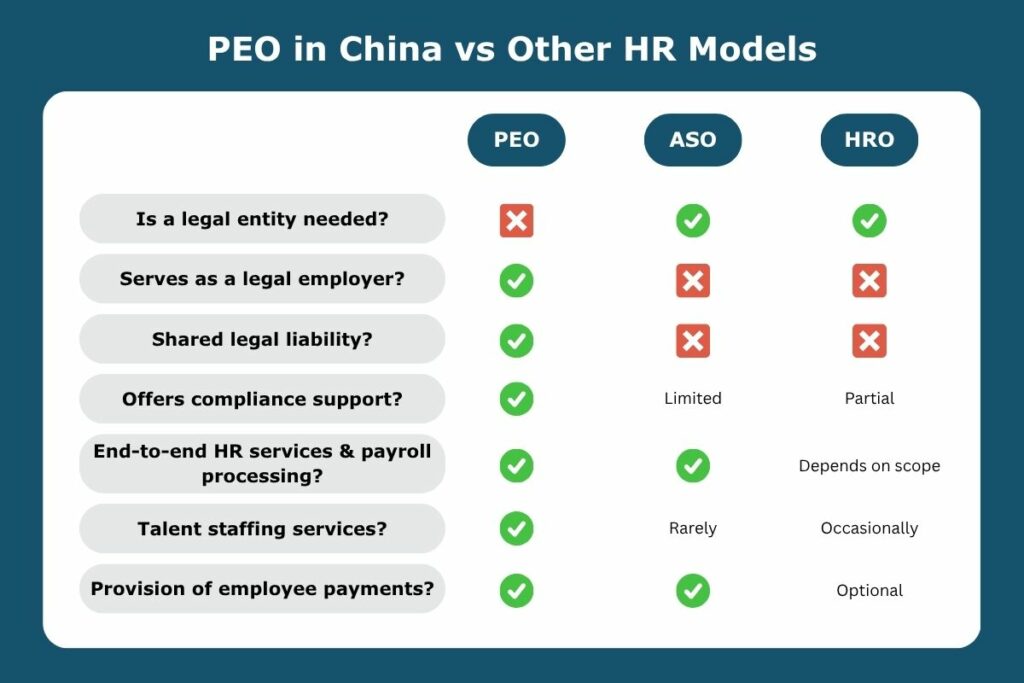
Understanding the key differences

Understanding their distinctions helps you choose the best fit for your company’s goals in China.

Understanding their distinctions helps you choose the best fit for your company’s goals in China.

To help you choose the right option for your company, the following overview explains how PEO in China differs from ASO and HRO models in terms of control, compliance, and scalability. 

  • PEO: Co-employment model. The client and the Professional Employer Organization share employer responsibilities. 
  • ASO: Provides HR administration but doesn’t assume legal responsibility. 
  • HRO: Handles specific HR tasks like payroll, recruitment, or training, but only as a service provider. 

Table 1 below provides a side-by-side comparison of these four models. It outlines their core business factors, including structure, risk, scale, scope, cost, and services. Thus, you can quickly see which approach aligns with your expansion goals. 

Factor  PEO (Professional Employer Organization)  ASO (Administrative Services Organization)  HRO (Human Resources Outsourcing) 
Structure  Co-employment between client and PEO.  Client retains employer status; ASO provides admin support.  Client retains full control, outsources selected HR tasks. 
Risk  Shared compliance responsibility.  Client holds legal liability.  Client holds liability. 
Scale  Ideal for SMEs or mid-size firms expanding abroad.  Best for large firms with internal HR teams.  Best for large enterprises seeking efficiency. 
Scope  Covers employment, payroll, benefits, compliance.  Payroll and HR administration.  Training, recruitment, or HR consulting. 
Cost  Moderate, shared employment costs.  Lower, minimal HR services.  Variable depending on the services. 
Services  HR management, payroll, benefits and compliance.  Payroll and benefits admin.  Custom HR solutions. 

Table 1: Comparison Overview – PEO vs ASO and HRO 

PEO in China stands out for combining shared compliance, cost efficiency, and local HR expertise, making it an ideal option for businesses seeking flexibility without sacrificing control. 

While the first table compares strategic factors, the next one highlights practical HR features such as legal responsibility, compliance support, and payroll processing. You can use this snapshot to determine which model best meets your company’s operational and legal needs in China. 

Feature  PEO  ASO  HRO 
Is a legal entity needed?  No  Yes  Yes 
Serves as a legal employer?  Yes  No  No 
Shared legal liability?  Yes  No  No 
Offers compliance support?  Yes  Limited  Partial 
End-to-end HR services & payroll processing?  Yes  Yes  Depends on scope 
Talent staffing services?  Yes  Rarely  Occasionally 
Provision of employee payments?  Yes  Yes  Optional 

Table 2: Features at a glance – PEO vs ASO and HRO 

These key features demonstrate that the PEO model delivers the broadest HR coverage while minimizing legal risk and administrative work. For most foreign companies entering the Chinese market, partnering with a PEO in China provides the smoothest path to hiring, payroll management, and full compliance from day one. Understanding these distinctions is essential for choosing the most suitable HR framework for your business. The next section explains when to choose each model and why PEO in China often provides the perfect balance between agility, compliance, and operational control. 

When to choose each model 

Choosing the right HR model depends on your organization’s size, level of market commitment, and appetite for legal responsibility. Here’s when each approach makes sense and why PEO in China often strikes the best balance between cost efficiency, control, and compliance. 

  • PEO in China: Best when you want speed, compliance, and shared HR management without establishing a local entity. 
  • ASO: Works for larger companies that already have an entity but need help with payroll administration.
  • HRO: Established firms outsource specific HR functions or projects. 

For most international SMEs expanding into China, the PEO model offers the ideal balance between control, cost, and compliance. 

4. How PEO Services Accelerate Business Expansion in China

Expanding to China requires speed, local knowledge, and compliance with Chinese labor laws. A PEO in China acts as your local HR engine. It helps you hire employees, manage payroll, and operate legally, all within a matter of weeks. By partnering with a China PEO service, you can: 

  • Recruit and onboard staff quickly. 
  • Avoid costly delays in entity registration. 
  • Reduce legal risk through compliant HR management. 
  • Focus resources on business development instead of administration. 

The approach is particularly valuable for companies testing new markets, establishing representative offices, or running pilot projects before setting up a subsidiary. 

5. How PEO Services Work in China

VVR International signs a local employment contract with the employee, ensuring full compliance with Chinese labor laws.

VVR International signs a local employment contract with the employee, ensuring full compliance with Chinese labor laws.

PEO services in China follow a well-defined structure that simplifies every stage of employment: 

  • Employment contract setup: 
    • VVR International signs a local employment contract with the employee, ensuring full compliance with Chinese labor laws. 
    • The client company retains operational control while VVR manages administrative obligations.
  • Payroll management: 
    • VVR handles all salary calculations, bonuses, benefits, and health insurance contributions. 
    • Each month, the company receives one clear invoice covering gross salary, taxes, and service fees. 
  • Compliance and taxation: 
    • The PEO ensures compliance with local tax rules, including withholding tax and mandatory social contributions.
    • All payments are made to government-approved channels in the employee’s registered city.
  • HR and administrative support: 
    • VVR RH manages onboarding, probation, performance records, and offboarding in accordance with local law. 
    • For foreign employees, the company also handles work visa and residence permit applications.
  • Continuous legal assurance: 
    • With regular policy updates and proactive HR advice, PEO services maintain long-term compliance and transparency. 

With this structure, foreign companies can hire employees in China confidently, focusing on growth while the organization PEO in China handles the rest. 

6. Why Choose VVR RH as Your Best PEO Services Partner

When choosing a PEO service in China, experience, licensing, and local insight matter. VVR International stands out as a trusted partner combining European reliability with on-the-ground Franco-Chinese expertise. 

VVR International RH handles: 

  • Drafting legally compliant employment contract. 
  • Comprehensive HR management, including onboarding and employee relations. 
  • Full payroll administration (salary, benefits, bonuses, reimbursements). 
  • Administrative tasks such as social protection, housing fund, and health insurance. 
  • Taxation and withholding handled accurately each month. 
  • Contract renewals, terminations, and exit procedures. 
  • Immigration support for foreign employees (work visa and residence permit).
VVR RH stands out as a trusted partner combining European reliability with on-the-ground Franco-Chinese expertise.

VVR RH stands out as a trusted partner combining European reliability with on-the-ground Franco-Chinese expertise.

Operational highlights: 

  • Monthly invoicing for salaries and service fees ensures transparency. 
  • Holds an official Labor Dispatch License, authorizing legal employment of Chinese and foreign staff. 
  • Pays all taxes and social charges in the employee’s registered city, as required by law. 

Additional support from VVR RH: 

  • Intercultural management helps align European and Chinese work cultures for smoother onboarding. 
  • VVR’s teams in France and China coordinate time zones and expectations. 
  • Expatriate assistance offers adaptation training, relocation help, and ongoing HR support. 

More than HR outsourcing, we provide a complete ecosystem for your success in China, ensuring your team operates confidently and compliantly from day one. 


Read more related articles:


7. Final Thoughts

To sum up, a PEO in China allows businesses to hire, manage, and pay employees without setting up a local entity, combining compliance, speed, and scalability. Compared to other HR models, the PEO/EOR approach offers shared control, lower risk, and complete transparency. Whether you’re entering China for the first time or expanding your presence, partnering with an experienced provider like VVR International helps you navigate every step of your journey. 

Are you ready to start your expansion in China? Contact VVR International today to learn how our PEO services in China can help you hire employees, manage payroll, and stay compliant, without the burden of establishing a legal entity.

Share your project with us via contact@vvrinternational.com.

CONTACT US

FAQ

  • What are the main HR challenges in China that outsourcing helps foreign companies solve?

The main HR challenges in China include compliance with labor contract law, managing payroll across different cities, handling social insurance and housing fund contributions, and navigating work permit requirements for foreign employees.

HR outsourcing for foreign companies in China addresses these issues by providing local expertise, payroll outsourcing services, contract management under mutual agreement rules, and support for work permits. This allows companies to operate smoothly while minimizing legal and operational risks.

  • How do HR outsourcing services in China support strategic HR management and long-term growth?

HR outsourcing services in China support strategic HR management, aligning with modern HR practices in China, including digital HR solutions, employee retention strategies, and ESG-focused HR policies. By outsourcing HR functions, companies gain access to market insights, salary benchmarks, and compliance monitoring, enabling them to build sustainable teams in China while adapting to workforce trends and long-term business objectives.

Related Posts

Read More