Category: Uncategorized

Learning expedition in China: an immersion to understand the innovation and culture of a changing market

Learning expedition in China: an immersion to understand the innovation and culture of a changing market

Why is immersion becoming an essential step before launching a business in China?

Understanding the Chinese market from within China

The Chinese market attracts companies from around the world due to its size, capacity for innovation, sustained growth, and vast opportunities in cutting-edge sectors. But China is also a complex market with its own dynamics, unique business culture, and rapid changes. For foreign companies, it is not always enough to consult reports or follow trends from a distance. Field experience can therefore be an asset in preparing for expansion in China, enabling informed decisions to be made and strategies to be adjusted.

This is why learning expeditions are a valuable tool for better understanding the Chinese market. At VVR International, our teams in France and China design and organize these immersive trips tailored to each project, in order to offer groups of companies a precise and strategic vision of the Chinese market.

What is a learning expedition in China?

The concept of a “learning expedition” is a short trip (usually between 4 and 8 days) during which a group of decision-makers, executives, or business managers meet with key players in an ecosystem: companies, institutions, incubators, start-ups, R&D centers, etc.

A learning expedition is not just a business trip punctuated by a series of visits; it is designed to be an immersive experience, with strategic objectives defined in advance with the help of our teams of Chinese market experts:

  • Explore a sector or market,
  • Identify opportunities,
  • Understand local practices,
  • Draw inspiration from models of innovation,
  • Establish initial contacts.

This format is particularly relevant in China. The country is vast, diverse, evolving at a rapid pace, and often operates according to principles that are very different from those of Western markets. Immersion, direct observation, and contextualization provide a better understanding of China and its potential for development in this market.

It should be noted that for nationals of many countries, including France, visas are no longer required to enter China for stays of 30 days or less (for more information, read our article “Making a success of your first business trip to China”).

Immersion in the heart of the Chinese industrial ecosystem: what are the objectives for foreign companies?

The learning expedition enables companies to reduce uncertainty about the Chinese market by providing a concrete understanding of it. Each mission is built around several key objectives that enable participants to improve their understanding of China:

1. Decoding the specificities of the Chinese market

Chinese consumers do not have the same expectations, purchasing practices, and preferences as consumers in European countries. Regulations and the competitive landscape are also very different from those in European countries. By meeting with local companies, experts, and institutions, participants gain a direct understanding of the realities on the ground:

  • How do consumers make their decisions?
  • What are the rules for accessing the market in a given sector?
  • How are local partnerships built?

2. Draw inspiration from Chinese innovations

China is now a global driver of innovation in sectors such as green tech, automotive, smart cities, energy, healthcare, and logistics. Seeing these innovations at work, both in industry and manufacturing and in marketing and distribution, allows participants to challenge their own models and identify opportunities for collaboration or adaptation.

3. Make useful contacts

A learning expedition opens doors. Whether through B2B meetings, site visits, or informal exchanges, companies can forge initial links with potential partners, suppliers, customers, or local influencers.

4. Become familiar with Chinese business culture

In China, understanding cultural customs, negotiation mechanisms, and social codes is important for success. Immersion allows you to grasp these subtleties, which are often invisible from a distance but crucial for building a relationship of trust.

5. Refine your development strategy in China

Upon returning from China, participants have tangible elements to adjust their strategy: which regions to target? Which entry model to adopt (distribution, partnership, JV, subsidiary, license)? Which products or services to adapt? The learning expedition thus becomes a decision-making tool. The VVR International teams then assist participants in analyzing and adjusting their development strategy in China.

China: a laboratory for innovation and a market of the future

China is a leading technological player. It invests heavily in R&D, actively supports the emergence of cutting-edge companies in many strategic fields, and develops innovation hubs across all its regions.

Some particularly innovative sectors:

  • Tech and digital: ultra-integrated e-commerce, mobile payment, AI, connected objects.
  • Mobility and energy: electric cars, batteries, shared mobility solutions.
  • Industry 4.0: automation, robotics.
  • Smart cities: urban flow management, big data, connected infrastructure.
  • Agri-food: traceability, food safety, food tech.
  • Medicine

Observing these trends from the inside allows foreign companies to better understand market expectations and potential levers for differentiation.

How does VVR International support companies in their learning expeditions?

A tailor-made and locally-based approach

Organizing an effective learning expedition in China cannot be improvised. VVR International offers federations, professional organizations, business associations, and clusters tailor-made support. Our experts have in-depth knowledge of China and its industry, mobilize the right contacts, and provide high-quality cultural support.

With more than 25 years of experience in China, VVR International designs learning expeditions that are tailored to the objectives, sector, level of international maturity, and schedule of each group of participants.

Our services include:

  • Upstream strategic framing: understanding objectives, selecting priority geographical areas and sectors.
  • Complete program organization: identifying companies to visit, experts to meet, and building an optimized itinerary.
  • On-site support: professional interpreters, intercultural consultants, turnkey logistics (transportation, accommodation, catering).
  • Daily debriefings and final summary: putting things into perspective, key lessons learned, strategic recommendations.
  • Post-mission follow-up: connecting with partners, analyzing identified opportunities, support for the next phase.

What participants take away from a learning expedition

Learning expeditions are often “trigger” moments, allowing you to move from intention to action, or, conversely, to readjust a strategy and avoid costly mistakes. The strength of a learning expedition lies in the combination of concrete observations, informal exchanges, cultural discoveries, and collective reflection.

Understanding China to effectively prepare for development

Expanding into the Chinese market requires serious and meticulous preparation. Learning expeditions are a strategic step in the process of reflection and acculturation. These well-prepared trips, accompanied by experts in the Chinese market, are a valuable tool for field analysis that can be decisive when considering or initiating a development project in China.

For more than 25 years, we have been helping foreign companies succeed in their industrial or commercial development in China, supporting them at every stage of their project: market analysis, identification of opportunities, search for partners, institutional networking, legal and operational structuring, intercultural management, etc.

Contact our experts to build a strategy tailored to your sector and the realities on the ground in order to secure each stage of your project in China and thus sustain your activities in the Chinese market.

Read More
VVR International advises TRASIS on the acquisition of its distributor and the creation of its joint venture in China

VVR International advises TRASIS on the acquisition of its distributor and the creation of its joint venture in China

VVR International assisted TRASIS, a global leader in nuclear medicine equipment, in structuring, negotiating and signing the acquisition of its distributor, as well as setting up a joint venture with its long-standing Chinese partner, Beijing PET Technology.

This signing marks a decisive step in TRASIS‘ international development strategy. It is the result of a comprehensive support mission led by VVR International, aimed at transforming a distribution relationship into a lasting structural presence.

Access the full press release:

Read More
Perfume in China 2025: a sector undergoing cultural and economic transformation

Perfume in China 2025: a sector undergoing cultural and economic transformation

In 2025, the perfume market in China is experiencing strong growth, with a significant increase in sales and changing consumer behavior. Here are the key points to remember:

Growth and potential of the Chinese perfume market

The Chinese perfume market is expected to reach 21.4 billion yuan (approximately $2.9 billion) in 2025, with an average annual growth rate of 13.4% between 2020 and 2025. This growth is well above the global average of 4-6% per year. China is on track to become the world’s second-largest market for fine perfumery in 2025, just behind the United States, driven by a young and affluent population that is increasing its consumption of luxury goods and perfumes. [1]

Consumer trends and changing habits

The market is dominated by young people aged 24 to 40, mostly women, with perfume penetration still low (around 5% of the population), leaving strong potential for growth. Chinese consumers prefer light, fruity, and floral scents, but demand for niche perfumes and different products is also growing. The use of men’s fragrances is increasing, reflecting a cultural shift towards greater acceptance of beauty products among men.[2] Finally, the niche fragrance segment is experiencing spectacular growth: +45% growth in 2024[3]. In this segment, unisex and customizable fragrances are very popular, in line with increased demand for individualization.

Foreign brands or local brands: what are the trends and success factors?

Shanghai[4] plays a central role in the growth of this sector, attracting large multinationals such as IFF and Givaudan, which have set up innovation and creative centers there. The city is positioning itself as a strategic economic and commercial hub with policies favorable to brand launches. The market is still largely dominated by international brands, particularly French ones, but they now need to adapt further:

  • Launch exclusive collections for China
  • Adapt formats (e.g., miniatures for travel retail)
  • Playing on local cultural references in their communication

Western niche brands such as Le Labo, Byredo, and Diptyque have managed to succeed, driven by an arty positioning and a high-end boutique experience.

The emergence of local brands investing in R&D and marketing is a notable phenomenon, particularly since the pandemic. Local brands enjoy strong consumer appeal and manage to combine quality, trends, and local cultural elements. This is the case, for example, with the brand To Summer, founded in 2020, which draws inspiration from the seasons and Chinese nature. It stands out for its elegant packaging and poetic fragrances. The brand recently launched an immersive boutique in Beijing, recreating a contemporary Chinese garden. Retail is becoming an experiential arena, combining art, design, and technology.

Distribution and digital marketing: how are perfumes sold in China?

Digital and e-commerce, via platforms such as Tmall, JD.com, and Red (XiaoHongShu), are essential marketing channels, supported by the strong influence of KOLs (influencers) and KOCs (Key Opinion Consumers) who contribute to brand awareness and guide consumer choices. This also facilitates the emergence of niche and local brands that are gradually gaining market share (see our infography on the perfume market).

What does the future hold for perfume in China?

In 2025, the Chinese perfume market is experiencing remarkable growth, driven by a young generation in search of personal expression, a confident move upmarket, and a high-performance digital ecosystem. China is becoming a laboratory for innovation and experimentation where both local and foreign brands must adapt their offerings, storytelling, and market entry strategies to a unique market.

For more than 25 years, VVR International has been helping French and European companies successfully establish themselves in the Chinese market, particularly in the luxury, cosmetics, and perfume sectors.

Our teams based in China and Paris support you at every stage of your development:

  • Targeted sector market research
  • Identification of partners (distributors, R&D centers, influencers)
  • Product adaptation and local positioning
  • Strategy for entering Chinese digital platforms (Tmall, JD, RED)
  • Regulatory monitoring and compliance with local standards (e.g., NMPA)

[1] french.shanghai+2

[2] staiirs+1

[3] Mintel China Fragrance Report, 2024

[4] https://french.shanghai.gov.cn/fr-Editorspick-DoBusiness/20250909/5dcc0ee33bd248dca66cdae4de556dbe.html

Read More
VVR International, partner of the French Pavilion at the 8th edition of the CIIE in Shanghai

VVR International, partner of the French Pavilion at the 8th China International Import Expo (CIIE) in Shanghai

From November 6 to 10, 2025, Shanghai hosted the 8th edition of the China International Import Expo (CIIE), the event for all international companies wishing to strengthen their presence in the Chinese market. VVR International was proud to be a partner of the French Pavilion, organized by Business France, and to support an initiative that illustrates the transformations taking place in the Chinese economy: greater openness to foreign products and the rising expectations of Chinese consumers.

Chloé Berndt and Xia Dan, associate directors of VVR International, were present at the inauguration of the French Pavilion in the presence of Nicolas Forissier, Minister Delegate to the Minister for Europe and Foreign Affairs, in charge of Foreign Trade and Attractiveness, Bertrand Lortholary, French Ambassador to China, and Joan Valadou, French Consul in Shanghai.

A 2025 edition focused on quality

The China International Import Expo (CIIE) showcases foreign companies that import goods into China and reflects the Chinese government’s desire to stimulate domestic consumption by promoting access to quality products. Once again this year, the exhibition halls brought together major international brands, distributors, and discerning Chinese trade visitors.

French expertise in the spotlight

On the initiative of Business France in China, the French Pavilion offered a dozen French companies, professional federations, and regions from various sectors the opportunity to showcase their expertise and the high quality of their products at this major trade show.

Thanks to this partnership, Business France and VVR International are demonstrating their conviction that the complementary nature of their actions to support French companies is an asset for their successful development in China.

Read More
VVR Medical China Medtech Monthly: September 2025 Executive Briefing

VVR Medical China Medtech Monthly: September 2025 Executive Briefing

September 2025 marked a pivotal moment in the Chinese MedTech sector, characterized by extreme duality: severe protectionist threats from abroad countered by an aggressive, state-backed industrial push focused on self-reliance and high-end domestic innovation. The sector is rapidly adopting disruptive technologies, while government procurement models are fundamentally evolving to prioritize quality over pure price. This report highlights key policy shifts, clinical breakthroughs, and market signals confirming the domestic recovery.

Geopolitical Tides and Market Access Levers

  • U.S. National Security Probe Escalates Risk: The U.S. Department of Commerce launched a Section 232 investigation into the national security effects of imported medical devices and consumables. This action uses national security as justification for potential severe restrictions, such as high tariffs or quotas, threatening established global supply chains.
  • Shanghai’s High-End Ambition: The Shanghai municipal government released an “Action Plan” to cultivate a world-class high-end device industry. By 2027, key targets include achieving over 500 new domestic Class III medical device approvals and cultivating at least two “leading enterprises” with annual output exceeding ¥10 billion ($1.41 billion) each.
  • Guangdong Bay Area (GBA) Market Access Solidified: Guangdong issued “Administrative Measures” taking effect November 1, 2025, formalizing the GBA “urgent use” pathway. This pivotal policy introduces a “pre-review database,” transforming the GBA pathway from a reactive selection into a proactive, manufacturer-driven nomination process for foreign devices seeking access before national NMPA approval.

 Market Dynamics and Procurement Evolution

  • VBP Shifts Focus to Quality (“VBP 2.0”): The next national Volume-Based Procurement (VBP) round for Traditional Chinese Medicine (TCM) decoction pieces introduced a transformative new scoring system. Price now accounts for only 50% of the total score, with quality indicators accounting for 40% and supply stability the final 10%. This is a fundamental pivot toward a “best value wins” framework.
  • Domestic Recovery Confirmed: Industry leader Mindray Bio-Medical Electronics signaled a crucial market inflection point in Q3, projecting a return to positive year-on-year revenue growth. This confirms that hospital procurement activities, previously slowed by the 2024 anti-corruption campaign, are normalizing.
  • Global Validation Achieved: Changzhou Finno Medical Technology received FDA 510(k) clearance for its Dental Cone-beam Computed Tomography (CBCT) system. This milestone provides external validation of the Chinese firm’s quality management system and its ability to develop advanced products for the world’s most demanding regulatory markets.

 Innovation and Regulatory Leapfrogging

  • World-First AI Robotics Procedure: Sir Run Run Shaw Hospital announced the successful completion of a “world’s first” surgical procedure utilizing a novel system combining AI-powered navigation and flexible robotics for minimally invasive, “one-stop” bilateral lung nodule surgery.
  • Disruptive Clinical Trials Registered: A landmark first-in-human trial was registered for a novel extravascular renal denervation (RDN) system for treating refractory hypertension. This approach, which ablates nerves from outside the artery, represents an attempt by domestic innovators to leapfrog existing catheter-based RDN technologies.
  • NMPA Accelerates High-End Tech: The National Medical Products Administration (NMPA) detailed 10 new measures to support high-end device innovation. Crucially, the NMPA established a clear regulatory pathway for emerging Brain-Computer Interface (BCI) technology by issuing new standards for terminology and performance testing.

 Ecosystem Investment & Capacity

  • State-Backed Funding for Platform Tech: 3D cell culture technology provider Huakan Bio completed a major Series B+ financing round, valued at “several hundred million RMB,” co-led by state-affiliated investment funds. This highlights strategic capital flowing into foundational technologies crucial for advanced therapies.
  • Manufacturing Capacity Expansion: Contract manufacturer Rosti underscored confidence in the manufacturing ecosystem by announcing a significant capacity expansion, including adding a 500-square-meter ISO Class 8 cleanroom to its Suzhou facility.
  • Domestic Regulatory Strength Confirmed: August 2025 NMPA approval data revealed the strength of the domestic pipeline, with 208 domestic Class III devices approved, significantly outpacing the 31 imported Class III devices approved during the same period.

To understand how these converging geopolitical pressures and quality-focused policy shifts will determine winners and losers in the rapidly recovering Chinese healthcare market, ask for the free full September 2025 VVR Medical Report.

Read More
Navigating China’s Pharmaceutical Market Access Landscape: Key Insights from the 2025 National Drug Catalog Adjustment

Navigating China’s Pharmaceutical Market Access Landscape: Key Insights from the 2025 National Drug Catalog Adjustment

The recent release of the 2025 National Basic Medical Insurance, Maternity Insurance, and Work-related Injury Insurance Drug Catalog Adjustment Work Plan on July 10th, 2025, marks a pivotal moment for pharmaceutical companies operating in China. This comprehensive framework, accompanied by crucial supporting documents like application guidelines, renewal rules, and non-exclusive drug bidding rules, officially kicks off the 2025 National Reimbursement Drug List (NRDL) adjustment process. For market access specialists, this year’s adjustment is particularly significant, not only for its refined mechanisms for basic medical insurance but, crucially, for the inaugural establishment of a Commercial Health Insurance Innovative Drug Catalog. This dual-track approach signals a strategic shift towards a multi-tiered healthcare security system, demanding a sophisticated and adaptive market access strategy from industry players.

A Trajectory of Refinement: Evolution of China’s NRDL Adjustments

China’s NRDL adjustment mechanism has undergone a significant transformation since its inception in 2000, evolving through ten editions to its current sophisticated state. The establishment of the National Healthcare Security Administration (NHSA) in 2018 marked a turning point, ushering in a normalized adjustment process. Key milestones include:

  • 2009: Integration with essential drug lists and the introduction of negotiation-based access rules.
  • 2017: Further alignment with negotiated drugs, supporting Traditional Chinese Medicine (TCM) and innovative drugs.
  • 2020: Implementation of enterprise self-
  • 2021: Maturation and stabilization of adjustment rules, with increased emphasis on clinical comprehensive evaluation and pharmaco-economics.
  • 2022: Introduction of non-exclusive drug bidding rules and removal of certain payment
  • 2023-2024: Heightened support for innovative drugs and expansion of rare disease drug inclusion.

The negotiation and bidding process has similarly matured, with eight rounds of national negotiations completed since 2017, leading to substantial price reductions and increased access. For instance, the 2023 round saw 121 out of 143 drugs successfully negotiated or tendered, with an average price reduction of 61.7%. The 2024 round achieved an average price reduction of 63%.

2025 NRDL Adjustment: The Dual-Track Imperative

The 2025 adjustment largely mirrors the 2024 basic medical insurance adjustment scheme, upholding the principles of “filling gaps, optimizing structure, and encouraging innovation“. The process is structured into five distinct stages: preparation, declaration, expert review, negotiation, and results publication. The online application window is July 11th 9:00, to July 20th 17:00, 2025.

However, the most significant innovation this year is the introduction of the Commercial Health Insurance Innovative Drug Catalog. This new catalog aims to encompass innovative drugs that exceed the “basic” insurance scope but possess high innovation, significant clinical value, and substantial patient benefits. These drugs are recommended for reference by commercial health insurance, mutual aid, and other multi-tiered medical protection systems.

Eligibility for the Commercial Innovative Drug Catalog

 Drugs eligible for this new catalog are exclusive drugs that meet either of the following conditions:

  • New Generic Name Drugs: Approved for marketing by the National Medical Products Administration (NMPA) between January 1, 2020, and June 30, 2025 (inclusive).
  • Rare Disease Treatment Drugs: Approved for marketing by the NMPA by June 30,

Crucially, eligible drugs can either separately declare for the commercial innovative drug catalog or simultaneously declare for both the commercial innovative drug catalog and the basic medical insurance catalog. This “dual submission” pathway provides a strategic avenue for innovative drugs that might face challenges in immediate basic NRDL inclusion due to high cost or market impact but still offer significant clinical value. It also necessitates that companies submitting for the commercial catalog must provide information on their inclusion in inclusive commercial health insurance programs such as Huiminbao and other supplementary commercial health insurance plans.

Considerations for Pharma in China’s Evolving Reimbursement Landscape

The 2025 NRDL adjustment and the new commercial innovative drug catalog introduce several operational and strategic considerations for pharmaceutical companies.

Operational Efficiency: Streamlined Digital Process

 A key operational change for 2025 is the unified medical insurance information system module covering the entire NRDL adjustment process, from declaration to agreement signing. This system standardizes data submission and feedback, emphasizing the need for robust internal data management. Companies must ensure a single, consistent account is used throughout all stages.

Key Declaration Changes for Pharma

  • Dual-Track Application: The explicit option to declare for both basic and commercial
  • Detailed Adaptation Information: Enhanced requirements for multi-indication drugs, emphasizing comprehensive rather than selective reporting of new indications and approval times.
  • Reference Drug Selection: Clarification that reference drugs should primarily be the most widely used in-catalog drugs within the same therapeutic area and mechanism of action.
  • Fairness Information (New Requirement): For drugs applying to the commercial innovative drug catalog, companies must provide details on their inclusion in commercial health insurance products, including product descriptions, pricing/discount levels, and claims.
  • Sales Data Focus:
    • Out-of-catalog drugs: Previously, 3 years of sales data; now, 1.5 years (full 2024 and Jan-June 2025) of sales data within the medical insurance payment scope, broken down by specification.
    • In-catalog drugs: Future sales projections shift from 3 years to 2 years for both current and new indications. This requires more precise short-term market

Negotiation Dynamics: Navigating Simplified Renewal and Re-negotiation

  1.  Turn to Routine Management (Conventional Entry)

 The conditions for drugs to transition from negotiated status to routine catalog management have been tightened. Notably, the condition allowing exclusive drugs to become routine after two consecutive agreement periods without payment standard or scope adjustment has been removed. Now, only specific conditions apply:

  • Government-priced narcotics;
  • Drugs from national centralized procurement (VoBP);
  • Non-exclusive drugs (based on generic drug prices);
  • Exclusive drugs continuously in the “negotiated drugs” section for 8 years (as of Dec 31st of the adjustment year, applicable to drugs included in 2017).
  1. Simplified Renewal: A Critical Focus on Payment Scope Expenses

 A significant change in simplified renewal is the shift from “fund expenditure” to “drug expenses within the scope of payment” (i.e., total drug expenses paid by both the fund and insured individuals) as the primary calculation metric. The thresholds for annual drug expenses have also been adjusted upwards (in green in both tables below), indicating a broader tolerance for volume growth before triggering price cuts.

Table 1: Simplified Renewal Price Adjustment (Ratio A) – Actual Sales vs. Forecast

ANNUAL DRUG EXPENSES WITHIN PAYMENT SCOPE (RMB) ≤110% (RATIO A) 110% < A ≤

140%

140% < A ≤

170%

170% < A ≤

200%

≤300 MILLION No Adjustment -5% -10% -15%
>300 MILLION – ≤1.5 BILLION No Adjustment -7% -12% -17%
>1.5 BILLION – ≤3 BILLION No Adjustment -9% -14% -19%
>3 BILLION – ≤6 BILLION No Adjustment -11% -16% -21%
>6 BILLION No Adjustment -15% -20% -25%

Table 2: Simplified Renewal Price Adjustment (Ratio B) – Incremental Expenses due to Scope Adjustment

ANNUAL INCREASE IN DRUG EXPENSES (RMB) WITHIN PAYMENT SCOPE ≤10% (RATIO B) 10% < B ≤

40%

40% < B ≤

70%

70% < B ≤

100%

≤300 MILLION No Adjustment -5% -10% -15%
>300 MILLION – ≤1.5 BILLION No Adjustment -7% -12% -17%
>1.5 BILLION – ≤3 BILLION No Adjustment -9% -14% -19%
>3 BILLION – ≤6 BILLION No Adjustment -11% -16% -21%
>6 BILLION No Adjustment -15% -20% -25%

Strategic highlight: For Class 1 chemical drugs, Class 1 therapeutic biological products, and Class 1 TCM drugs, if Ratio A falls between 110% and 200%, companies can choose simplified renewal or apply for re-negotiation, where the price reduction may not necessarily be higher than that determined by simplified rules. Furthermore, a crucial rule states that if a drug has been continuously in the “negotiated drugs” section for 4 years or more (i.e., included before Jan 1, 2022), any triggered price reduction will be halved. This provides a degree of predictability and stability for long-standing innovative therapies.

  1. Re-negotiation

 Exclusive drugs that do not meet the conditions for routine management or simplified renewal will be subject to re-negotiation. This pathway also explicitly allows Class 1 chemical drugs, Class 1 therapeutic biological products, and Class 1 TCM drugs to opt for re-negotiation even if they qualify for simplified renewal (110% < A ≤ 200%).

  1. Non-exclusive Drug Bidding

 The rules for non-exclusive drug bidding remain consistent with the 2024 version. The lowest bid among competing enterprises sets the payment standard. A critical aspect is that if the lowest bid is less than 70% of the medical insurance payment willingness, 70% of the medical insurance payment willingness will be set as the payment standard.

Ensuring Market Access: Supply and Compliance

The new plan underscores the importance of supply assurance and data integrity. Companies must guarantee market supply and timely report significant changes to the NHSA. Failure to supply without justifiable reasons can lead to the drug being removed from the catalog and the enterprise being frozen from future NRDL adjustments for a period. Accurate and timely submission of sales and fund expenditure data is paramount, as this data directly informs renewal calculations.

Conclusion: A Landscape of Opportunity and Challenge

The 2025 NRDL adjustment presents a complex but structured pathway for pharmaceutical innovation in China. The introduction of the commercial innovative drug catalog offers a vital new channel for high-value therapies that may not immediately fit the basic insurance mandate, fostering a multi-layered payment system. For existing drugs, the refined renewal rules, particularly the shift to “payment scope expenses” and the “4-year reduction by half” rule, demand sophisticated data analysis and strategic forecasting. Companies must prioritize robust internal data collection and analytical capabilities, engage proactively with the new digital submission process, and carefully assess the optimal entry/renewal strategy – whether dual submission, simplified renewal, or re-negotiation – to maximize patient access and commercial viability in this dynamic market. The focus remains on clinical value, innovation, and affordability, urging pharma to align their strategies with China’s evolving healthcare priorities.

Key Takeaways

  • The 2025 medical insurance catalog adjustment officially launched on July 10, 2025.
  • A commercial health insurance innovative drug catalog is established for the first time.
  • The change prioritizes innovation, addressing clinical gaps, rare diseases, and pediatric drugs.
  • Certain innovative drugs can apply to both basic and commercial catalogs.
  • A new online system covers the entire catalog adjustment process.
  • Simplified renewal rules were updated; “transfer to regular” conditions tightened.
Read More
A major achievement in China: the world’s first recovery for type 1 diabetes

A major achievement in China: the world’s first cure for type 1 diabetes

A revolutionary medical advance

For the first time, a 25-year-old Chinese woman has been completely cured of type 1 diabetes thanks to a therapy developed by Chinese researchers. The approach, carried out at Tianjin Main Hospital in collaboration with Peking University, is based on cell regeneration. The researchers took cells from the patient’s pancreas, which they then chemically treated to return them to a stem cell state. Once modified, the cells were re-implanted into the patient’s pancreas via a micro-invasive route. Following this operation, the level of insulin secreted increased by 700%. The results of this operation were rapid and long-lasting: as early as 75 days after the operation, blood sugar levels were regulated without the need for external insulin injections, and the patient no longer had any symptoms of diabetes. This complete cure marks a major therapeutic revolution.[1]

A silent epidemic

Despite this progress, diabetes remains a real public health emergency. With more than 140 million people affected, China has one of the highest prevalence rates in the world, representing around 12% of its adult population[2] . By 2040, China could have 166 million diabetics, consolidating its position as one of the most affected countries.[3] Worryingly, type 2 diabetes also affects 1.77% of Chinese children aged between 3 and 18[4] .  Added to this is a lack of awareness: only 36.5% of Chinese diabetics are aware of their condition and, of those who are treated, less than half (49.2%) manage to control their blood sugar levels effectively[5] . The complications associated with diabetes are numerous and can be serious[6] :

  • Cardiovascular disease: the main cause of death among diabetics.
  • Kidney problems: kidney failure is common.
  • Neurological and ocular disorders: neuropathy, which can lead to blindness, is also common.

The underlying causes of this epidemic

Diabetes in China is not just a question of genetic predisposition. Several social, economic and environmental factors are converging to fuel this crisis.

Urbanisation

The rapid development of cities in China has transformed lifestyles. Urban populations, which make up a growing proportion of Chinese society, have a much higher prevalence of diabetes than rural areas (12.1% compared with 8.3%).

Dietary changes

Changes in eating habits have also played a crucial role. The increased consumption of sugars, processed foods and fast food among affluent populations puts them at greater risk of diabetes. This transition, once limited to large cities, is now spreading to rural areas as a result of increasing access to industrial food products.

A sedentary lifestyle and stress

With the rise of office jobs, physical activity has declined considerably. At the same time, the urban environment and growing socio-cultural challenges are generating chronic stress, known to disrupt hormonal and metabolic mechanisms.

An ageing population

Like many countries, China’s population is ageing rapidly. This phenomenon mechanically amplifies the prevalence of diabetes, a disease that affects the elderly to a greater extent.

Strategic solutions: prevention rather than cure

To curb the diabetes epidemic, China is investing in prevention and awareness-raising policies:

Education and screening

By raising awareness of diabetes, it is possible to increase the rate of early detection and appropriate management.

Encouraging a balanced diet

Promoting high-fibre, low-sugar diets helps to improve the health of at-risk populations.

Promoting physical activity

Incorporating exercise into the daily routine through incentives, promoting the benefits of sport and creating more accessible infrastructures in urban areas could help to reduce the prevalence of the disease.

Strengthening medical infrastructures and equipment

Rural areas still lack the resources to diagnose and treat diabetes effectively. Strengthening the capacity of local healthcare centres is essential to bridge this gap. Massive investment in diabetes management equipment such as glucometers, insulin pumps and other innovative medical devices is being made to meet this public health challenge.[7]

A land of opportunity for foreign companies

The fight against diabetes in China offers many opportunities for European and French companies, particularly in :

  • Innovative medical devices such as connected glucometers.
  • Digital solutions for monitoring and managing diabetes.
  • Advanced treatments (such as GLP-1 drugs like Ozempic), both for diabetes itself and for its complications.

The key to success lies in an in-depth understanding of the local market, the players involved and the regulations in force. VVR Medical, a division of VVR International and an expert in the Chinese pharmaceutical and medical markets, supports companies in their development strategy in China.

[1] World first: Chinese woman cured of type 1 diabetes

[2] https://www.federationdesdiabetiques.org/information/diabete/chiffres-monde

[3] https://fr.statista.com/statistiques/571668/pays-avec-le-plus-grand-nombre-previsionnel-de-personnes-diabetiques-en-2040/

[4] https://www.thelancet.com/journals/lanpub/article/PIIS2468-2667(24)

[5] https://www.dbl-diabete.fr/tout-sur-le-diabete/societe/classement-diabete-pays-monde

[6] https://www.thelancet.com/journals/lanpub/article/PIIS2468-2667(24)

[7] https://www.mordorintelligence.com/fr/industry-reports/china-diabetes-devices-market/market-size

Read More
The adoption of Ozempic in China: implications for public health and obesity control

The adoption of Ozempic in China: implications for public health and obesity control

In 2022, 38% of the population was overweight and 8% obese. China is experiencing a rapid rise in obesity. This phenomenon is worrying the health authorities and has prompted reaction from the public. Among the many fashionable weight-loss techniques and diets, there has been a boom in specialist drugs such as Ozempic (semaglutide).

GLP-1 and ozempic drugs

Ozempic, produced by Novo Nordisk under the name NovoCare in China, belongs to the GLP-1 class of drugs. Initially approved for type 2 diabetes, its field of action has recently been extended to the treatment of obesity. These drugs work by mimicking a hormone that regulates blood sugar levels and helps suppress appetite, making them useful for weight loss.

Regulatory and market advances

In 2024, the NMPA approved Ozempic for long-term weight management, a first for GLP-1 drugs in the country. This approval is seen as a response to rising obesity rates. At the same time, Eli Lilly’s tirzepatide has also been approved, signaling an opening of the market to these treatments. For the time being, the two companies together account for around 94% of total sales of GLP-1 drugs in China.

Questions and mixed opinions

Despite the popularity of Ozempic and other GLP-1 drugs, concerns remain about their side effects and high cost, which could limit their uptake. In addition, social networks reflect divided opinions, oscillating between enthusiasm for their efficacy and mistrust due to negative experiences.

Prospects for GLP-1 drugs on the Chinese market

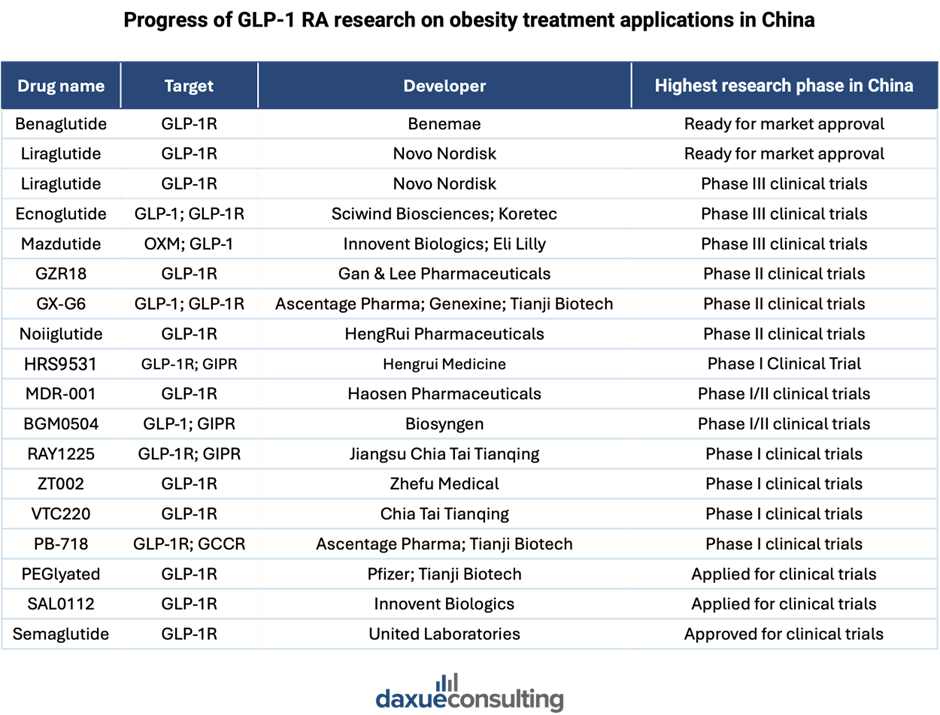
Strong demand and public health concerns continue to stimulate interest in GLP-1 drugs. Players in the Chinese pharmaceutical sector have initiated their own research and development into GLP-1 drugs. Currently, Shanghai Benemae’s beinaglutide, the first GLP-1 drug developed in China, is undergoing clinical trials for the treatment of weight loss, with potential approval expected soon.  The companiesHengrui Medicine

Gan & Lee Pharmaceuticals and Haosen Pharmaceuticals are also investing heavily in research and development to bring GLP-1-based treatments to market.

Source: 36Kr, Designed by daxue consulting, GLP-1 anti-obesity drugs being researched in China

With patents about to expire and the emergence of potentially cheaper local products, the market could become more competitive and accessible. Transparency about the long-term effects and results will be crucial to winning consumer confidence.

For the full article and more details, see the Daxue dossier: Behind the burgeoning popularity of weight loss drug Ozempic in China

VVR Medical and Daxue Consulting specialise in providing strategic and operational support to companies in the medical sector on the Chinese market. Do not hesitate to contact us at contact@vvrmedical.com to receive advice and support from our experts for your project.

Read More
Press release: Daxue Consulting joins VVR International

Press release: Daxue Consulting joins VVR International

Press release

Consulting and business services – China / Asia
Daxue Consulting joins VVR International

Paris / Shanghai, July 25, 2024 Daxue Consulting, a market research and strategy consulting firm that has supported over 400 clients in China and Asia since 2012, and VVR International, a consulting and organization services provider having facilitated the industrial and commercial development of over 1,000 companies in China since 1999, today announce their strategic merger to form a leading group on China-related issues.

The skills and expertise of Daxue Consulting, specialized in identifying and mobilizing the growth levers of its customers in China and Asia, remarkably complement the operational capabilities of VVR International, whose mission is to define and implement innovative organizational models that will enable the Group’s clients, whatever their sector of activity, to develop in these markets ambitiously, securely, and sustainably.

With more than 70 consultants combined (excluding PEO employees), including over 60 in China, spread across 8 offices managed by an Executive Committee of 9 French and Chinese partners, the Group aims to become the leader in strategic and organizational consulting for companies in China. VVR International and Daxue Consulting provide their global clients – multinationals, ETIs, SMEs and start-ups alike – not only with a clear, quantified vision of their growth opportunities, but also with the ability to implement this vision, via a set of particularly innovative and solid operational, regulatory and HR services.

Capitalizing on their strong brand awareness, both entities will continue to operate under their own brand names. The Daxue Consulting and VVR International teams in Shanghai are joining forces immediately, to accelerate synergies and foster the rapid development of an integrated consulting and services offering. In particular, the Group will increasingly draw on the unrivalled expertise of its consultants in the fields of business development, digital, medical technologies and capital partnerships in China.

Matthieu David, CEO and founder of Daxue Consulting:

The alliance between Daxue Consulting and VVR will enable companies worldwide which are invested in China to benefit from business development solutions at both strategic and operational levels. For Daxue and its team, VVR’s operational offering is the ideal complement to Daxue’s mission to serve our clients in both the strategy and execution of their ambitions in China. It should be added that this merger will enable Daxue to draw on VVR’s expertise in the medical field, negotiation, and distribution issues.

Camille Verchery, CEO and founder of VVR International:

The integration of Daxue Consulting’s expertise will enable us to offer our clients high-quality strategic market research and relevant marketing skills, particularly in the healthcare and BtoC sectors. The new group will achieve sales of 10 million euros. What’s more, the group’s growth will justify greater investment in new technologies. Last but not least, the culture, the DNA of our teams and our values are incredibly similar, which is ultimately the most important thing for the development of our employees, and therefore performance for our clients“.

About Daxue Consulting

Founded in 2012, Daxue Consulting is a strategic market research and consulting firm specializing in the Chinese market, with offices in Beijing, Shanghai and Hong Kong.
Through strategic market research tailored to the needs of its clients (large international companies and SMEs), Daxue Consulting’s team defines unique and fine-tuned growth strategies in the Chinese market.
Thanks to a combination of digital data collection tools and traditional investigation methods, Daxue Consulting has supported over 400 clients through 600 projects, in sectors as varied as F&B, beauty, food, cosmetics & luxury, healthcare, video games, e-commerce and numerous industrial sectors.

About VVR International

Founded in 1999, VVR International is a consulting and services company that assists companies from all over the world in their industrial and commercial development in China.
VVR International’s core business is to secure and perpetuate its clients’ development in China by setting up sustainable and innovative organizations.
Over the past 25 years, VVR International has managed more than 1,000 projects in China, including over 350 distribution projects (strategic diagnosis, development of sales networks, recruitment, PEO and setting up of sales structures), 250 capital partnership projects (technology transfer, setting up of own operations, joint ventures, fund-raising, mergers, acquisitions), and over 400 purchasing/quality projects (sourcing, auditing, product development, quality control) in 20+ business sectors.
VVR International is a founding member of Globallians and Medicallians.

Download the press release:

Read More
Navigating the New Wave of Opportunities: M&A Expansion in China

Navigating the New Wave of Opportunities: M&A Expansion in China

The Chinese market, with its impressive growth trajectory, has established itself as fertile ground for mergers and acquisitions (M&A), creating a landscape rich in opportunities for international companies ready to venture in. In 2023, the data reveals a dynamic M&A scene, marked by figures that underline the renewed confidence of investors and the vitality of the market.

A vibrant M&A scene

The Chinese M&A market had a dazzling year in 2023, with inbound deals jumping 68% and outbound deals growing by 31%, a clear indication of China’s growing appeal to both local and international investors.

Consolidation in sectors such as technology, renewable energy and financial services reflects a maturing economy seeking to capitalise on global trends and innovations. Renewable energy, for example, has captured attention thanks to government-backed initiatives, propelling China to global leadership in the sector.

Focus on Sectors and Key Transactions

M&A activity was concentrated mainly in the industrial sector, which accounted for 21.5% of the market or $66 billion, followed by commodities (14.6%) and high technology (13.3%). This illustrates a strategic interest in key industries that are at the heart of China’s economic growth and integration into the global economy. A major acquisition this year was the partial acquisition (10%) of Rongsheng Petrochemical by Aramco Overseas Co for $3.4 billion.


Investment focus : Beijing, Shanghai and Guangzhou

The 2023 M&A market in China highlights the importance of leading cities as investment centres. Beijing recorded $70 billion in transactions, Shanghai followed closely with $60.5 billion, and Guangzhou posted $58 billion. Despite a downward trend on the previous year, these figures confirm the crucial role of these metropolises as strategic investment hubs in China, acting as incubators for companies setting up there.

This regional dynamic underlines the potential of these cities not only as economic centres, but also as privileged points of entry for international companies exploring opportunities in China. (More information on the main Chinese cities in our article : here)

Navigation Challenges and Strategies

Although investment flows and the Chinese market in general are growing exponentially, there are a multitude of factors that need to be taken into account in order to set up effectively in this market, including regulatory nuances, cultural differences and business practices. Success in China requires a deep understanding of the local market, the ability to establish solid strategic partnerships and the flexibility to adapt to market dynamics.

Conclusion: A Future of Mutual Growth

The M&A boom in China is an open invitation to international companies to explore this market. With a strategic approach and an in-depth understanding of current trends, companies can not only successfully establish themselves in China but also contribute to the country’s dynamic economy, creating a virtuous circle of growth and innovation.

Read More